The United States’ Internal Revenue Service (IRS) is allegedly considering requiring tech giants to report on crypto activity by users, according to a presentation reportedly from an IRS presentation and provided by a Twitter user on July 9.
According to the documents shared, the IRS hopes to use Grand Jury subpoenas on firms such as Apple, Google and Microsoft to check taxpayers’ download history for crypto-related applications.
Known as Crypto Tax Girl,Laura Walter, certified public accountant and crypto tax specialist, tweeted the presentation, which was allegedly for agents in the IRS’s Criminal Investigation division.
Facebook blockchain lead David Marcus told U.S. lawmakers that the social media giant plagued by privacy scandals won’t have access to personal financial information with its new cryptocurrency.
In a letter dated Monday to the Senate Banking Committee responding to pointed questions the lawmakers sent in May, Marcus took a diplomatic tone, acknowledging the panel’s concerns about data privacy and telling them:
“I want to give you my personal assurance that we are committed to taking the time to do this right.”
A similar letter was sent to the House Financial Services Committee, the Hill reported earlier Tuesday.
Bitcoin mining difficulty – a measure of how hard it is to compete for mining rewards on the world’s first blockchain network – has posted its largest two-week increase in 12 months.
According to BTC.com data, mining difficulty reached 9.06 trillion (T) at block height 584,640 around 9:17 UTC on July 9, surpassing the previous record of 7.93 T by 14.23 percent. This was the strongest growth in any two-week period since August 2018 – a sign that competition among miners is not only intensifying but doing so at an accelerated rate.
The bitcoin network is designed to adjust its mining difficulty every 2,016 blocks (roughly 14 days) based on the participating mining power in each cycle, in order to ensure the block-producing time at the next period stays at about every 10 minutes.
Facebook Inc has no plans to offer its Calibra digital wallet services in its largest market, India, the social giant said, just as a top government official expressed skepticism about its newly-announced cryptocurrency Libra.
“There are no plans to offer Calibra in India,” a Facebook spokesman said in an email, effectively ruling out the rollout of its Libra cryptocurrency in the country. “As you may know, there are local restrictions within India that made a launch of Calibra not possible at this time.”
India’s central bank, the Reserve Bank of India, has banned banks from dealing in cryptocurrencies but informal networks abound. In an effort to curb them, the government is proposing a law with stringent penalties, including prison sentences of up to 10 years. Subhash Garg, the country’s economic affairs secretary, said in an interview to Bloomberg that India would not be comfortable with a private cryptocurrency.
“Interested in building on #EOSIO? Join us on July 10th from 8-10am (HKT) for a walkthrough of all you need to know about getting started.”
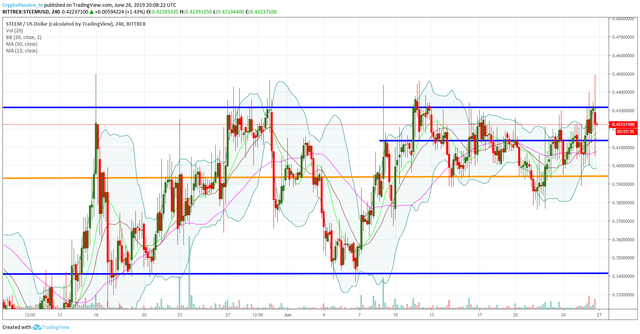
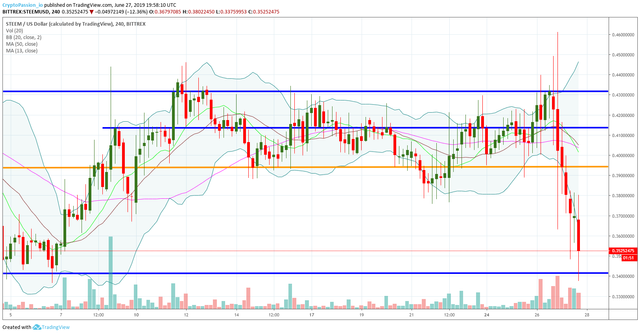
STEEM Trading Update by my friend @cryptopassion
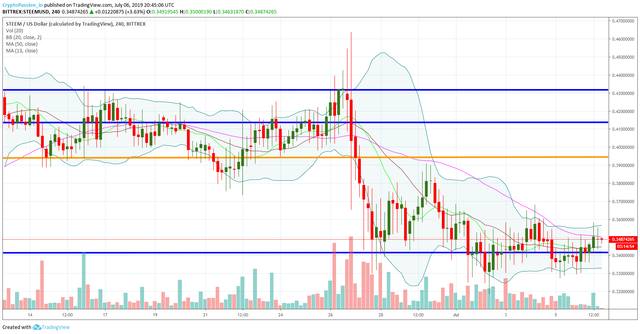
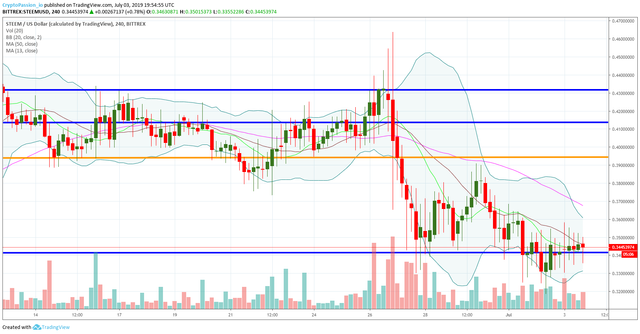
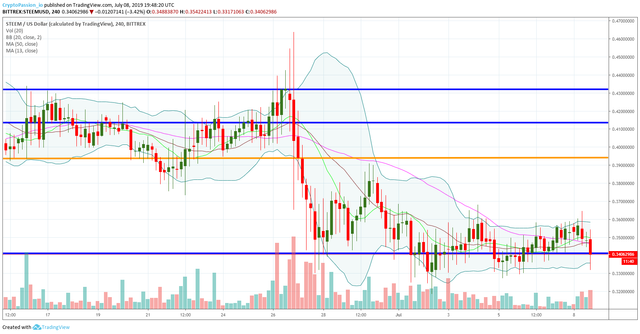
Here is the chart of yesterday :
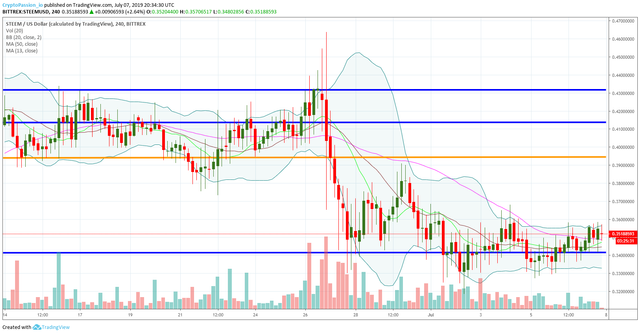
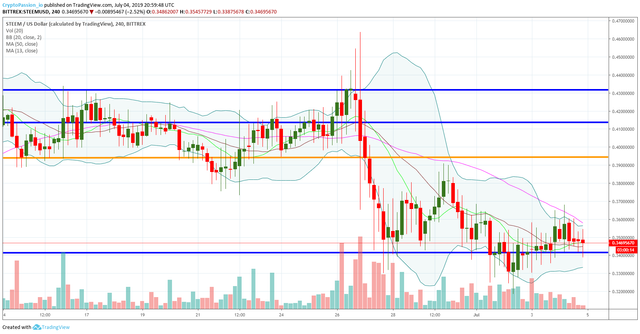
Here is the current chart :
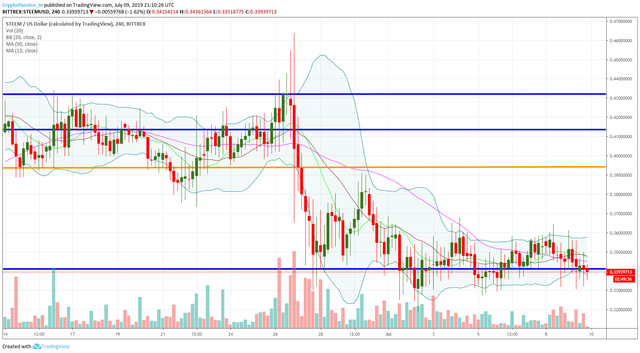
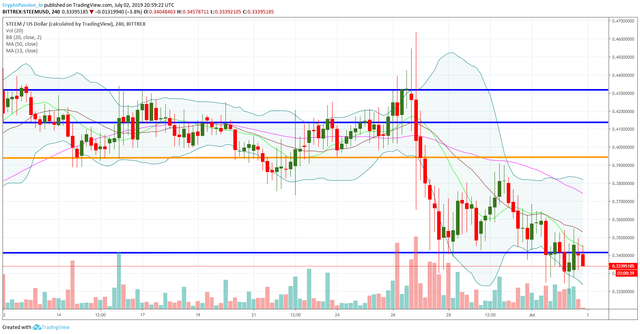
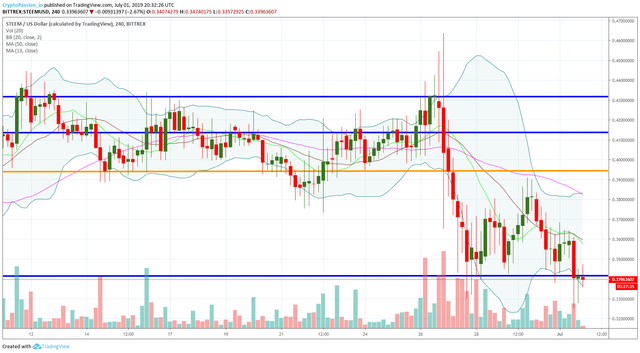
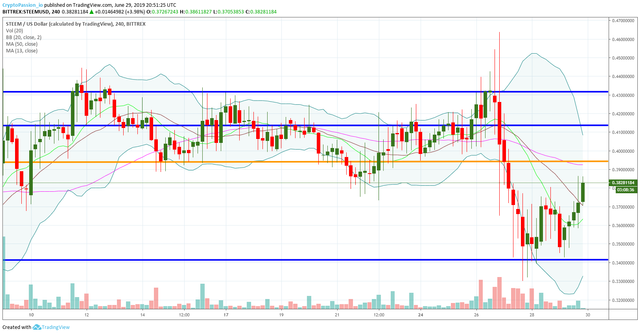
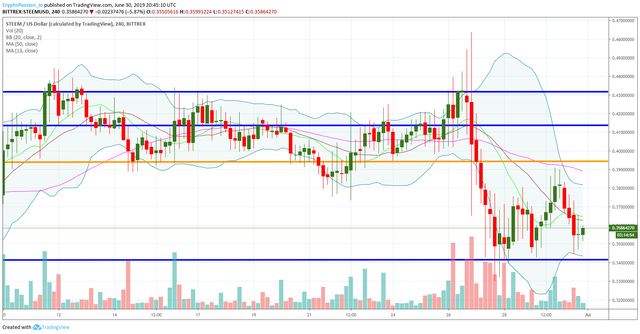
So most of the altcoins are still in depression mode and for sure it is also the case on the STEEM. Since yesterday, we are trying to break the support around 0.34$ but till now, we are lucky and that line is holding us. For how many times, I really don’t know but let’s at least enjoy that little positive news.
Bitcoin price (BTC) felt more bullish than ever June 9 after another 24 hours of upside propelled markets close to $13,000.
Data from Coin360 painted a rosy picture for cryptocurrency traders, with bitcoin still leading the way in terms of daily gains.
At press time, BTC/USD was up 11% versus Monday on $12,666. The pair had reached as high as $12,707 before a slight pullback below the $12,700 barrier.
In 2015, the Ethereum public mainnet launched, followed by a raft of private blockchain offerings targeting the enterprise. This opened the floodgates on companies prioritizing collaboration, funding long-overdue digitization efforts, and extending business processes across corporate borders.
Today, a new epoch of system integration is underway. However, efforts to make blockchain technology enterprise-friendly split the community into two camps: public networks versus private networks. The dichotomy was wrong-headed from the start, making it easy to believe that public blockchain networks shouldn’t be used in confidential business operations and that private networks were safe and secure.
The first belief is wrong, and the second is dangerous.
The New York Attorney General’s Office (NYAG) has submitted new evidence in its aim to prove that crypto exchange Bitfinex and Tether had served New York customers longer than they claimed.
As part of the NYAG’s ongoing investigation into Bitfinex and Tether, the NYAG filed a Memorandum of Law in Opposition, an affirmation, as well as a total of 28 pieces of exhibits on July 8, with the New York Supreme Court.
The NYAG said in the new documents: “Even a cursory examination of the facts gathered to date in the OAG’ s investigation shows that Respondents have extensive and consistent contacts to New York concerning the matters under investigation.”
SThe United States Securities and Exchange Commission (SEC) and the Financial Industry Regulatory Authority (FINRA) outlined regulatory compliance issues for cryptocurrency custodians in an announcement on July 8.
According to the joint statement, the organizations have yet to discover a set of circumstances in which a crypto custodian could comply with the SEC’s Customer Protection Rule, which is described as follows:
“Put simply, the Customer Protection Rule requires broker-dealers to safeguard customer assets and to keep customer assets separate from the firm’s assets, thus increasing the likelihood that customers’ securities and cash can be returned to them in the event of the broker-dealer’s failure.”
The Internal Revenue Service is expected to update its 2014 guidance on cryptocurrencies in coming weeks, following an April request from a bipartisan group of 20 lawmakers. It is part of a broader push to boost the nascent cryptocurrency industry. Congress is considering at least three bills that would resolve some of the murky legal issues surrounding digital money.
“Chainlink Integration Engineer Thomas Hodges is leading a meetup in Plano, TX next Tue July 9th.”
STEEM Trading Update by my friend @cryptopassion
Here is the chart of yesterday :
Here is the current chart :
The market is currently trying to break the support line at 0.34$… It is quiet sad because when BTC is doing nice UP, STEEM is dropping and when BTC is doing a correction, STEEM is droping also… To resume it, we are not able anymore to add value to our blockchain….
I start to be really worry for our little coin because if all of that continue, yeah we will finish to be outside of the Top100, we will have less volume, less investors and all that, whatever the improvements that we will have…
Latin American social networking giant Taringa! has partnered with MakerDAO and e-wallet provider Airtm to launch a stablecoin-powered points system for its 27 million strong user base.
According to an official Taringa! news release published on July 7, the development was revealed on Friday during the Blockchain Summit Latam in Mexico City.
The pilot program, dubbed “Taringa! Pioneers,” will reportedly reward users with points for creating popular platform content, which can then be monetized by being converted into MakerDAO’s Ethereum blockchain-based stablecoinDAI.
Coming from an organization so tied to the question of identity (whether real or not), it is surprising that Facebook’s Libra coin seems confused about its own.
The organization has chosen to brand Libra “a stable global cryptocurrency,” and the label “cryptocurrency” has been replicated by media around the world. Yet Libra is not a cryptocurrency.
Don’t get me wrong – those of us in the sector appreciate the global attention given to the concept since the announcement. But in this case the definition matters beyond semantics: it will affect eventual use cases and regulatory treatment. It could also transform how investors view both stablecoins and blockchain-based securities going forward.
What’s in a name? First, let’s look at why it’s not a cryptocurrency.
High-frequency trading (HFT), a longtime and controversial practice in traditional markets, is becoming commonplace in crypto, too.
Placing trading servers physically close to exchanges’ matching engines can win an edge on speed. This helps HFT firms make large profits in the legacy markets.
Crypto exchanges such as ErisX, Huobi and Gemini are trying to attract large algorithmic traders with colocation offers. Demand for the service is high, but its benefits are a matter of debate, due to the structure of the crypto market.
Singapore plans to exempt cryptocurrencies that are intended to function as a medium of exchange from Goods and Services Tax (GST) — the local equivalent of Value-Added Tax (VAT).
The news was revealed in a draft e-tax guide published by the Inland Revenue Authority of Singapore (IRAS) on July 5.
The proposed exemption, if accepted, is set to take effect on January 1, 2020, and will overhaul the current system wherein the supply of digital payment tokens is treated as a taxable supply of services.
European Central Bank executive board member Benoit Coeure said that financial regulators must act fast to prepare for Facebook’s Librastablecoin, Bloomberg reports on July 7.
Per Bloomberg, Coeure argued on Sunday in Aix-en-Provence in southern France that allowing for the development of new financial services and asset classes in a regulatory void is irresponsible. He concluded:
“We [financial regulators] have to move more quickly than we’ve been able to do up until now.”
According to Coeure, the development of digital assets has exposed gaps in current financial regulations, and underlines banks’ slow rate of adoption of new technologies:
“All these projects are a rather useful wake-up call for regulators and public authorities, as they encourage us to raise a number of questions and might make us improve the way we do things.”
We are stabilizing on the support line at 0.34$ since days now, waiting for the next big move on the BTC. Let’s really hope that the BTC will go up because if it is not the case, I’m sure that this support line at 0.34$ will be broken just in some seconds and that we will go in the direction of the last low around 0.23$. If it is a UP, first objective is the orange resistance line around 0.39$.
CME’s bitcoin futures product is continuing to show signs of increased popularity, with June setting a new record for open interest amid a surge of new account sign-ups.
More than 2,960 accounts have traded CME Group’s bitcoin (BTC) futures across all client types and time zones since launch, according to new data from the derivatives marketplace. In 2019 alone, there has been more than 950 new accounts created, marking a 30 percent increase in total client sign-ups, CoinDesk has learned.
In addition, the number of large open interest holders, entities that hold contracts worth at least 25 BTC (worth $280,000 at press time) grew to 49, up from an average of 46 during the last week of June, a new record.
At first glance, Facebook’s Libra cryptocurrency doesn’t make sense.
On its face, it is a non-speculative token which uses enough decentralization to make it difficult if not impossible for Facebook to profit off it as the company does from its social media platform.
But in crypto, there is always an upside to the people who launch a new protocol, in the event the protocol succeeds and even in many cases for simply having started development of the project.
This article deals specifically and exclusively with that upside, admittedly handwaving aside many other potential issues with the protocol, to be addressed elsewhere.
Venezuela’s President Nicolas Maduro ordered the country’s leading bank, Banco de Venezuela, to accept the nation’s cryptocurrency, the Petro (PTR) at all of its branches, the country’s Finance Ministry tweeted on July 4.
According to the tweet, Maduro gave “the express order to open Petro desks in all the branches of the Bank of Venezuela.” The announcement apparently came during an event celebrating the tenth anniversary of the nationalization of the bank in question.
On June 19, Maduro announced that 924 million bolivars (over $92.5 million) were allocated to the Digital Bank of Youth and Students to open one million Petro wallet accounts for the country’s youth. José Angel Alvarez, president of the country’s National Cryptocurrency Association, commented to cryptocurrency news outlet CCN:
“It is a bold and correct decision to move forward towards a hybrid economy where the fiduciary currency of a country competes face to face with cryptocurrency.”
The price of the popular dogecoin cryptocurrency is surging after the announcement that it will soon be listed on the Binance exchange.
Binance said in a support notice that trading will open for dogecoin (DOGE) at midday (UTC) Friday.
The exchange will at launch offer trading pairs for DOGE against Binance coin (BNB) and bitcoin (BTC), as well as the stablecoins tether (USDT), Paxos standard (PAX) and USD Coin (USDC).
Users can already deposit DOGE in preparation for trading, the exchange said.
Schiff, who is well known for warning investors not to trust bitcoin as replacement for gold, triggered the goodwill gestures after becoming the topic of a Twitter debate with Morgan Creek Digital co-founder, Anthony Pompliano. Pompliano (also known as Pomp), highlighted the fact that Schiff in fact does own some BTC despite his negative comments.
”This raises serious privacy, trading, national security, and monetary policy concerns for not only Facebook’s over 2 billion users, but also for investors, consumers, and the broader global economy.”
“Join us this Friday afternoon (EST) as special guest Dave Winterstein (co-founder and CEO) takes over the Aion AMA. ”
STEEM Trading Update by my friend @cryptopassion
Here is the chart of yesterday :
Here is the current chart :
The market is again trying to break the support line at 0.34$. As we can see, till now that line is doing well its job but I’m not sure it will stay alive long time if we continue to test it like that hours after hours. However, long tests like that can also show that we are reaching a low and that the market doesn’t want go lower. So everything is not always negative but for sure I would like to see the STEEM going UP and take some distance from that support line.
Facebook’s David Marcus is pushing back against concerns about the social media giant’s new cryptocurrency project, Libra. In a note published Wednesday on Facebook, Marcus addressed “a number of questions and a few misunderstandings” about the project.
In Wednesday’s post, Marcus sought to address a number of issues that have been raised by lawmakers and informed observers alike, including whether Libra is actually decentralized, why there isn’t a charter in place for the Libra Association and whether Libra can actually address financial inclusion.
Bitcoin has risen nearly $2,000 in the last 24 hours, establishing strong support at $9,600.
The outlook, however, would only turn bullish once the bearish lower-highs pattern is invalidated with a move above $12,448. A breakout, if confirmed, could be followed by a rise to or above the recent high of $13,880.
Bitcoin could fall back to $9,600 if prices fail to hold above $10,830 in the next 24 hours, validating the bearish crossover of the 5- and 10-day moving averages.
The operator of Binance’s upcoming U.S. crypto exchange, BAM Trading Services, has hired a former Ripple executive as its CEO.
BAM announced on Tuesday it had appointed Catherine Coley as CEO, who will be responsible for rolling out Binance U.S., as well as expanding the exchange’s marketplace in North America.
Prior to joining the firm, Coley was the head of XRP Institutional Liquidity at San Francisco-based distributed ledger tech startup Ripple, BAM said in the announcement.
Before entering the blockchain and crypto space, Coley worked for banking giant Morgan Stanley in Hong Kong and London in the institutional foreign exchange market, and handled international payments and global treasury management for startups while at Silicon Valley Bank.
Changpeng Zhao, founder and CEO of Binance, said in the announcement:
“I am confident that with Coley’s leadership and Binance’s leading technology platform, Binance.US will be able to provide valuable services to the U.S. community.”
NYU professor and noted anti-cryptocurrency economist Nouriel Roubini exploded online last night after a debate with Arthur Hayes, CEO of BitMEX, at the Asia Blockchain Summit in Taipei. The debate, called the “Tangle in Taipei,” was allegedly not streamed live at the behest of the organizers and and Roubini wasn’t having it.
Another @CryptoHayes scam: he didnt allow the blockchain conference to record our debate and beam it live. He controls the only recording of it and will only release heavily edited "highlights". I destroyed @CryptoHayes in the debate and he is hiding. RELEASE THE TAPE YOU COWARD!
Hayes, for his part, shot back at the economist, further enraging Roubini.
u didnt dust me. I busted u but you are a such a coward hiding the video tape of our debate mafioso style with hush money. Release the full video – not the manipulated highlights – and let the world judge. @CryptoHayeshttps://t.co/7vEwJlJSlC
The United States House of Representatives Committee on Financial Services requested Facebook and its partners to stop the development of the Libra stablecoin.
In a July 2 letter addressed to Facebook CEOs Mark Zuckerberg and David Marcus, and COO Sheryl Sandberg, the lawmakers request that Facebook and its partners immediately agree to a moratorium on the development of Libra and its dedicated Calibra wallet.
The committee claims that the project may lead ”to an entirely new global financial system that is based out of Switzerland and intended to rival U.S. monetary policy and the dollar.” The committee notes that it believes such an endeavor could have serious implications:
”This raises serious privacy, trading, national security, and monetary policy concerns for not only Facebook’s over 2 billion users, but also for investors, consumers, and the broader global economy.”
“Join us for the IOTA Barbecue Satellite TOA Event in Hafenküche July 4 at 6PM.”
STEEM Trading Update by my friend @cryptopassion
Here is the chart of yesterday :
Here is the current chart :
We can clearly see that the 0.34$ became an important point on the STEEM chart as support but also as resistance. As I was supposing yesterday, the support line has not really been broken and the market decided to save it some hours after the little break. You can see now that we are upper of that line so let’s see if a bigger candle will come in the coming hours to confirm that we saved that support line.
Over 30 advocacy groups have appeared as signatories on a request that Congress and regulators implement an official moratorium on Libra development, as per the letter published on July 2.
The letter was also addressed to Facebook, with Mark Zuckerberg himself cc’d, and asked that the social media giant wait until Congress and regulators have scrutinized a detailed presentation of the proposed stablecoin-esque virtual currency. The letter includes a number of questions that the signatories say need answers before Libra can proceed, including the following:
“The plan for Libra makes explicit and implicit promises to consumers – such as the claim that value will remain stable – but what is to stop the Libra Association from changing policy in order to, for example, degrade the value of Libra or to impose a microtax on every Libra transaction?”
Ethereum’s leaders are pursuing a “moonshot” in the Middle East.
The Ethereum Foundation’s head of special projects, Virgil Griffith, told CoinDesk the nonprofit is partnering with finance experts in the Gulf Coast to show that the world’s second largest blockchain is compatible with Islamic law. Islamic finance customs adhere to certain beliefs, including the prohibition of earning interest on loaned funds.
The move is seen as a first step toward potentially securing investment from the region’s plutocrats.
“My job is to keep rolling dice,” Griffith told CoinDesk about work to certify ethereum’s Sharia compliance. “Probably nothing will happen. But there’s a hypothetical case where say, the Saudi sovereign wealth fund invests, like, a trillion dollars [in ethereum projects], which would be a real boon. That would be really great.”
The operator of Binance’s upcoming U.S. crypto exchange, BAM Trading Services, has hired a former Ripple executive as its CEO.
BAM announced on Tuesday it had appointed Catherine Coley as CEO, who will be responsible for rolling out Binance U.S., as well as expanding the exchange’s marketplace in North America.
Prior to joining the firm, Coley was the head of XRP Institutional Liquidity at San Francisco-based distributed ledger tech startup Ripple, BAM said in the announcement.
Before entering the blockchain and crypto space, Coley worked for banking giant Morgan Stanley in Hong Kong and London in the institutional foreign exchange market, and handled international payments and global treasury management for startups while at Silicon Valley Bank.
Changpeng Zhao, founder and CEO of Binance, said in the announcement:
“I am confident that with Coley’s leadership and Binance’s leading technology platform, Binance.US will be able to provide valuable services to the U.S. community.”
The Winklevoss-owned cryptocurrency exchange Gemini will apply for a broker-dealer license from the Financial Industry Regulatory Authority (FINRA), CoinDesk has learned.
This is the first step toward becoming an approved Alternative Trading System, where customers can lawfully swap digital securities.
Gemini previously partnered with the tokenized securities platform Harbor, which allows institutional investors to buy securities with Gemini’s GUSD stablecoin and to also receive dollar-denominated dividends via GUSD. It stands to reason that Gemini would also want to facilitate the trading of such securities on its own platform.
Cuba is the latest country to consider using cryptocurrency to skirt U.S. sanctions, Reuters reported quoting a government source on July 3.
In a public address on local television, the country’s president, Migual Diaz-Canel, said the plan would raise capital for around one quarter of the population, helping to pay for reforms.
Cuba has felt a severe knock-on effect from the crisis in Venezuela, which was previously a major source of aid.
“We are studying the potential use of cryptocurrency… in our national and international commercial transactions, and we are working on that together with academics,” Reuters quoted economy minister Alejandro Gil Fernandez as saying.
Live Q&A with Thomas Marchi, Lead Developer of Sentivate. July 3rd at 22:00 GMT.
STEEM Trading Update by my friend @cryptopassion
Here is the chart of yesterday :
Here is the current chart :
The BTC is doing a bounce from 10k but you know what? STEEM doesn’t want do the same and is dropping… So yeah, technically, the support line at 0.34$ is broken. However we are staying just next to it and so it could be simply a little trap or not a real break of that line. Let’s see if we will be able to be higher than this line in the coming hours.
Is Bitcoin Really Selling for $76,000 in Zimbabwe? ;
? Daily Crypto Calendar, July, 2nd?
STEEM Trading Update
Welcome to the Daily Crypto News: A complete Press Review, Coin Calendar and Trading Analysis. Enjoy!
? Binance Exchange to Launch Crypto Futures Trading with 20x Leverage
Binance, the world’s largest cryptocurrency exchange by trading volume, is soon to launch futures trading.
During a presentation at the Asia Blockchain Summit in Taipei on Tuesday, Changpeng “CZ” Zhao, founder and CEO of the exchange, showcased a futures trading interface on Binance with features including longs and shorts on crypto assets.
“Binance will be launching a futures platform very soon. I don’t have the exact date yet. The simulation test version will be live in a few weeks,” he said. Referring to the screenshot of the interface showed on the stage, Zhao added:
“This is an actual screenshot of the working system. So Binance futures is coming.”
Bitcoin has dropped below $10,000 for the first time in 11 days, reinforcing the buyer exhaustion signaled by the weekly chart, as discussed yesterday.
The daily chart indicators have turned bearish, while the 4-hour chart is reporting a bearish lower-highs, lower-lows pattern. As a result, the price could slip further toward the former resistance-turned-support of $9,097 (May 30 high) in the next couple of days.
A UTC close below $9,097 would invalidate the bullish setup on the daily chart.
A high-volume break above the falling trendline on the 4-hour chart, currently at $11,100, would shift risk in favor of retest of the recent high of $13,880.
Masterchain, a blockchain project backed by Russia’s central bank, is falling behind on its goals two years after inception. Sberbank, the leading bank in Russia, is unsatisfied with the system’s speed, security and overall efficiency after testing it.
The bank is looking to shift its work to other enterprise platforms, Sberbank’s blockchain lab head said.
United Kingdom bitcoin (BTC) mining operator Argo Blockchain surpassed its own expectations in Q2, the company said in a new report released on July 2.
Argo, which previously said it had benefited from the upturn in bitcoin prices, said revenues would continue to improve over previous estimates.
“The Company now expects to generate 161 BTC, or GBP1.38m of cryptoassets, in June based on a BTC price of $10,817.16 USD as of 30 June 2019,” the report confirmed.
“This is an increase of approximately 101% from the Company’s May mining results and represents a mining margin of roughly 81%. The Company considers that this demonstrates that the Company is one of the most efficient miners in the market.”
Bitcoin traders in Zimbabwe and South Africa are seeing skyrocketing premiums on their bitcoin (BTC), according to a report from financial news outlet Fxstreet on July 2.
Amid new capital controls in South Africa and Zimbabwe’s recent ban on local trading in foreign fiat currencies, local traders have reportedly seen asking prices of as high as $50,000 per 1 BTC if they attempt to purchase the coin from abroad.
At press time, bitcoin is trading above $10,915 on South African crypto exchange Luno, according to CoinMarketCap data — 10.5% above its price point on Cointelegraph’s bitcoin price index.
Meanwhile, other commentators on social media this week claimed that bitcoin is allegedly trading at as high as $76,000 in Zimbabwe — a premium of over 600%. As appears to be corroborated by screenshots from P2P site LocalBitcoins.com shared on Twitter, at least a scattering of traders have attempted to pocket colossal gains at an asking rate of $75-76,000:
NPXS BEP2 integration and XWallet auto-swap, withdrawal, and deposit planned before July 1.
STEEM Trading Update by my friend @cryptopassion
Here is the chart of yesterday :
Here is the current chart :
it was too nice to be true on the STEEM. The W pattern that we started yesterday has been invalidated today and we did go test again the support line around 0.34$. The support line at 0.34$ did its job but it is really possible that we finish to break it in case of acceleration of the correction on the BTC.
Data form mobile app analytics firm App Annie shows that, while in the first half of 2018 there were 65.8 million cryptocurrency-related app downloads, in the first six months of this year there were 67 million, an increase of about 1.82%.
This growth is not nearly as sharp as that reported in previous years, considering that the first half of 2017 saw 28.2 million crypto apps downloads from 2016’s 15.3 million, a 45% increase.
There is never a dull moment in the world of blockchains and cryptocurrencies.
The two earth-shattering stories of the past two weeks – the launch of the Libra project and the wild swings in the bitcoin market – might seem like unrelated topics. And, for the most part, the causal impact of the former on the latter is probably not much greater than that of another oft-noted bitcoin price correlation: the avocado chart.
However, the coincidence of these two developments does speak to how globally impactful Satoshi Nakamoto’s invention has now become.
From that wider perspective, these two developments are not at all unrelated. Indeed, they both capture elements of a massive, worldwide financial transformation, all happening at a time of growing economic uncertainty.
Last weekend, two privacy coin conferences heralded the future of cryptocurrency governance: the hybrid startup model versus grassroots experimentation.
Over 200 people gathered in Croatia for Zcon1, organized by the nonprofit Zcash Foundation, while roughly 75 attendees gathered in Denver for the first Monero Konferenco. These two privacy coins are fundamentally different in a variety of ways on clear display at their respective events.
Zcon1 had a gala dinner with a seaside backdrop and programming that displayed close relations between companies like Facebook and the zcash-centric startup Electronic Coin Company (ECC), as evidenced by Libra being widely discussed with team members in attendance.
German Blockchain-as-a-Service (Baas) provider Advanced Blockchain AG has become the first blockchain development firm to be listed on Germany’s Xetra digital stock exchange, operated by Deutsche Börse. The news was reported by financial news site DGap on July 1.
The Xetra all-electronic trading system was founded in 1997 for use on the Frankfurt Stock Exchange, but has since expanded to over 200 trading participants from across16 European countries, as well as Hong Kong and the United Arab Emirates.
According to recent data, Xetra accounted for €131.4 billion ($149 billion) of Deutsche Börse’s total cash markets €146.0 billion ($165 billion) turnover in May 2019, with an average daily Xetra trading volume of €6 billion ($6.79 billion).
Gemini is hoping to achieve what rival Coinbase couldn’t: successfully building out a presence in Chicago aimed at luring high-speed traders to the incipient cryptocurrency market.
The New York-based firm, led by twin brothers Tyler and Cameron Winklevoss, announced Thursday the new outpost for Gemini, which will scale its existing colocation data centers. In an interesting twist of fate, the firm says it has brought on a number of engineers who previously worked for Coinbase’s Chicago office, which was shuttered in April.
Gemini shooting its shot
A person familiar with the situation told The Block Gemini attempted to recruit several employees who previously worked for Coinbase. They have brought on five, according to reporting by CoinDesk.
NPXS BEP2 integration and XWallet auto-swap, withdrawal, and deposit planned before July 1.
STEEM Trading Update by my friend @cryptopassion
Here is the chart of yesterday :
Here is the current chart :
it was too nice to be true on the STEEM. The W pattern that we started yesterday has been invalidated today and we did go test again the support line around 0.34$. The support line at 0.34$ did its job but it is really possible that we finish to break it in case of acceleration of the correction on the BTC.
Facebook has 2.7bn users and 90mn companies operating on its various platforms. Perhaps more than any other non-state player, it has the resources, reach and data trove to launch a global currency. The networking and social media giant is also loathed by many critics, who accuse it of abusing its market dominance. Hence, it is notable that Facebook is leading an association of companies that will co-manage the new currency and payments system as partners. It is a less than reprehensible plan, but there is a mountain to climb if Libra is to emerge as a new form of money.
This report will focus on what Libra must do if it is to become a widely-used medium of exchange. It will not judge if Facebook and its Libra grouping can develop payment services like Paypal, Venmo or Wepay; it won’t address whether Facebook will roll out rivals to Blackrock’s exchange traded funds or Alipay’s gigantic Chinese money market fund. With or without Libra being a success, Facebook could end up competing in all these areas—after all, none of the above providers have also created the holy grail of money.
What is certain is that if the new Libra were to be launched as a regular investment product, it would bomb. It may resemble a money market fund, except that the manager bags all accrued interest and the investor gets stuck with any value changes. On this basis, Blackrock or Goldman Sachs would likely fancy their chances against Libra.
Libra is, in fact, competing with central banks. Its model is to issue new Libra units and buy interest-bearing government bills from markets such as the US, UK, Germany and Japan. The fact that it may first exchange Libras for dollars, euros and yen, before buying the instruments does not change the basic proposition. It is similar to a central bank that scoops up safe interest-bearing assets using money that it has created out of thin air.
However, becoming a quasi central bank without government support will be hard. Users must be convinced to use the new currency in preference to the “legal tender” required by government agencies for a range of transactions.
Barbarians at the gate
Libra’s backers may be able to persuade regulators that they offer the requisite consumer protections and safeguards. They may even be able to automate the reporting of all capital gains and losses for tax purposes. But this does not mean that governments will meekly accept competition in the currency game. After all, if demand for fiat money shifts to Libra, the value of “old money”, when measured in goods and services, will fall. To avoid an inflation spiral, the responsible central bank will have to contract the supply of fiat money to match the now reduced demand. This will mean the central bank shrinking its own balance sheet, and likely pressuring its member banks to do the same thing (via monetary policy tightening).
Governments will be unnerved by this squeezing of their central banks since seigniorage profits—earned by the central bank issuing money at little or no cost and buying interest-paying assets—usually flows into state coffers. In the case of Libra, this same “money for free” will get distributed to the 100 members of the Libra Association, and not to the government.
Central and commercial banks buy lots of local-currency debt, especially paper issued by their own governments. Libra’s backers will buy similar government paper as backing for its units. However, because this group has promised to diversify across trusted currencies and government issuers, it will end up holding less US government paper than traditional US banks.
Still, if Uncle Sam does not love the Libra idea, other governments are likely to hate it—especially those in developing economies since the Libra Association is not likely to buy much of their public debt.
Take India, which has a history of currency debasement from unruly inflation. Any capital flight out of Indian banks is likely to see the authorities quickly stamp on Libra. And how precisely will they block a crypto-currency? Easy. They will just tell Facebook, Uber, Visa, Mastercard and the rest of the Libra Association that unless they desist with this currency nuisance, their main businesses will be excluded from India’s burgeoning consumer market.
But will users want to use Libra?
Still, regulators aside, will Libra be attractive to users? After all, the basic point of any currency is that it must be desired not just by a few people, but by many. The race to become money is the ultimate winner-takes-all contest; it is the most marketable “good” in an economy—the one that can be most readily and reliably traded for other goods, services and assets.
In each country or currency block, one currency typically dominates—and it is almost always the one needed by people to pay taxes. For some, this is a core reason to be skeptical about bitcoin’s chances of ever becoming money. Using two currencies is always more hassle than just one. And since fiat currencies will remain a necessary holding, at least to pay taxes, Libra has to give users good reasons for the hassle it creates.
The Libra Association promises to (i) provide banking to the “unbanked”, and (ii) offer lower transaction costs and faster settlements. At this point, it is not clear why Libra will succeed where existing financial institutions have failed. Is it because of new tech and/or greater scale and global reach? Or will Libra allow users to cut corners on “know your customer” rules and so cut costs for banking services? If it is the latter, then regulators’ revenge could be swift.
A question of value
Even if it proves a poor store of value in the long run, money must have low volatility over the short to medium term and a small chance of suddenly collapsing. bitcoin has so far failed both tests. Its value is very volatile, and there is always the fear/hope that a better crypto-currency may come along leaving dawdlers with a worthless stash of digital tokens. For these reasons, bitcoin has had the characteristics of a great speculative asset, but has never progressed to becoming anything resembling money.
In contrast, US dollar cash, which has lost half its real value since 1990, has proved a fairly awful investment. Yet at the same time, the dollar has been good as “money” since its value has been stable in the short to medium term, and no collapses in value have occurred.
Near-term stability is key as it allows a currency to act as a standard of value and to facilitate price comparisons. For example, the user can compare the price paid on a good last week, with the price offered by someone else today. If the price of money is soaring or plunging week-to-week, or even year-to-year, then more stable money will be sought after.
So how does Libra do on my key money checklist? Better than bitcoin and bolivars. But arguably not as well as US dollars, euros or even rupees.
Since Libra is backed by short-term assets issued by reputable governments and central banks, it should not face the “greater fool” problem of holders hitting the exits in a panic. So long as assets in the Libra reserve do not collapse, then, unlike bitcoin, it should weather market vicissitudes.
There is always a chance that Libra’s corporate backers get greedy by buying higher-yielding assets that have the potential to implode in the manner of sub-prime mortgage assets in 2008. After all, it is this group which earns the income, so arguably there is an agency-type problem. Still, at the outset, the Libra will be backed by assets that should be safe and liquid. Hence, there are reasons to treat it as credible.
Libra’s volatility problem
Libra’s backing means it should not suffer price volatility like bitcoin, but it is likely to be more changeable than most fiat currencies. For starters, a diversified asset base does not ensure price stability in real-term. Libra’s backers plan to anchor it to a basket of major currencies, like the International Monetary Fund’s quasi-currency, the Special Drawing Rights. The SDR’s problem is that it has proven more volatile than individual fiat currencies.
Price variations in US dollar cash are captured by the US CPI, which measures the prices of US consumer goods and services in US dollar terms. Since 1990, its annual variations have been between 0% and 5%, and the number has often been close to the Federal Reserve’s target of 2%. This has made price comparisons and economic calculations in US dollars fairly easy. Hence, dollars have made for decently good money.
By contrast, a US consumer who chose to diversify his or her cash holdings and use SDRs as money would have experienced much larger fluctuations in the real value of their money. SDR inflation rates (repricing the US CPI in SDR) have since 1990 regularly fluctuated between -10% and 10%.
Perhaps more surprisingly, Libra may offer no stability advantages over major developing economies. When investors do the same test for India—perhaps the biggest potential market for Libra—a similar picture emerges. The SDR may have held its value better than the rupee in the long run, but as already noted that is not the main thing with money. Even the rupee has displayed less price volatility than the SDR (see second pane of the chart below).
The relative stability of local currency versus the SDR shows that most central banks have been pretty good at targeting low and steady inflation—at least since 1990. When foreign monetary policy is imported, as in the case of SDR usage, the consumer must accept more volatile prices. As a real world example, Hong Kong’s CPI is more volatile than most countries, in part because it imports US monetary policy—which has been set to achieve stable US consumer prices, not stable Hong Kong consumer prices. Hong Kong people accept higher price volatility because they have to. The Hong Kong dollar is the fiat currency that is effectively imposed on the population by the government. By contrast, the Libra Association is asking consumers to willingly adopt a more volatile currency.
So given these dynamics, will prices be set in Libra? Probably not during the adoption phase, and perhaps not ever. As the service is rolled out, vendors like Uber will likely quote two prices when showing a fare—the local fiat price, and a Libra price which is a conversion of a fiat price.
Even if only Libra prices are quoted, this is likely to be a conversion of an internally set fiat price. After all, companies will still have fiat-denominated costs for the foreseeable future (taxes at least). So long as the Libra price is a conversion of fiat prices, it is likely to fluctuate more like the SDR price index shown above than the relatively stable fiat price indexes shown.
Hence, if governments do not shut down a competitor to their own “legal tender”, it is not clear that Libra will be attractive to users given the hassle of handling multiple currencies, paying capital gains taxes on all transactions, and dealing in an inherently more volatile currency. So why bother with Libra? We worry that users and governments may not.
Growing up in liberal Canada, Vitalik Buterin—co-founder of the world’s second biggest blockchain, Ethereum—was never allowed to forget his Soviet heritage.
Canada is obviously a far cry from Soviet Russia. But it does have strong socialist tendencies, as Dmitry Buterin told early bitcoin adopter Jeff Berwick, in a recent interview. In the video clip, Buterin senior explains that his heritage was key to helping the would-be-entrepreneur look to alternative ways of organising people and ideas, that would ultimately lead him to blockchain.
The father of the 25-year-old boy-genius, Dmitry Buterin, 46, is from oil-rich Chechnya—a region which suffered some of the worst atrocities committed in Russia’s long, authoritarian past.
Buterin senior studied computer science in Moscow before turning serial entrepreneur. He emigrated with his family to Canada, when Vitalik was six, settling in Toronto. But the Soviet experience, during his formative years, has naturally stayed with him.
American financial clearing and execution company Apex Clearing and its crypto investment subsidiary Apex Crypto have launched a new trading platform for broker-dealers and financial advisors to help their clients trade crypto more effectively.
According to a June 27 press release announcing the new broker-integrated Apex Crypto platform, equity investors will be able to seamlessly open and fund new crypto trading accounts “within minutes” — rather than the purported weeks it would usually take clients to do so.
Founded in 2012, Apex Clearing is an SEC-registered and FINRA member digital wealth management firm owned by American financial services company PEAK6 Investments LLC.
Members of the U.S. House of Representatives questioned Financial Crime Enforcement Network (FinCEN) director Kenneth Blanco about Facebook’s planned cryptocurrency Thursday.
Representatives Emanuel Cleaver, II (D-MO), Trey Hollingsworth (R-IN), Bill Foster (D-IL) and French Hill (R-AR) held a briefing with members of the House Financial Services Committee, discussing the Libra project with Blanco, who heads up FinCEN, the U.S. Treasury Department’s anti-money-laundering wing.
The briefing was held as part of a broader look at how machine learning and artificial intelligence can limit illicit money laundering and related activities.
What started as a $575 million token sale is now a rewards program for watching videos.
TaTaTu’s initial coin offering (ICO) was among the biggest of 2018, with film producer Andrea Iervolino raising money from royals like Lady Monika Bacardi, of the famous liquor family. Before this raise, Iervolino was best known for films such as “Bernie The Dolphin” and “Finding Steve McQueen.”
As some token sales start to slowly yield results, TaTaTu offers a prime example of a platform that used “blockchain” as a fundraising technique and then largely moved on.
The TaTaTu project, originally meant to offer a publicly traded cryptocurrency associated with a media streaming platform similar to Netflix, once attracted investment from Ari Paul’s BlockTower Capital (which declined to comment for this article) and movie stars like Johnny Depp (whose representatives did not respond to requests for comment).
San Francisco-based incubator for the blockchain Ethereum Classic (ETC), ETC Labs, has announced that it has partnered with cryptocurrency firm Metronome to create a solution for Ethereum (ETH)/ETC interoperability, in an official blog post on June 27.
Per the announcement, blockchain interoperability—also referred to as “chainhopping”—is a property of a blockchain asset meaning that it can be transferred between separate blockchains. In this case, the cryptocurrency Metronome (MET) will be transferable between the ETH and ETC blockchains.
The ETH and ETC blockchains initially split in the summer of 2016 after a contentious vote to return money lost when The DAO collapsed in 2016.
Yesterday I was saying that sentence : ” What else to say… imagine now that the BTC will correct, I’m quiet sure that we will break very easly all our support lines. “
Unfortunatly I was more that correct as we are breaking support lines after support lines on the STEEM. It is almost the case on every altcoins but again STEEM is one of the best in correction matter as we didn’t do any up or almost any up during the BTC run but now we are even correcting more than the average of altcoins. What to say… let’s wait better time and hope support line at 0.34$ will hold.