According to a new
survey by Autolist, the top reasons for not buying an EV were range, price, and charging, with c. 40%
of respondents concerned about these issues.
The author makes the argument that these concerns are outdated, as EV
prices are already below US$30k (after fuel cost advantage), provide a range of
~250miles, and the are thousands of charging points every where in the US.
One of the positive insights from the survey is that
the majority of consumers (55%) now said
they would use an EV as their primary vehicle rather than as a secondary
vehicle (which was previously the top answer).
Analysis and Comments
This article fits in well with the investor’s view as to the process by which EV uptake will occur
The short version is that, as the article highlights, the key issue around EV adoption will be familiarity. For most consumers, current EVs are perfectly suitable for day to day use. Most of us just don’t drive far enough to need to recharge more than once a day (as with the person in this story). So the key is getting people to try one.
This does not understate the charging infrastructure challenge; yes, there is a lot more that needs to be done to roll out charging stations, especially fast chargers. But this is a solvable problem.
As with similar innovations, the adoption curvestarts slowly and then rapidly accelerates – we expect to hit this inflection sometime in the mid 2020s. Tailwinds to this include tougher emission standards & city centre driving restrictions & potential headwinds include cutting of subsidies and a lack of affordable model choice.
The article also makes an important point:
Auto makers don’t need to keep making the range further & further, if the cost is more expensive batteries & hence a very expensive EV. The alternative is cheaper shorter range EVs, possibly with a lease package that includes the occasional use of a petrol car for longer trips
Following a visit to Switzerland to meet with the country’s financial regulators, United States lawmakers are still concerned over Facebook’s proposed cryptocurrency project, Libra.
Meetings with multiple agencies
According to an official statement from Representative Maxine Waters published on Aug. 25, members of the U.S. House of Representatives Financial Services Committee met with multiple regulatory agencies and lawmakers. These included the State Secretariat for International Financial Matters, the Federal Data Protection and Information Commissioner and the Financial Market Supervisory Authority.
As announced earlier this month, the representatives aimed to clarify how various Swiss authorities would regulate Libra and learn more about the status and magnitude of the project. Despite being helpful, Waters said of the meetings:
In case you missed it, a new self-proclaimed Satoshi Nakamoto came out of the woodwork last week, this one brandishing a “proof” based on numerology and an obsession with BCCI, the scandal-ridden bank that collapsed in 1991.
The widely debunked “reveal” from Bilal Khalid, aka James Caan – Khalid officially changed his name to that of the American actor – followed a host of equally absurd developments in a Florida court case against the other “Faketoshi,” Craig S. Wright. These included a hand-written note to the judge in which yet another person, one Debo Jurgen Etienne Guido, also laid claim to being bitcoin’s secret progenitor.
Sensible minds in the crypto community remind us that this is all a sideshow, that these competing claims to bitcoin’s creation ultimately mean nothing to its value proposition.
It is a truth universally acknowledged that crypto aficionados love Burning Man.
Both the long-running festival in the Nevada desert and the bitcoin ethos revolve around openness to exploring new governance models with fewer rules.
Take me, for instance. I still have the colorful Burning Man ticket from 2010, when, like so many future bitcoiners, I went to camp in Black Rock City for a week in late August. Back then, I showed up with little more than a tent, a bikini and a Costco-sized bag of marshmallows to barter for supplies. There were no rules about how to trade these treats or attire myself, so in the free market of campgrounds I did quite well.
Then, just earlier this month, the company became the subject of a blackmailing and extortion attempt from a hacker who allegedly gained access to several users’ photo IDs originally used for KYC purposes. The hacker demanded a bitcoin ransom in exchange for the photos remaining safe and unseen.
As a result, Binance today announced that the investigation into this latest breach remains ongoing. And that while the company maintains that many of the images are photoshopped or altered in some way, it now admits that some of the pictures correspond with those that it sent to a third party, which Binance contracted over a period of two months.
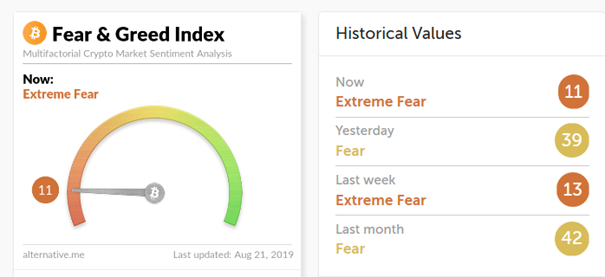
We are seeing a very high level of fear (or low level of greed). I posted below a graph of their Fear & Greed Index followed by a graph of the Bitcoin Price.
In the last 18 months, the indicator dipped strongly 2 times before and when it did you can see the reaction by BTC a few weeks later !
AXpire burns 20,000 AXPR as a part of burning percents of aXpire’s revenues.
STEEM Trading Update by my friend @cryptopassion
Here is the chart of yersterday :
Here is the current chart :
Today, we had an important UP in the direction of the 0.21$ resistance line. The rejection was quiet big as we can see that on the same candle, we almost touched that level to go directly lower after. Most of the time this kind of candle is a very bearish signal but let’s see what will happen in the coming hours. If the BTC is going to make a nice UP, I expect that we test quickly again that resistance line. In case of correction on the BTC, this will validate the bearish candle pattern.
While drinking rates are declining globally, particularly among young people, in the UK, baby boomers (aged 55-64) remain the most likely to drink heavily and are the least likely to abstain from drinking alcohol.
The universal decline may therefore be more of a polarisation around drinking, with the decline of overall consumption levels potentially masking on-going heavy drinking among some young people and particularly older ones.
In the UK, the 4% of the population who drink the most heavily are responsible for c. 30% of all alcohol purchases, and alcohol-related deaths as well as hospital admissions are growing significantly in recent years.
Analysis and Comments
It is estimated that over 20% of the population does not drink at all, and its c. 30% for people under 24 (the data is not very precise). It is also estimated that c. 4% of the population drink around 30% of the alcohol consumed and that these consumers make up c.25% of industry profits. In addition, and perhaps more worryingly, deaths related to alcohol misuse are the highest in a decade, with related hospital admissions up 67%.
The implications are fairly stark for Beverages companies – in Western markets we should expect a continuing shift away from consumption of mass market beer, toward premium beer, wine & spirits. This is not necessarily bad news for drinks companies, they have been repositioning themselves for this shift for some time. Plus emerging markets consumption is still rising and the trend toward premium (i.e. more profitable) drinks continues.
As I wrote in this post a few weeks ago when I digged into HF21, I believe this will be very positive for the STEEM price in the Medium Term.
Now that we have different tokens (thanks to Steem-Engine and soon to SMTs). The ecosystem is flourishing quickly through the many dapps that you all use daily.
With this new HF21, stakeholders (therefore investors) might play a bigger role curating and harvesting more value of the STEEM Blockchain. In order to do so, they will have to increase their SP Holdings (which we are seeing during the past 2 days).
STEEM Price is performing very well ahead of HF21
I read daily very carefully @penguinpablo reports. In the past days, we have seen Steemians STAKING more than they were Unstaking ! Yes, you read that right.
This has not been the case for a long, long time and I believe considering the current price of STEEM outperforming the Crypto Market, a few more days like this and we could get into a STEEM Frenzy again.
Steemians and Investors have been powering up in the past 2 days
I have been buying STEEM in the past months and will try to do so before HF21.
Active Steemians Writers are also staking
I came accross this post from a fellow Steemian @toofasteddie: https://steemit.com/newsteem/@toofasteddie/harvestingtime-7yr6gb5xmq
In this post, he is explaining why he sells its STEEM Alts to Buy more STEEM before the upcoming HF.
I think, to make STEEM price continue on this trend, we just need a few hundreds of Steemians, before outsiders see the move and amplify it !
Cryptocurrency exchange Binance has confirmed user funds are not at risk after a reported technical problem began affecting withdrawals.
According to CEO Changpeng Zhao, also known as CZ, the situation was being resolved on Aug. 23, while funds security was not compromised.
“Funds are #safu,” he wrote on Twitter, employing a now well-known catchphrase he had previously inadvertently created while confirming there was no danger to cryptocurrency holdings.
Ethereum could become the first public blockchain on Hyperledger – if the open-source consortium’s technical steering committee approves a proposal to adopt the ConsenSys-backed Pantheon project.
Pantheon is a suite of ethereum-based services built by PegaSys, a 50-strong engineering team at ConsenSys. The Pantheon ethereum client, built on Java, is used to develop enterprise applications with features like privacy and permissioning.
The proposal was sent out in a Hyperledger mailing list email on Aug. 8, and if it is accepted, Pantheon will be renamed Hyperledger Besu (a Japanese term for base or foundation).
The approval would bring Pantheon’s protocol under Hyperledger, joining blockchain projects like Hyperledger Fabric by IBM and Hyperledger Sawtooth by Intel.
Coinbase Wallet’s decentralized web feature will allow users to link to supported Dapps from any browser using a new system called Walletlink.
The San Francisco-based cryptocurrency exchange announced today in a blog post, the open-sourced Walletlink acts as a “secure bridge” between the Coinbase ecosystem and the traditional web.
The feature will enable Coinbase Wallet users to access and administer their funds – separate from their crypto holdings on Coinbase.com – from a desktop Dapp interface for the first time, said Coinbase Wallet product lead Sid Coelho-Prabhu.
Circle is hiring a new general partner to raise a $100 million venture capital fund.
The fund will take advantage of the deal flow coming through SeedInvest, the equity crowdfunding startup that Circle acquired in March 2019.
The listing on LinkedIn says: “The Partner will be expected to develop and drive an investment thesis designed to leverage SeedInvest’s sizable deal flow and its unique network of 250,000 investors to maximize returns.” SeedInvest emphasizes itself a registry of potential startup investments that have been thoroughly vetted by the firm before they are shown to users.
San Francisco-based nonprofit Kiva, a company that crowdfunds loans for financial inclusion, has launched a blockchain platform for credit history with the government of Sierra Leone.
According to a Reuters report on Aug. 21, Kiva and President of Sierra Leone Julius Maada Bio jointly launched the blockchain initiative in the country’s capital.
The platform will use biometric data collected by the government, such as fingerprints, in order to access the credit history of citizens in the country. This will purportedly give a way for lenders to obtain citizens’ credit history.
We are seeing a very high level of fear (or low level of greed). I posted below a graph of their Fear & Greed Index followed by a graph of the Bitcoin Price.
In the last 18 months, the indicator dipped strongly 2 times before and when it did you can see the reaction by BTC a few weeks later !
“We invite you this Friday to learn more about #AE’s #Sophia language, #statechannels and #Starfleet incubator.”
STEEM Trading Update by my friend @cryptopassion
Here is the chart of yersterday :
Here is the current chart :
So the bounce from the support line created from the lows looks quiet powerfull. We are going quickly in direction of the resistance line at 0.18$. The question will be to see if we will be able to break it this time or if we will play ping pong between these 2 lines. Stay carefull, I’m not sure that the bounce on the BTC will continue so we could be heavly impacted on the STEEM.
According to a new survey by Harmony Healthcare IT, millennials prefer getting medical advice online to going to their doctor; 76% of the respondents said they used specialized websites like WebMD or news articles.
It highlights the current transformation of the healthcare sector. Millennials, who will outnumber baby boomers by 20m in 2030, are favouring retail clinics and telehealth for healthcare treatment. The online presence of traditional providers is also important: 65% said they only see doctors who can be found online, with 48% saying they would prefer to have a virtual visit with a doctor than an in-person appointment.
One of the main argument is cost: WebMD for instance, the first choice website for those surveyed, is free, which makes it the economically more sensible option, as only 35% of those surveyed set aside savings for medical emergencies, with 51% of those saving less than US$100 per month.
Analysis and Comments
The first thing that is probably important to note about this survey is that the respondents are American (which explains the emphasis on cost advantages).
However, a much larger study conducted by Accenture in February looked at four times as many consumers from all around the world and came to similar conclusions: there is a shift away from traditional care offerings, towards online alternatives.
Importantly, this shift was not only found among members of the youngest generations (Millennials and Gen Z), but also Generation X (the one after the Boomers).
We are seeing a very high level of fear (or low level of greed). I posted below a graph of their Fear & Greed Index followed by a graph of the Bitcoin Price.
In the last 18 months, the indicator dipped strongly 2 times before and when it did you can see the reaction by BTC a few weeks later !
American cryptocurrency exchange Kraken is adding support for Basic Attention Token (BAT) and Waves (WAVES.)
According to an announcement on Aug. 21, the exchange’s users will be able to deposit, withdraw and trade both assets starting Aug. 22. Kraken will roll out trading pairs between BAT and WAVES and Bitcoin (BTC) and Ether (ETH,) as well as with fiat currencies such as the euro and the U.S. dollar.
“The first trade executions will take a bit longer because sell orders cannot be placed until deposits are credited,” the post adds.
Bitcoin quickly fell from $10,842 to $10,082 earlier today, confirming a rising wedge breakdown on the hourly chart. The bearish reversal pattern has opened the doors for a retest of $9,467 (Aug. 15 low).
On the way lower, prices may find support at the 100-day moving average, currently at $9,882. The average served as strong support earlier this month.
The bearish case would be invalidated if prices rise above $11,000 with high volumes in the next 24 hours. As of writing, that looks unlikely. A convincing move above $12,000 is needed to revive the bullish setup, as per the weekly chart.
The U.S. Treasury Department’s Office of Foreign Assets Control (OFAC) has sanctioned three Chinese nationals and their cryptocurrency addresses, alleging they violated money laundering and drug smuggling laws.
OFAC named Xiaobing Yan, Fujing Zheng and Guanghua Zheng as narcotics traffickers under the Foreign Narcotics Kingpin Designation Act, freezing any property they own within the U.S. and listing a number of email aliases, citizen numbers and passport information for the three.
The agency also listed a number of bitcoin addresses, as well as one litecoin address, that the agency claims belong to the Chinese citizens.
Ethereum wants to translate all of its resources into 15 languages as part of a push to make the network more accessible, the Ethereum Foundation announced yesterday.
The foundation says it’s only focusing on translating its website at the moment—Ethereum.org—but has plans to expand its translations to include “important community resources like documentation, guides, blog posts, and more.”
Its first full translation, Ethereum.org/ko, is the result of a team of eight translators led by Taeyeon Kim, and translates everything on Ethereum’s recently relaunched site into Korean.
San Francisco-based nonprofit Kiva, a company that crowdfunds loans for financial inclusion, has launched a blockchain platform for credit history with the government of Sierra Leone.
According to a Reuters report on Aug. 21, Kiva and President of Sierra Leone Julius Maada Bio jointly launched the blockchain initiative in the country’s capital.
The platform will use biometric data collected by the government, such as fingerprints, in order to access the credit history of citizens in the country. This will purportedly give a way for lenders to obtain citizens’ credit history.
“Trading will start at 18:00 on August 22, 2019 (UTC+8) and withdrawal will open at 20:00 on August 22, 2019 (UTC+8).”
STEEM Trading Update by my friend @cryptopassion
Here is the chart of yersterday :
Here is the current chart :
So the worst case that I was talking about yesterday just happened. We are now testing the low and the support line that I traced for you which has been created by the 2 previous lows around the same level. Till now we have a bounce from this support line but let’s see if it will be enough if the BTC continues to correct.
If you have been in the CryptoWorld for a while, you probably came accross this indicator.
What is it?
The crypto market behaviour is very emotional. People tend to get greedy when the market is rising which results in FOMO (Fear of missing out). Also, people often sell their coins in irrational reaction of seeing red numbers. With our Fear and Greed Index, we try to save you from your own emotional overreations. There are two simple assumptions:
Extreme fear can be a sign that investors are too worried. That could be a buying opportunity.
When Investors are getting too greedy, that means the market is due for a correction.
Therefore, we analyze the current sentiment of the Bitcoin market and crunch the numbers into a simple meter from 0 to 100.
The complete list of factors with their weighting
Volatility (25%)
Market Momentum/Volume (25%)
Social Media (15%)
Surveys (15%)
Dominance (10%)
Trends (10%)
For a full disclosure on what are these factors exactly referring to please go to their website
We are seeing a very high level of fear (or low level of greed). I posted below a graph of their Fear & Greed Index followed by a graph of the Bitcoin Price.
In the last 18 months, the indicator dipped strongly 2 times before and when it did you can see the reaction by BTC a few weeks later !
I am not saying it is a 100% probability metric but something is SURE; I prefer buying when people are scared than the opposite. And today, it seems investors are being careful maybe too much?
The increased cost of transacting on the ethereum blockchain is hurting the software’s adoption, says project creator Vitalik Buterin.
Speaking with the Toronto Star this week, Butertin suggested projects that are considering whether to build on the technology will likely be butted out as the blockchain is overloaded with transactions, or in his words “almost full.” (While a blockchain cannot ever be technically ‘full,’ Buterin’s comments indicate his current sentiment on the severity of the problem.)
Still, Buterin’s comments speak to his understanding of the difficulties ahead for the project, with major planned upgrades including Ethereum 2.0 and a switch to proof-of-stake consensus ahead.
He told the newspaper:
“If you’re a bigger organization, the calculus is that if we join, it will not only be more full but we will be competing with everyone for transaction space. It’s already expensive and it will be even five times more expensive because of us. There is pressure keeping people from joining, but improvements in scalability can do a lot in improving that.”
Ethereum’s seven-day transaction fee average, a measure of demand on the network, actually sits at a 50-day low, falling since July 1 to sit around 0.11 ether per transaction currently.
Facebook is reportedly already under investigation by the EU over antitrust issues related to its Libra cryptocurrency project.
A document seen by Bloomberg indicates that the European Commission is “currently investigating potential anti-competitive behavior” by the Libra Association. The report describes the document as a questionnaire suggesting the commission is concerned that Facebook’s planned digital payment system could unfairly lock out competitors.
The governance structure and membership of the Libra Association is apparently under scrutiny. A number of major companies including Mastercard and Visa have already signed loose agreements to partner with the Libra Association on the project.
Smart contracts could soon get a boost in bitcoin as prominent programmer Pieter Wuille has unveiled a new coding language designed specifically for their use.
Posted to the bitcoin developer mailing list Monday, the ‘Miniscript’ language aims to make it easier for programmers to write up “smart contracts” or conditions for spending bitcoins. Programmers Wuille, Andrew Poelstra and Sanket Sanjalkar have been working on the code for roughly a year, Wuille said.
Although it’s been shared around behind the scenes, Wuille said he is now posting it to the email list because it’s now it’s reached “a stage where I’d like to get it some more attention.”
Backing up a bit, “Script” is the smart contracting language in bitcoin, which allows users to specify certain conditions need to be met before the bitcoin can be spent. Say, funds are locked up until a certain time before they can be spent. Or, two people need to sign off on a transaction before the money can be moved, a concept called “multi-sig.”
Eleven crypto projects announced Tuesday they had joined the Messari Disclosures Registry, including four top-100 projects by market cap: Cardano, Lisk, V Systems and Beam.
The new batch of crypto assets brings the total number of projects listed on the registry to 54. It launched with 12 projects in November 2018.
“The ability to find basic information on networks and their underlying tokens will be essential to responsible growth in the industry; and we’re thrilled to be working with such a great group to move the industry forward,” Ryan Selkis, Messari’s founder, told CoinDesk.
Bitcoin (BTC) price faced fresh bearish sentiment Aug. 21 after a rejection of $11,000 sent markets tumbling hundreds of dollars in minutes..
$9K Levels on horizon for Bitcoin price
Data from Coin360 shows BTC/USD topping out at just under $10,900 before reversing. Hours later, a sudden loss of support saw the pair dip to below $10,100 before bouncing slightly higher*
“Launch of a campaign to attract international organizations from 67 countries in the field of wildlife protection, improvement of…”
STEEM Trading Update by my friend @cryptopassion
Here is the chart of yersterday :
Here is the current chart :
Today, we validated the testing of the resistance line at 0.18$ but we failed to break it and so we are currently having a rejection. Except if the BTC is starting a new correction, I think we should try soon to break this line again in the coming hours. The worst case would be that we go test the support line related to the previous low around 0.165$.
According to recent data from GoodRX, an app tracking drug prices, only 3% of insurance claims for Eli Lilly’s insulin were for the half-price version that the company revealed shortly before being questioned by Congress on soaring insulin prices.
According to the article, many pharmacists do not know that a cheaper version is available or it cannot be accessed because it wasn’t added to individual patient’s list of drugs that are covered.
The company said it was aggressively working to increase awareness as well as access to the cheaper diabetes drug.
Analysis and Comments
Best Healthcare analysts expect a strong downward pricing pressure and slowing volume growth for the previous classes of drugs such as DPP4 and basal insulins.
This will likely result in a slowdown in the sales growth for the global pharmaceutical market. We project the global diabetes pharma market to grow at only 3% CAGR to reach $46bn by 2025.
While the overall diabetes pharma market is set to slow, GLP1 and SGLT4 are likely to experience rapid growth.