Here is a quick post to tell you that I am doubling up on STEEM. One of the Reason is HF21 (find all the info from @steemitblog’s post here) but this is neither the only one or the most important.
I think HF21 has its flows, yes it redistributes more to SP holder, but through this it will bring more investors, therefore more Buying pressure and a better STEEM Price I Believe.
More curation rewards also means more attention spent by SP Holder to curate content of quality. This would be beneficial to the entire STEEM Community.
In the end, what is the point to have 75% of your posts STEEM rewards / SBD if they are valued at a few cents, wouldn’t it be better to have 50% of a post valued a few $$$?
Not to mention that your SP and current liquid STEEM would increase in overall value.
As you know, a good STEEM price increase would attract new users, which will make prices go up : Virtuous circle.
Lately, I have assisted to many projects which confirm that STEEM is the Home of an innovating ecosystem with great entrepreneurs
@actifit launching its token on Steem-engine
@steem-engine allowing projects to get some kind of funding
@steemmonsters keeps on rolling ! Guilds are online and I think the phone APP launch will be the “going to mainstream” moment
@drugwars developments are continuing and even if the last release was not to the liking of some in the Community, th game is heading in the right direction
@nextcolony is launched and people seem to enjoy it
@steem-bounty increases interactions between Steemians
@steemhunt has maintained a high level of engagement
@partiko is working smoothly and is still my go to app on a mobile phone. (@esteem is also very popular)
@steempress allow bloggers all over the world to publish on Steem so easily
@dtube and @threespeak allow “Youtubers” to share and earn through the STEEM Platform
@appics is entering its final phase of development and will launch its token very soon
I could go on and on ! So many great projects out there !
Later, in another post, I will also share with you some doubts about some of the coins that popped up on Steem-Engine and are valued at delirious levels.
Later, in another post, I will also share with you some doubts about some of the coins that popped up on Steem-Engine and are valued at delirious levels.
My Latest Transfers to Steemit
Today
On July, 30th
Preparing HF21
As I want to be very active after this HF21, I decided to increase my SP in order to curate some of the best content creators I know on the STEEM Platform
If you happen to have some Spare SP, do not hesitate to fill my offer on @minnowbooster !
I hope you enjoyed this post, if you did : upvote, comment and resteem. I will upvote answers and set a nice @steem-bounty.
Bitcoin (BTC) has risen back above $11,000 after regaining ground lost on July 8 and July 22, when the world’s largest cryptocurrency by total value suffered bearish breakdowns that sent its price below $10,000.
At 15:00 UTC on August 4, bitcoin rose above $11,000 for the first time in 21-days.
BTC’s price stalled and then was retested along the $10,600 area on Aug. 4, proceeded by a breakout above $11,000, 10 hours after its most recent sell-off. BTC was last seen changing hands at $11,227 after a strong hourly candle broke above $11,050.
Following a recent hard fork of Bitcoin SV (BSV), the network saw a three-chain split after a massive 210 megabytes (MB) block was mined.
As reported by BitMEX Research on Aug. 3, Bitcoin SV nodes divided into three groups on Saturday, making the network to split into three separate chains. According to the report, 65% of nodes were located on the current tip, while 17% were stuck on the 210 MB block and 19% had not even upgraded and were on the old pre-hard fork chain.
According to data from Coin Dance, the 210 MB block was mined on Aug. 3 by CoinGeek miner and involved 808,633 transactions.
Bitcoin SV, a hard fork of Bitcoin Cash (BCH), which is in turn a fork of the major cryptocurrency Bitcoin (BTC), successfully ran its own scheduled hard fork on July 24 as part of plans to increase its block size from the previously set limit of 128 MB up to 2 gigabytes.
The total computing power now dedicated to securing the bitcoin blockchain has set yet another record.
According to data from mining services operator BTC.com, the average bitcoin mining hash rate over the last two weeks has reached 71.43 quintillion hashes per second (EH/s), up from 64.49EH/s on July 23. The threshold was breached as bitcoin adjusted its mining difficulty at block height 586,672 on Monday 2:52 UTC – that is a 6.94EH/s, or 10.78 percent jump since mid July.
Bitcoin mining difficulty is a measure of how hard it is to compete for mining rewards on bitcoin. Just how difficult the bitcoin software makes it to generate new blocks adjusts every 2,016 blocks – approximately every 14 days – to ensure the block production time remains about 10 minutes at the next cycle.
Max Keiser, a former Wall Street trader and host of the RT program Keiser Report, said that he believes Bitcoin (BTC) will break $15,000 this week.
In tweet published Aug. 3, Keiser said that he is “sensing #Bitcoin will cross $15,000 this week.” He further stated that confidence in central governments, central banks and centralized fiat money are at the lowest level they have been in decades. He noted:
“I’m confident. So I just burned another $10,000 in $USD shitcoin. Correlation does not equal causation, but whenever I burn a few thousand $USD, BTC price goes up significantly.”
One of the murkier corners of the cryptocurrency market is becoming even less transparent.
Tether, the controversial token that serves as a conduit for trading coins on many of the world’s largest crypto exchanges, is becoming the means for conducting transactions on a spate of new blockchains, the distributed digital ledgers that underpin the digital assets.
The migration from the dominant Bitcoin and Ethereum platforms risks making it more difficult for investors to track transactions, going against one of the key tenets championed by crypto advocates since the advent of the self-styled alternatives to money a decade ago.
“At the start of every month, we will be taking snapshop of all EthereumX token holders with more than 300,000 ETX tokens.”
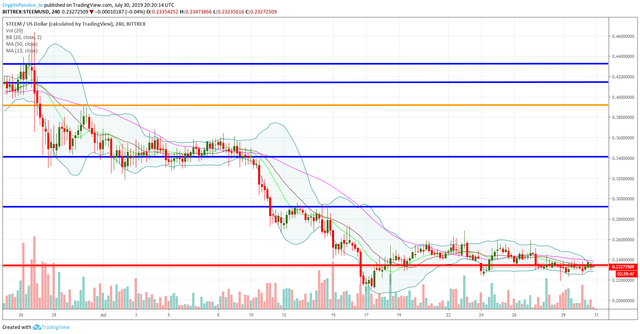
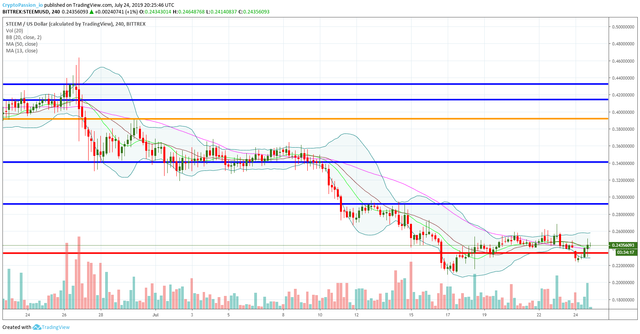
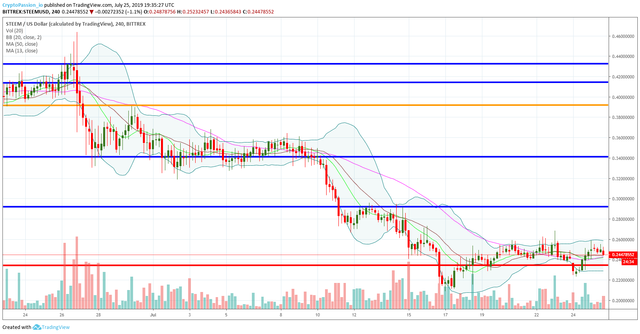
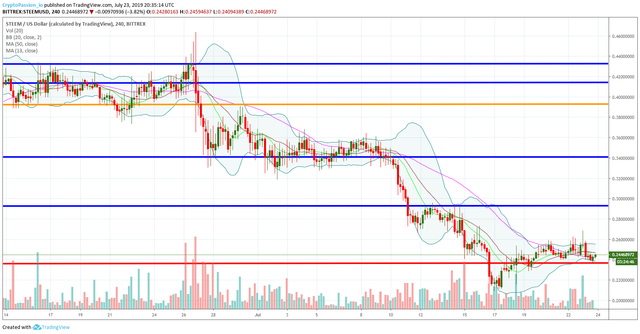
STEEM Trading Update by my friend @cryptopassion
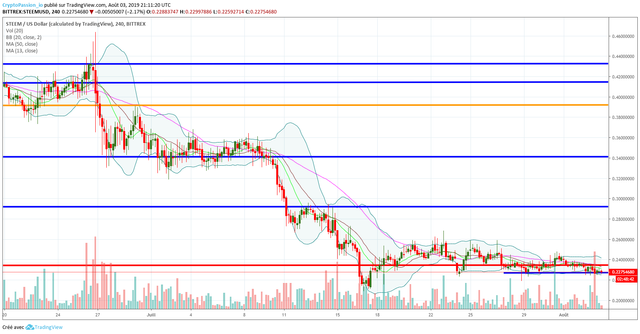
Here is the chart of yersterday :
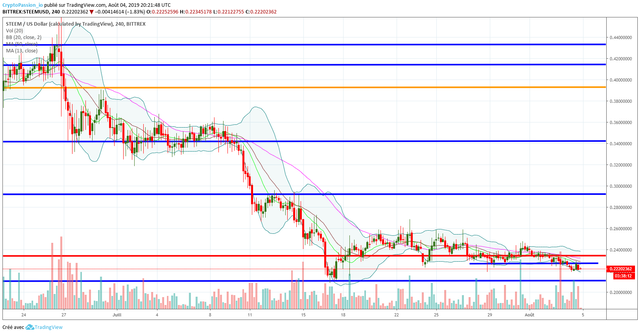
Here is the current chart :
So yeah my friends, except if we have a sudden big up in the coming hours, the support line at 0.24 and the little support just under in blue can be considered as broken. We should now go in the direction of the support line at 0.21$ which is a major support line which hold us since december 2018. If we break that support… I really don’t know where we will stop… 0.15$, 0.1$, 0.05$, 0.01$? what would be the minimum for you ? Let’s share your opinion.
Payments company Square reported its second-quarter earnings Thursday, revealing $125 million in bitcoin sales through its Cash App, nearly doubling a record first quarter.
“During the quarter, bitcoin revenue benefited from increased volume as a result of the increase in the price of bitcoin, and generated $2 million of gross profit,” the earnings report explains.
Founded by Twitter co-founder Jack Dorsey, Square reported that bitcoin represented very nearly half of the total revenue on its Cash App, at $260 million, for the second quarter of 2019. Bitcoin costs, however, are listed at $122.9 million in the unaudited quarterly report, yielding the aforementioned $2 million in profit.
A new patent filing suggests that United States retail giant Walmart may be developing its own U.S. dollar-backed digital currency similar to Facebook’s Libra cryptocurrency.
Walmart filed patent for “Digital Currency via Blockchain”
Patent filing number 20190236564, “System and Method for Digital Currency via Blockchain,” was published by the U.S. Patent and Trademark Office (USPTO) on Aug. 1. The document outlines a method for:
“Generating one digital currency unit by tying the one digital currency unit to a regular currency; storing information of the one digital currency unit into a block of a blockchain; buying or paying the one digital currency unit.”
Eric Conner, founder of information site ETHHub and product researcher at blockchain startup Gnosis, said:
“I think in four years, Ethereum will be moving past the hardest parts of its ambitious goals around proof-of-stake and scaling. At that point, the network will be able to onboard more users and we’ll start to grow beyond the use cases we are seeing today.”
LedgerX admitted Thursday it has not launched bitcoin futures, as the firm had previously claimed, after the U.S. Commodity Futures Trading Commission (CFTC) said it had not approved the exchange to do so.
The company previously told CoinDesk it was planning to launch the product on Wednesday. LedgerX would have been the first venue in the U.S. to offer physically-settled bitcoin futures, which are contracts that pay out in the underlying cryptocurrency rather than in cash.
“Not only are they delivered physically in the sense that our customers can get bitcoin after the futures expires, but also they can deposit bitcoin to trade in the first place,” LedgerX CEO Paul Chou told CoinDesk on Monday.ring connections to external services like the crypto exchange ZigZag, the blog Yalls and games like Lightning Roulette, facilitates nearly 10,000 referrals a month. So far, BlueWallet users have completed more than 100,000 lightning transactions.
The New York Office of the Attorney General (NYAG) has submitted a letter to Justice Joel M. Cohen, arguing that cryptocurrency exchange Bitfinex and affiliated Stablecoin firm Tether should not be granted a continuing stay of demands. The NYAG submitted its letter on Aug. 1 — the latest chapter in the New York Attorney General’s ongoing case against Bitfinex, parent company iFinex and Tether, in which the state alleges a multimillion loss coverup took place.
The motivation for NYAG’s letter
The court initially issued a stay of document demands in May at the defendants’ request. This means that the court currently only requires the defendants to produce documents and information pertinent to the issue of whether or not New York is the appropriate jurisdiction for the NYAG’s complaint, as opposed to a wholesale disclosure of complaint-pertinent documentation.
Bitfinex’s lawyers recently wrote that it had spent over $500,000 responding to NYAG’s document requests, adding that they would appeal for a continued stay of demands even if a dismissal motion does not go through.
“Scarcity is about to kick in,” the crypto trading account known as Rhythm on Twitter commented on the event.
The current Bitcoin supply means only a maximum of 17,850,000 people can own an entire coin. In reality, however, some of the existing mined supply is not in circulation and never will be, as users lose access to private keys.
Bitcoin (BTC) price climbed back over $10,000 to nearly $10,500 on the morning of August 2 as the market has shown a surprising bounce defying earlier calls by some traders for more downside.
“August could turn out to be a good month”
Trader and market analyst Josh Rager said that BTC/USD moving back above $10,000 is finally showing some nice follow through.
“A close above previous 4hr resistance is a nice sign,” he continued. “The good news about the death cross is that it leads to a golden cross as the 50MA is already starting to turn up.”
Rager concludes that:
“August could turn out to be a good month for price, IMO”
“Join us in Geneva on August 2nd for a “Workshop on #DLT Scalability and Interoperability” hosted by the @ITU FG on DLT #Standardization.”
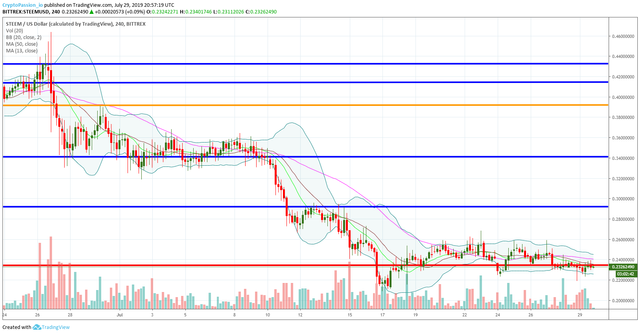
STEEM Trading Update by my friend @cryptopassion
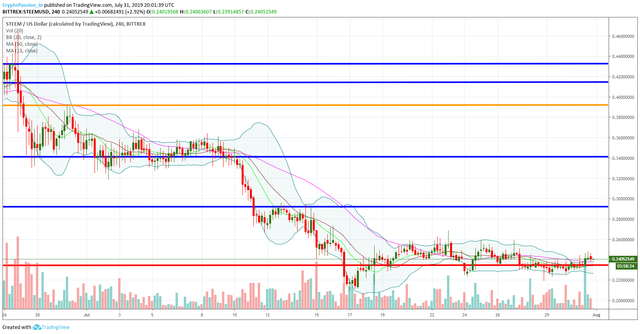
Here is the chart of yersterday :
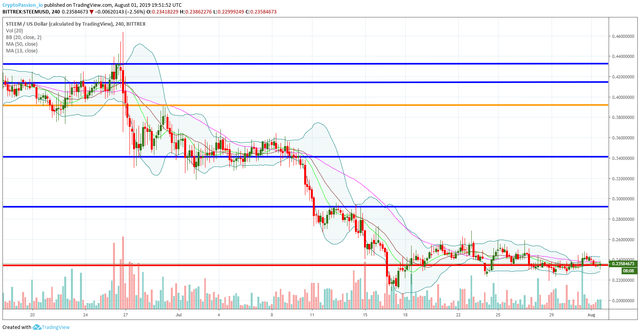
Here is the current chart :
The STEEM is still stitting exactly on the support line. I think we should have a decision from the market quiet soon. Let’s hope it will be a good news. The current pattern could indicate that the market is not able to go lower anymore and if this is the case, a sudden UP should appear suddenly. However, this kind of support line can finish also to be broken so we must stay all very carefull.
@actifit is doing it again! They have launched another new functionality, from now on you can exchange your AFIT tokens for STEEM at the STEEM-ENGINE market.
In order to allow all users and investors the use of this new functionality, you need to have AFITX tokens in your wallet which are going to be airdropped in the coming hours, with a maximum of 10 AFITX per account (equivalent to 100 STEEM at the current price).
In short, For every 1 AFITX owned, you can move daily up to 100 AFIT.
That means, AFIT current price is 0.05 STEEM/AFIT , so, at the current price it is 5 STEEM a day just with 1 AFITX!
But, wait, AFITX seems to be even more important than the rewarding AFIT token… The more AFITX token you have in your wallet the higher your user rank and so the higher you will be rewarded in AFIT, STEEM, ZZAN, SPORTS, PAL.
Also have a look on the Token description:
“AFITX is a new special benefits token for Actifit users & AFIT token holders. Holding this token enables users to: – Daily Move AFIT tokens to S-E – Increases user rank – Increases post rewards via our different rewarded tokens – Receive priority when exchanging AFIT for STEEM upvotes – Participate in contests – AFITX will constitute the basis for our future Exchange framework“
So here I am now buying some AFITX while exchanging already some of my AFIT for STEEM…
Actually, it is working somehow as an AFIT POWER-DOWN in automatic, so, seems that you have to select the amount you want to send daily to the Steem-engine exchange so, be sure to choose a sustainable amount because it can affect your User Rank.
For me this is a Clear WIN-WIN again!!!!
Congratulations and thanks to @mcfarhat and @actifit team for the excellent work.
A rule embedded within litecoin’s (LTC) code is set to soon reduce rewards for the miners who today ensure transaction processing on the world’s fourth-largest blockchain by total value.
In approximately five days, litecoin will undergo a scheduled reward halving – a process aimed at preserving cryptocurrency’s purchasing power. The mining reward is currently set at 25 litecoins ($2,500) per block and will drop to 12.5 litecoins ($1,200) per block on Aug. 5.
With that transition, the protocol will be adding significantly fewer litecoins to the market after Aug. 5.
Yesterday, ethereum celebrated its fourth birthday.
Four years ago, on July 30, 2015, the world’s first general-purpose blockchain platform went live. Called ethereum, the platform was the first of its kind to feature a Turing-complete virtual machine and native programming language able to deploy code of any algorithmic complexity.
“Before ethereum, developers had to design and write extremely complex software,” blockchain researcher Mihailo Bjelic told CoinDesk. “Ethereum introduced a generic programmable layer which abstracted this whole process and enabled developers to build decentralized applications by only writing their applications’ core logic.”
There are roughly 800 monthly active developers building on the ethereum blockchain, according to new data from investment firm Electric Capital.
Eric Conner, founder of information site ETHHub and product researcher at blockchain startup Gnosis, said:
“I think in four years, Ethereum will be moving past the hardest parts of its ambitious goals around proof-of-stake and scaling. At that point, the network will be able to onboard more users and we’ll start to grow beyond the use cases we are seeing today.”
Lightning-centric bitcoin wallets are gaining traction in 2019 and making small transactions affordable by reducing network fees.
The bootstrapped Spanish startup Bluewallet garnered 35,000 downloads so far this year, according to co-founder Nuno Coelho, a significant jump from the 5,000 users it had in 2018.
Coelho told CoinDesk the wallet’s built-in lightning marketplace, offering connections to external services like the crypto exchange ZigZag, the blog Yalls and games like Lightning Roulette, facilitates nearly 10,000 referrals a month. So far, BlueWallet users have completed more than 100,000 lightning transactions.
Bitcoin (BTC) now has 85% of its supply in circulation as of August 1, leaving just 3.15 million new coins for the next 120 years.
3.15 million bitcoins, 120 years
According to data from monitoring resource Blockchain, Thursday saw Bitcoin miners extract the 17,850,000th unit as part of the transaction validation process.
As a result, due to the number of coins awarded to miners per block decreasing over time, the remaining supply will only be unlocked in the year 2140. Bitcoin has a total fixed supply of 21 million units.
“Scarcity is about to kick in,” the crypto trading account known as Rhythm on Twitter commented on the event.
The current Bitcoin supply means only a maximum of 17,850,000 people can own an entire coin. In reality, however, some of the existing mined supply is not in circulation and never will be, as users lose access to private keys.
Because of its pseudo-anonymous, censorship-resistant nature, cryptocurrency has become a popular payment method in the adult entertainment industry. Porn sites, webcam sites and online sex shops have been using crypto to reduce their dependence on traditional payment services, which often impose restrictions and high transaction fees on these kinds of businesses — which are considered to be high risk.
Sex performers, who often struggle to set up regular bank accounts, can receive crypto payments directly from their clients, counting on the immutability and censorship resistance of blockchain technology.
Monthly interest distribution by Auxilium Interest Distribution Platform for coinholders. Also supports charity.
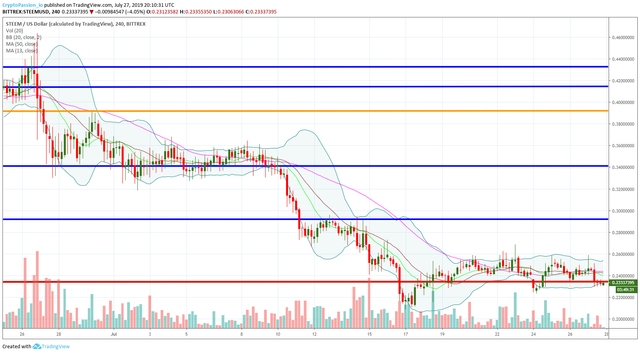
STEEM Trading Update by my friend @cryptopassion
Here is the chart of yersterday :
Here is the current chart :
The STEEM that we know since months now is back. The BTC is having a nice UP but the STEEM is not really following, even we had a little UP move which has been now cancelled. However, the more important is to don’t break our support line around 0.24$. If we continue like that, the UP will come back at one moment.
Bitfinex and Tether have spent half a million dollars just on finding documents for the New York Attorney General’s (NYAG) office, a new letter by its lawyers says.
In the letter filed with the New York Supreme Court Tuesday, attorneys Jason Weinstein and Charles Michael of Steptoe and Johnson LLP, and David Miller and Zoe Phillips of Morgan, Lewis and Bockius LLP, urged Judge Joel M. Cohen to rule against immediately compelling the crypto exchange and stablecoin issuer to produce all the documents the NYAG demanded.
Cohen previously ruled that Bitfinex and Tether would need to preserve and turn over a subset of those documents, staying the rest of the NYAG’s injunction.
During today’s United State Senate Banking Committee hearing on the regulatory framework for cryptocurrencies and blockchain, Cointelegraph will be updating live with the most important developments.
The July 30 hearing, titled “Examining Regulatory Frameworks for Digital Currencies and Blockchain,” follows the previous hearings in mid-July that examined the regulatory hurdles surrounding Facebook’s Libra.
Circle CEO Jeremy Allaire will be a witness today in front of the Senate Committee on Banking, House, and Urban Affairs on behalf of The Blockchain Association, along with Rebecca M. Nelson, a specialist in international trade and finance, and Mehrsa Baradaran, a professor of law at University of California, Irvine School of Law.
For more detailed information on the witnesses, Cointelegraph has a dedicated analysis here.
The Russian Federal Customs Service has opened a criminal investigation into an importer of bitcoin miners for potential underpayment of customs fees.
The Far-East Trading and Industrial Company, or DTPK, may have failed to pay about $1.2 million on 6,012 Bitmain-manufactured ASIC miners imported from August 2017 to February 2018, according to a search warrant obtained by CoinDesk.
DTPK, based in Moscow, showed customs officers falsified documents with the incorrect prices for the equipment, which included Bitmain’s Antminer S9-13.5, L3+ and D3 models, along with power elements for them, says the search warrant, dated July 17.
Coinbase executive Tim Wagner is leaving the crypto exchange after slightly over a year on the job. Other high-ranking engineering staffers are leaving too, CoinDesk has learned.
Wagner, Coinbase’s vice president of engineering, will be departing in the next two weeks, a Coinbase spokesperson confirmed. The departure will leave a vacancy on the company’s leadership team.
Previously, Wagner served more than six years at Amazon Web Services, making him one of most senior alums of big tech to join the cryptocurrency industry. Wagner joined shortly after Coinbase acquired Earn.com and made Balaji Srinivasan its chief technology officer.
Nasscom, a major Indain trade organization, has said that it is against a blanket ban on cryptocurrencies, which was recently proposed by a governmental panel in the country According to a report by local financial periodical The Economic Times on July 30, Nasscom commented:
“Nasscom believes that the recent proposal of the inter-ministerial committee of the government to ban all cryptocurrencies barring those that are backed by the government, is not the most constructive measure. […] Instead, the government should work towards developing a risk-based framework to regulate and monitor cryptocurrencies and tokens.”
As per the report, Nasscom claims that crypto projects can always be tested in regulatory sandboxes prior to launch. Nasscom also reportedly believes that banning crypto will only serve to push away legitimate businesses who are already pro-compliance.
SubstratumNode v1.0.0 RC1 release expected in July.
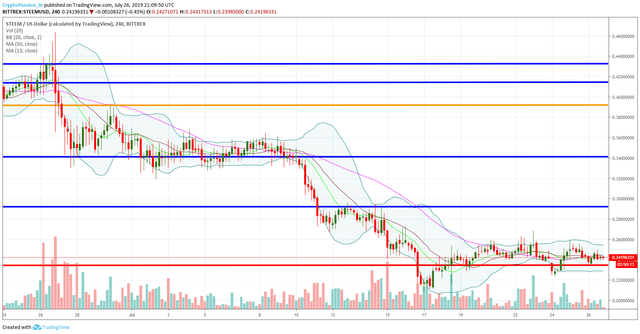
STEEM Trading Update by my friend @cryptopassion
Here is the chart of yersterday :
Here is the current chart :
It is nice to see that we are sitting on that line since days now. I don’t mean that I like that value for the STEEM but at least it looks a good level to allow the STEEM to consolidate and prepare the next move which we hope will be a nice UP.
Let’s hope the BTC won’t make a massive correction which will destroy that support line, this is the only risk that we have now at short term.
The chief of the United States Securities and Exchange Commission (SEC) Division of Enforcement’s Cyber Unit, Robert A. Cohen, has stepped down from his role at the commission.
According to an official announcement by the SEC, Cohen served as the first chief of the Cyber Unit since its inception in 2017.
The Cyber Unit is in charge of securities violations pertaining to cryptocurrency and digital assets, in addition to cyber-related trading violations and cybersecurity disclosures and procedures.
Regarding Cohen’s work as chief of the Cyber Unit, the Division of Enforcement’s co-director Steven Peikin said:
“The Cyber Unit has been a great success under Rob’s strategic leadership […] Soon after its creation, the Cyber Unit immediately began filing impactful cases that protect investors and demonstrate the SEC’s ability to respond nimbly to new and difficult challenges.”
Bitcoin’s three-day chart is reporting a golden cross, a long-term bull market indicator, for the first time since February 2016. A similar crossover seen six months ahead of the August 2016 mining reward halving paved way for a mega bull run. History may repeat itself with mining reward halving due in less than 12 months.
BTC may rise back to $10,000 in the next 24 hours or so with short duration charts signaling seller exhaustion.
A UTC close above $11,120 is needed to revive the bullish view. On the downside, key support is seen at $9,049 (July 17 low).
Bitcoin witnessed a golden cross in the three days to Feb. 3, 2016 – six months ahead of the mining reward halving – following which the cryptocurrency charted its way to a record high of $20,000 by December 2017.
With another reward halving (effectively, a supply cut) due in less than 12 months, history may just repeat itself.
As of writing , BTC is changing hands at $9,500 on Bitstamp, down 31.55 percent from June’s high of $13,880. The cryptocurrency could rise to $10,000 in the next 24 hours, according to the short-duration technical charts.
Square Crypto is focused on bitcoin, not the publicly traded company’s specific products.
That was the message Monday during a Twitter ask-me-anything (AMA) with the head of Square’s crypto team, Steve Lee.
The unit’s playful Twitter account fielded questions from its followers as well as crypto-community luminaries. With tweets signed simply “Steve,” it was Lee’s first set of public remarks on the team’s broad objectives since being hired in June.
The product we're focusing on is Bitcoin. It has been up and running for over 10 years… but there’s still a lot that needs to be done before we reach mass adoption. – Steve https://t.co/oU0yzhpWqX
Chinese importers in Russia are buying up to $30 million a day of tether (USDT) from Moscow’s over-the-counter trading desks.
They use the cryptocurrency to send large sums back to their home country, which has strict capital controls. Previously the merchants used bitcoin for this, but when the market crashed in 2018 they switched to tether, which is designed to maintain parity with the U.S. dollar.
Despite longstanding questions about USDT’s collateral, in this market “nobody actually cares if tether is backed or not,” says one Moscow trader.
Justice Joel M. Cohen of the New York Supreme Court (NYSC) has ruled to extend the preliminary injunction in the ongoing case of crypto exchange Bitfinex and Tether’s parent company, iFinex, against the New York Attorney General (NYAG), on July 29.
Cohen reportedly decided to give a 90 day extension to the case, which apparently means that OAG can continue investigating. Lawyers of Tether tried to appeal to dismiss the motion immediately, but Cohen rejected their appeal.
Speaking before the court, iFinex also argued that the court does not have subject matter jurisdiction because Tether is not a security or commodity as there is no futures market. The companies’ defense also stressed that Tether and Bitfinex are two different companies with two different business models, and that it is not proper to treat them as a single entity as the OAG does.
“Sign up today for the first episode scheduled for July 30th at 2 pm EST/8 pm CEST!”
STEEM Trading Update by my friend @cryptopassion
Here is the chart of yersterday :
Here is the current chart :
We are still testing that support line at 0.24$ since several days now and till now, we didn’t have a real break of it, even sometimes with a correction on the BTC.
What do you think? Do you think the marketis thinking that 0.24$ is low enough for the STEEM? Do you think it is just a pause before the next correction? Your TA or opinions are welcome.
As Bitcoin dropped an additional 8% on Saturday, naysayers claim the rally to a new all-time high is over. So what is it that’s keeping market analysts bullish in the face of a 33 percent correction?
Bitcoin price bears draw a line at $10,000
Bitcoin’s most recent price action has been less than satisfactory, unless you’re a bear. To date, the top digital asset is down 32% from it’s 2019 high of $13,739 and short term price action remains overwhelmingly bearish.
Over the past two weeks Bitcoin formed an M-top at $13,739 and $13,177 before dropping to the neckline around $9,600. Most traders expect that Bitcoin will retrace to the 61.8% and 50% Fibonacci Retracement level which is also near the CME futures gap. It’s possible that the group think surrounding the CME gap is causing it to function as a magnet, drawing BTC price nearer to the $8,500 – $7,500 range.
Dormant Bitcoin wallet address hit new all-time high
Earlier this week Coin Metrics released a report showing Bitcoin’s untouched supply reaching a new all-time high of 21%.
Not everyone supports this conclusion, however. Adamant Capital founding partner Tuur Demeester countered saying that: “I’m not so sure […] 5 years without updating your cold storage method is a long time in Bitcoin. Imo most of these coins are likely lost.”
Start of new bull markets coincides with miner capitulation, data shows
On Saturday expert crypto-analyst PlanB tweeted a rather intriguing chart that he and ParabolicTrav worked on.
According to the analysts, after a BTC/USD rally reaches its peak, a massive amount of Bitcoin is available at lower prices. The start of new Bitcoin bull markets have coincided with miner capitulation and Bitcoin price tends to rise from these bottoms to grow 100 times.
According to PlanB:
“We saw difficulty bottoms (miner capitulation) in Dec 2011 ($4.6), May 2015 ($230) and Dec 2018 ($3,896). Price continues to rise from these bottoms until ATH around 100x […] Implying a continuing uptrend until $370,000 ATH.”
In last week’s column — my third on Libra — I referred to a core dilemma confronting the cryptocurrency project’s financial inclusion goals: the impossibility of being both pro-privacy and pro-KYC.
I promise a break this week from Libra and its controversial founder, Facebook. But I want to dive deeper into that dilemma because the problem is hardly unique to that project. As “know-your-customer” rules have steadily encroached into their world, all cryptocurrency startups trying to expand financial access for the poor are hamstrung by requirements to identify and track the people they seek to serve.
This contradiction stems from tough policies contained under Anti-Money Laundering and Combating the Financing of Terrorism rules (AML-CFT), which were tightened worldwide after the September 11 attacks in 2001 and then again after the financial crisis. Since virtually every bank needs access to dollars, KYC rules everywhere tend to follow models laid down in the U.S. Bank Secrecy Act and in guidelines of the U.S. Financial Crimes Enforcement Network, or FinCEN.
Further internationalizing pressure comes from the inter-governmental Financial Action Task Force, or FATF, which sets the regulatory standards by which countries pressure each other to comply.
“It’s not a surprise to me that inevitably corporations are going after creating their own tokens but for Facebook to be one of the first big ones is is pretty much a surprise,” said Lukka CEO Jake Benson told us when news of Libra began to spread. The world shared his surprise when Facebook unveiled its wild cryptocurrency dreams last month. But that surprise quickly turned into concern and condemnation as politicians started thinking about what it meant for a company to run its own mint.
Facebook’s reaction to the hearings was also surprising. The usually-reticent social media giant sent their best fighter – Libra co-creator David Marcus – into the ring to defend the currency and the battle raged for two days as the U.S. Congress and Senate took turns bringing up their concerns.
The result? A stalemate… for now. token transactions.
Initial coin offering (ICO) consultant CoinLaunch has agreed to pay $50,000 to the Ontario Securities Commission (OSC), according to documents published on the regulator’s website dated July 24.
According to commercial litigator and former programmer Evan Thomas, CoinLaunch was consulted on two ICOs, BCZERO (raising funds for a Czech off-road truck racing team) and ECOREAL (raising funds for a Portuguese resort), both of which were found to be securities. CoinLaunch reportedly created the tokens, white papers and websites, advised on the sale structure and made introductions, including to crypto exchanges for listings.
According to Thomas, the OSC found that the service was an act in furtherance of the trade of the security tokens since it was instrumental to the solicitation of investors. The consultant agreed to pay a $50,000 fine under a settlement.
The hedge fund of famous investor Bill Miller saw 46% growth in the first half of 2019, reportedly in some part from investing in Bitcoin (BTC).
Citing an investor document, Bloomberg reports on July 26 that Miller achieved such outstanding results by investing in Bitcoin among other high-performing stocks. Alongside Bitcoin, other investments in the Miller’s fund reportedly include Amazon, security system firm ADT, as well as Avon Products.
The 69 year-old investor reportedly found success by following a similar investment strategy as he used during his three-decade run at Legg Mason, which envisions investing in securities that trade at a large discount to their intrinsic value.
“Cast your vote at 0x.org/vote to add support for ERC-1155 and the StaticCallAssetProxy!”
STEEM Trading Update by my friend @cryptopassion
Here is the chart of yersterday :
Here is the current chart :
The STEEM is still sitting on the support line at 0.24$, waiting for the next move from the BTC. I’m really afraid that the BTC will continue it’s correction so yeah, I’m little bit pessimist about that support line at 0.24$. However, I really wish that I’m wrong and that this support line will keep us upper but be very carefull in the coming hours.
Facebook co-founder and CEO Mark Zuckerberg said that the company will work as long as it takes to appease regulators’ concerns over its Libra stablecoin. Zuckerberg delivered his statements during the firms Q2 results conference call on July 24.
During the call, Zuckerberg said that — some years ago — Facebook would have just released a new product without prior warning, but now the company has changed. More precisely, he stated:
“We’ve opened a period of – however long it takes to address regulators and different experts and constituents’ questions about this and then figure out what the best way to move forward is.”
He also noted that — when Facebook was working on the white paper with the 27 other members of the Libra Association — they expected that, since finance is heavily regulated, there were going to be a lot of questions asked about the project.
The U.S. Securities and Exchange Commission has issued a no-action letter to Pocketful of Quarters (PoQ), a gaming startup looking to issue tokens on the ethereum blockchain.
PoQ may legally sell its Quarters tokens to consumers without registering them as securities, the SEC Division of Corporation Finance wrote in its second no-action letter to a company seeking to launch a token sale. (The first was granted in April to TurnKey Jet, a business-travel startup.)
Quarters are built according to the ERC-20 standard – the first such token to receive U.S. regulatory approval. In the July 25 letter, Jonathan Ingram, chief legal officer for the SEC’s FinHub wing, wrote:
cointele “Based on the facts presented, the Division will not recommend enforcement action to the Commission if, in reliance on your opinion as counsel that the Quarters are not securities, PoQ offers and sells the Quarters without registration under Section 5 of the Securities Act and does not register Quarters as a class of equity securities under Section 12(g) of the Exchange Act.”
The cryptocurrency industry is still grappling with the legal implications of the initial coin offering (ICO) trend of 2017. Two years after the token boom, the value of Bancor’s BNT token is in the dumps – sinking from $4.49 in July 2017 to an all-time low last week of $0.44, according to CoinMarketCap.
Yet, the project’s main investors are still holding.
For example, Yoni Assia, CEO of the crypto exchange eToro, described the $153 million Bancor ICO as a “pivotal” moment for the industry and told CoinDesk he is holding BNT because he believes in the team.
The Bancor platform, which provides quick liquidity for niche ERC-20 tokens by using BNT as a market-making reserve currency for all assets on the network, has routinely attracted 100-250 traders a week, according to Etherscan’s tally of BNT token transactions.
The Nigeria Deposit Insurance Corporation (NDIC), a federal insurance overseer and safety net provider, has issued a public warning about relying on cryptocurrency transactions in a press release on July 25.
According to the press release, managing director and CEO of NDIC Umaru Ibrahim said that relying on cryptocurrencies is very risky, because they are unregulated and unbacked by central banks in most financial jurisdictions.
Much like the United States’s Federal Deposit Insurance Corporation, the NDIC provides a safety net for depositors and aims to protect the banking system from instability caused by bank runs or loss of confidence.
U.S. investors have been able to purchase Bitfinex’s LEO exchange tokens, if only indirectly.
Seattle-based Arrington XRP Capital and Los Angeles-based Arca both said they invested in LEO tokens, despite Bitfinex’s stated policy of refusing to sell them to U.S. residents or entities.
Both investment management firms told CoinDesk that, rather than purchasing the tokens from Bitfinex, they acquired them, legally, from third parties.
The distinction is important because, in an ongoing court battle with the New York Attorney General (NYAG), Bitfinex maintains that it banned U.S. individuals from its platform in August 2017 and U.S. corporates a year later.
In arguing that it has jurisdiction in the case, the NYAG claims the exchange did business with New York entities as recently as early 2019.
“Thrilled to announce that our first-ever Developer Community Call will take place Friday 26 July @ 9 AM.”
STEEM Trading Update by my friend @cryptopassion
Here is the chart of yersterday :
Here is the current chart :
The false break of the support line yesterday triggered a bounce on the STEEM but we are already consolidating from it now. The positive point is that we are now back upper than this support line and that we are waiting for the next move. Till now it looks like that the support line at 0.24$ start to be considered as temporary low. A Up break out on the BTC could help us to validate that but let’s see what the market has planned.
This could be the first time the Lightning Network, a bitcoin scaling solution, officially impacts the U.S. presidential election.
Roughly a dozen bitcoiners who support Democratic presidential candidate Andrew Yang launched a crypto-friendly super PAC on Thursday, Humanity Forward Fund (Humanity FWD). Thanks to the PAC’s payment processor, OpenNode, the entity will be able to accept payments from lightning wallets.
“The super PAC obviously wants to receive donations as large as possible. But at the same time, individuals who want to donate just a bit to Yang’s platform now have that opportunity,” OpenNode CEO Afnan Rahman told CoinDesk. “It allows the donors to have all of the amount go toward the actual donation rather than miner fees.”
Ripple’s second-quarter report released Wednesday came with a few surprises: a gain, a loss, and a new partner. The distributed ledger technology firm’s total sales of XRP increased by nearly 48 percent to $251 million in the quarter, outpacing the first quarter’s $169 million in sales.
Direct institutional sales drove the uptick, increasing nearly 73 percent to $107.9 million from $61.9 million. Though programmatic sales still accounted for the majority of sales volumes with $144.6 million made in the second quarter up from $107 million in the first.
Despite this growth, the company states in a forward-looking projection:
“Ripple plans to take a more conservative approach to XRP sales in Q3.”
The Senate Banking Committee will hold a hearing on regulatory frameworks for cryptocurrencies and blockchain next week.
The committee said in a press release that it would hold an open session titled “Examining Regulatory Frameworks for Digital Currencies and Blockchain” on July 30, though it is unclear if this would be a fact-finding mission or if any specific pieces of legislation would be discussed.
Circle CEO Jeremy Allaire, representing the Blockchain Association; Rebecca Nelson, a member of the Congressional Research Service specializing in international trade and finance; and Mehrsa Baradaran, a law professor at the University of California Irvine School of Law will testify as expert witnesses.
Pantera Capital founder Dan Morehead discussed how Bitcoin (BTC) could hit $42,000 by the end of 2019, and even has the potential to reach $356,000 within a couple years. Morehead delivered his comments on an episode of the Unchained podcast on July 23.
Morehead specifically said that he predicts BTC will hit $42,000 by the end of the year, and climb to $356,000 by 2022. Morehead claimed that this would be consistent with the top cryptocurrency’s logarithmic growth rate:
“Graph the price of Bitcoin logarithmically […] its trend is going to grow at 235% compound annual growth rate and […] that put Bitcoin at $42,000 at the end of 2019. And I know this sounds crazy but we’re essentially halfway back there. […] I think it’s a good shot that by the end of the year we hit that. And if you just extrapolate that line out for another year it’s $122,000 per Bitcoin and then one more year, $356,000.”
United States Treasury Secretary Steven Mnuchin voiced new bearish views on Bitcoin today, saying that he probably will not be talking about the number one cryptocurrency in as soon as five years. In an interview with “Squawk Box” CNBC on July 24, Mnuchin said:
“I won’t be talking about Bitcoin in 10 years, I can assure you that […] I would bet even in 5 or 6 years I’m no longer talking about Bitcoin as Treasury Secretary. I’ll have other priorities […] I can assure you I will personally not be loaded up on Bitcoin.”
Mnuchin’s latest remarks follow a recent statement about how cryptocurrencies primarily exist as a vehicle for crime and speculative investment, saying, “I think to a large extent, these cryptocurrencies have been dominated by illicit activities and speculation.”
Meetup with NEO, LagomX, and Coin68 in Ho Chi Minh City, Vietnam from 14:30 – 15:30 (Indochina Time Vietnam Time).
STEEM Trading Update by my friend @cryptopassion
Here is the chart of yersterday :
Here is the current chart :
The support line at 0.24$ has been broken during some hours but it triggered an immediate bounce. It shows that this support line is quiet solid, at least from now. I don’t think we will be able to resist if the correction is continuing on the BTC but let’s at least enjoy that little good news. Steem is still alive….