What started out as a slow week, has been made up in the last two days thanks to all the volatility. Volatility is a necessary evil, if one is to make money. I say a necessary evil because when prices move, it provides an opportunity to make money and make money quickly. However, because trading is a zero sum game, that money that was made quickly was due to someone losing money quickly.
Fed Powell cut central bank cut rates on yesterday for the first time in ten years, due to continued uncertainty and a slowdown in the global markets. Fed Powell told the Markets not to necessary expect more cuts in the future. The DOW fell a little over 500 points.
Fed Powell tried to clear things up at the press conference,
“Let me be clear: What I said was it’s not the beginning of a long series of rate cuts,” Powell said. “I didn’t say it’s just one or anything like that. When you think about rate-cutting cycles, they go on for a long time and the committee’s not seeing that. Not seeing us in that place. You would do that if you saw real economic weakness and you thought that the federal funds rate needed to be cut a lot. That’s not what we’re seeing.”
but the damage was already done. I trade the futures market and missed the opportunity to ride on the backs of the Smart Money when price pulled back into a daily demand zone.
The Markets took off at the opening bell, the next thing I know the DOW was up almost 300 points. Then Trump did, what Trump does,
And the DOW reversed ending the day down almost 300 points, a 500 point reversal and busting through the daily demand zone in the process.
So what’s the lesson of this post…win, lose or draw, trade your plan, plan your trade.
This post is my personal opinion. I’m not a financial advisor, this isn’t financial advise. Do your own research before making investment decisions.
Payments company Square reported its second-quarter earnings Thursday, revealing $125 million in bitcoin sales through its Cash App, nearly doubling a record first quarter.
“During the quarter, bitcoin revenue benefited from increased volume as a result of the increase in the price of bitcoin, and generated $2 million of gross profit,” the earnings report explains.
Founded by Twitter co-founder Jack Dorsey, Square reported that bitcoin represented very nearly half of the total revenue on its Cash App, at $260 million, for the second quarter of 2019. Bitcoin costs, however, are listed at $122.9 million in the unaudited quarterly report, yielding the aforementioned $2 million in profit.
A new patent filing suggests that United States retail giant Walmart may be developing its own U.S. dollar-backed digital currency similar to Facebook’s Libra cryptocurrency.
Walmart filed patent for “Digital Currency via Blockchain”
Patent filing number 20190236564, “System and Method for Digital Currency via Blockchain,” was published by the U.S. Patent and Trademark Office (USPTO) on Aug. 1. The document outlines a method for:
“Generating one digital currency unit by tying the one digital currency unit to a regular currency; storing information of the one digital currency unit into a block of a blockchain; buying or paying the one digital currency unit.”
Eric Conner, founder of information site ETHHub and product researcher at blockchain startup Gnosis, said:
“I think in four years, Ethereum will be moving past the hardest parts of its ambitious goals around proof-of-stake and scaling. At that point, the network will be able to onboard more users and we’ll start to grow beyond the use cases we are seeing today.”
LedgerX admitted Thursday it has not launched bitcoin futures, as the firm had previously claimed, after the U.S. Commodity Futures Trading Commission (CFTC) said it had not approved the exchange to do so.
The company previously told CoinDesk it was planning to launch the product on Wednesday. LedgerX would have been the first venue in the U.S. to offer physically-settled bitcoin futures, which are contracts that pay out in the underlying cryptocurrency rather than in cash.
“Not only are they delivered physically in the sense that our customers can get bitcoin after the futures expires, but also they can deposit bitcoin to trade in the first place,” LedgerX CEO Paul Chou told CoinDesk on Monday.ring connections to external services like the crypto exchange ZigZag, the blog Yalls and games like Lightning Roulette, facilitates nearly 10,000 referrals a month. So far, BlueWallet users have completed more than 100,000 lightning transactions.
The New York Office of the Attorney General (NYAG) has submitted a letter to Justice Joel M. Cohen, arguing that cryptocurrency exchange Bitfinex and affiliated Stablecoin firm Tether should not be granted a continuing stay of demands. The NYAG submitted its letter on Aug. 1 — the latest chapter in the New York Attorney General’s ongoing case against Bitfinex, parent company iFinex and Tether, in which the state alleges a multimillion loss coverup took place.
The motivation for NYAG’s letter
The court initially issued a stay of document demands in May at the defendants’ request. This means that the court currently only requires the defendants to produce documents and information pertinent to the issue of whether or not New York is the appropriate jurisdiction for the NYAG’s complaint, as opposed to a wholesale disclosure of complaint-pertinent documentation.
Bitfinex’s lawyers recently wrote that it had spent over $500,000 responding to NYAG’s document requests, adding that they would appeal for a continued stay of demands even if a dismissal motion does not go through.
“Scarcity is about to kick in,” the crypto trading account known as Rhythm on Twitter commented on the event.
The current Bitcoin supply means only a maximum of 17,850,000 people can own an entire coin. In reality, however, some of the existing mined supply is not in circulation and never will be, as users lose access to private keys.
Bitcoin (BTC) price climbed back over $10,000 to nearly $10,500 on the morning of August 2 as the market has shown a surprising bounce defying earlier calls by some traders for more downside.
“August could turn out to be a good month”
Trader and market analyst Josh Rager said that BTC/USD moving back above $10,000 is finally showing some nice follow through.
“A close above previous 4hr resistance is a nice sign,” he continued. “The good news about the death cross is that it leads to a golden cross as the 50MA is already starting to turn up.”
Rager concludes that:
“August could turn out to be a good month for price, IMO”
“Join us in Geneva on August 2nd for a “Workshop on #DLT Scalability and Interoperability” hosted by the @ITU FG on DLT #Standardization.”
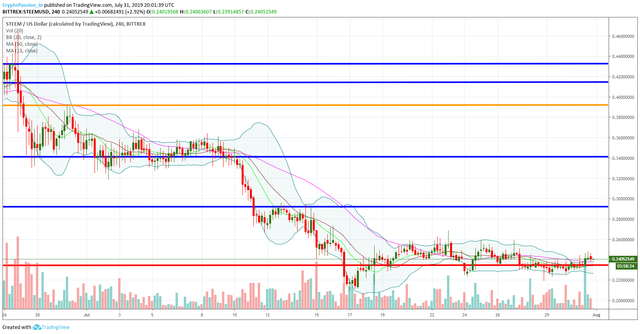
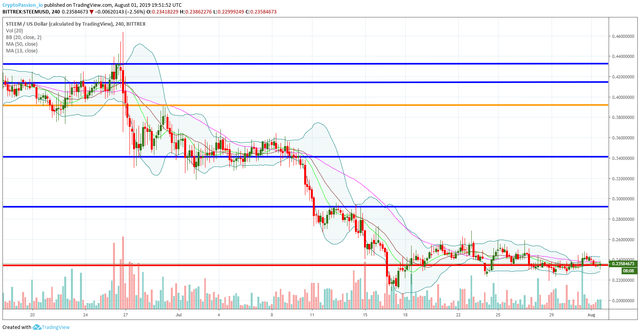
STEEM Trading Update by my friend @cryptopassion
Here is the chart of yersterday :
Here is the current chart :
The STEEM is still stitting exactly on the support line. I think we should have a decision from the market quiet soon. Let’s hope it will be a good news. The current pattern could indicate that the market is not able to go lower anymore and if this is the case, a sudden UP should appear suddenly. However, this kind of support line can finish also to be broken so we must stay all very carefull.
During a question-and-answer session on Oct. 3rd, Fed Chairman Jerome Powell said the central bank was a long way from adopting a neutral rate of growth. At the time the Markets were grinding higher from a very volatile 1st quarter where the US Equity Markets had not one, but two 10% declines. The Markets didn’t like what Powell said and showed him by tanking.
Then in December of 2018, Powell said the Fed’s program to reduce the bond holdings on its balance sheet was on “autopilot.” Powell later went on and raised short-term rates another one-quarter percent. The Markets didn’t like what Powell said and showed him by tanking again.
At this point, the Markets had Fed Powell right where it wanted him. The Markets become the puppeteer and Fed Powell became the puppet.
In early January, during a round table with Janet Yellen and Ben Bernanke, Powell said, there is no preset path for raising rates or adjusting the balance sheet. The Markets like what he had to say, eventually climbing 10%, aiding in one of the greatest V-reversals in US equity market history.
Yesterday, Fed Powell cut rates. However, the Markets had the rate cut priced in. But Fed Powell tried to cut the strings off from the puppeteer (the Markets) saying to the Markets not to expect more cuts, just because I cut rates this time. Well, the Markets pulled on the string by dropping almost 2%.
So what’s the lesson of this post, the relationship between the puppeteer is a special two way relationship in which the puppeteer gives life to the puppet by being man-handled when necessary.
This post is my personal opinion. I’m not a financial advisor, this isn’t financial advise. Do your own research before making investment decisions.
Fed Powell cut central bank cut rates on yesterday for the first time in ten years, due to continued uncertainty and a slowdown in the global markets. However, this wasn’t anything surprising as everyone and my Grandma expected the cut. However, it was his language that did surprise the Markets. He pretty much said, I’m throwing the markets a bone, but don’t necessary expect more bones.
This was a dovish tone in terms of more rate cuts and so the US dollar moved higher on the news as worldwide investors moved money into the currency (the US dollar) offering the greatest return. Although the US Feds cut rates, everyone around the world is cutting as well, but a faster pace.
So where is the US dollar heading next, lets go to the charts?
Bigger picture, the US dollar is moving towards the weekly demand at $99. This is key as there is room for the US dollar another $1 higher before potentially reversing. Which means Gold, Oil, Wheat, Soybeans, the Euro dollar, etc. should move lower as these assets are inversely correlated to the US dollar.
Based on the daily chart, potential turning points are between $99.40 and $100.40 as highlighted by the daily supply zones marked in white.
This post is my personal opinion. I’m not a financial advisor, this isn’t financial advise. Do your own research before making investment decisions.
A rule embedded within litecoin’s (LTC) code is set to soon reduce rewards for the miners who today ensure transaction processing on the world’s fourth-largest blockchain by total value.
In approximately five days, litecoin will undergo a scheduled reward halving – a process aimed at preserving cryptocurrency’s purchasing power. The mining reward is currently set at 25 litecoins ($2,500) per block and will drop to 12.5 litecoins ($1,200) per block on Aug. 5.
With that transition, the protocol will be adding significantly fewer litecoins to the market after Aug. 5.
Yesterday, ethereum celebrated its fourth birthday.
Four years ago, on July 30, 2015, the world’s first general-purpose blockchain platform went live. Called ethereum, the platform was the first of its kind to feature a Turing-complete virtual machine and native programming language able to deploy code of any algorithmic complexity.
“Before ethereum, developers had to design and write extremely complex software,” blockchain researcher Mihailo Bjelic told CoinDesk. “Ethereum introduced a generic programmable layer which abstracted this whole process and enabled developers to build decentralized applications by only writing their applications’ core logic.”
There are roughly 800 monthly active developers building on the ethereum blockchain, according to new data from investment firm Electric Capital.
Eric Conner, founder of information site ETHHub and product researcher at blockchain startup Gnosis, said:
“I think in four years, Ethereum will be moving past the hardest parts of its ambitious goals around proof-of-stake and scaling. At that point, the network will be able to onboard more users and we’ll start to grow beyond the use cases we are seeing today.”
Lightning-centric bitcoin wallets are gaining traction in 2019 and making small transactions affordable by reducing network fees.
The bootstrapped Spanish startup Bluewallet garnered 35,000 downloads so far this year, according to co-founder Nuno Coelho, a significant jump from the 5,000 users it had in 2018.
Coelho told CoinDesk the wallet’s built-in lightning marketplace, offering connections to external services like the crypto exchange ZigZag, the blog Yalls and games like Lightning Roulette, facilitates nearly 10,000 referrals a month. So far, BlueWallet users have completed more than 100,000 lightning transactions.
Bitcoin (BTC) now has 85% of its supply in circulation as of August 1, leaving just 3.15 million new coins for the next 120 years.
3.15 million bitcoins, 120 years
According to data from monitoring resource Blockchain, Thursday saw Bitcoin miners extract the 17,850,000th unit as part of the transaction validation process.
As a result, due to the number of coins awarded to miners per block decreasing over time, the remaining supply will only be unlocked in the year 2140. Bitcoin has a total fixed supply of 21 million units.
“Scarcity is about to kick in,” the crypto trading account known as Rhythm on Twitter commented on the event.
The current Bitcoin supply means only a maximum of 17,850,000 people can own an entire coin. In reality, however, some of the existing mined supply is not in circulation and never will be, as users lose access to private keys.
Because of its pseudo-anonymous, censorship-resistant nature, cryptocurrency has become a popular payment method in the adult entertainment industry. Porn sites, webcam sites and online sex shops have been using crypto to reduce their dependence on traditional payment services, which often impose restrictions and high transaction fees on these kinds of businesses — which are considered to be high risk.
Sex performers, who often struggle to set up regular bank accounts, can receive crypto payments directly from their clients, counting on the immutability and censorship resistance of blockchain technology.
Monthly interest distribution by Auxilium Interest Distribution Platform for coinholders. Also supports charity.
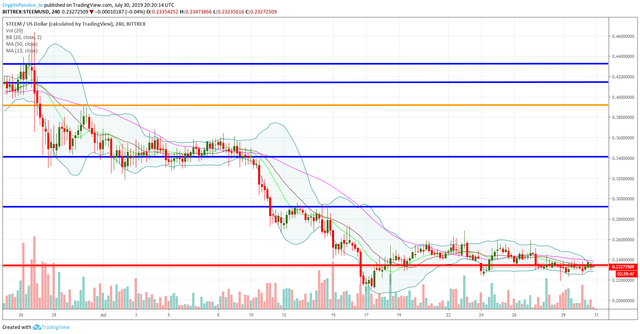
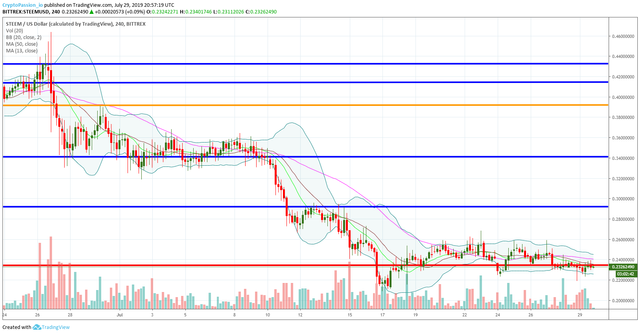
STEEM Trading Update by my friend @cryptopassion
Here is the chart of yersterday :
Here is the current chart :
The STEEM that we know since months now is back. The BTC is having a nice UP but the STEEM is not really following, even we had a little UP move which has been now cancelled. However, the more important is to don’t break our support line around 0.24$. If we continue like that, the UP will come back at one moment.
…according to the 13th Update of The Center for Information and Industry Development (CCID), under China’s Ministry of Industry and Information Technology.
STEEM is ranked 9th while BITCOIN is 11th on a list of 37 Crypto-Blockchain projects.
EOS is the 1st project, it makes sense to me since, if I am not wrong, some of the most important Block Producers are located at China.
I am happy to see that STEEM is up at some of the most important Blockchain Ranks. Surely, projects as @wherein are doing an excellent work there…
It is weird that Cryptocurrency trading is still banned at China…I don’t think this status will last for long since also the government is willing to understand the technicalities and applicabilities of this technology…
In the meantime, as usual, keep calm and steem on!
Faced with public pressure over contributions to plastic pollution, Coca-Cola and PepsiCohave both left the Plastics Industry Association, the former stating it withdrew “as a result of positions the organization was taking that were not fully consistent with our commitments and goals.”
Last year, household products company Clorox, medical device firm Becton Dickinson, and hygiene and cleanings tech company Ecolab ended their memberships, some citing disagreement with the lobbying group’s efforts to prevent plastic bans.
The withdrawals come at a time where the plastic pollution debate is becoming much more heated in state legislatures, with five more states passing laws banning or taxing plastic bags, while several other states are passing laws limiting or preventing such actions by local governments.
Analysts and comments
According to Greenpeace, in 2018, Coca-Cola, PepsiCo and Nestlé were the world’s biggest producers of plastic trash, mostly of polystyrene, which goes into packaging, and PET, which is used in bottles and containers.
The companies have now made various pledges to reduce plastic waste and facilitate recycling, with Coca-Cola, for example, partnering with the Ellen MacArthur Foundation and pledging to make all its packaging recyclable, reusable, or compostable by 2025.
You can find the latest news on Ellen MacArthur’s New Plastics Economy Global Commitment here. At 3m metric tons in 2017, Coca-Cola currently has the highest disclosed plastic packaging volume among the signatories who have made a disclosures (followed by Nestlé and Danone).
Of the 150 companies who have signed up to MacArthur’s global commitment to reduce plastic pollution, the majority still refuses to publicly disclose figureson their own plastic packaging production (including Pepsi Co, H&M, L’Oréal, Walmart and Marks & Spencer).
The Plastics Industry Association, through the American Progressive Bag Alliance (APBA), an arm of the group, has been advocating against plastic bag bans, arguing that conventional plastic has the least environmental impact compared with other bags, requiring 70% less energy and 96% less water to make than paper bags, according to its website.
Bitfinex and Tether have spent half a million dollars just on finding documents for the New York Attorney General’s (NYAG) office, a new letter by its lawyers says.
In the letter filed with the New York Supreme Court Tuesday, attorneys Jason Weinstein and Charles Michael of Steptoe and Johnson LLP, and David Miller and Zoe Phillips of Morgan, Lewis and Bockius LLP, urged Judge Joel M. Cohen to rule against immediately compelling the crypto exchange and stablecoin issuer to produce all the documents the NYAG demanded.
Cohen previously ruled that Bitfinex and Tether would need to preserve and turn over a subset of those documents, staying the rest of the NYAG’s injunction.
During today’s United State Senate Banking Committee hearing on the regulatory framework for cryptocurrencies and blockchain, Cointelegraph will be updating live with the most important developments.
The July 30 hearing, titled “Examining Regulatory Frameworks for Digital Currencies and Blockchain,” follows the previous hearings in mid-July that examined the regulatory hurdles surrounding Facebook’s Libra.
Circle CEO Jeremy Allaire will be a witness today in front of the Senate Committee on Banking, House, and Urban Affairs on behalf of The Blockchain Association, along with Rebecca M. Nelson, a specialist in international trade and finance, and Mehrsa Baradaran, a professor of law at University of California, Irvine School of Law.
For more detailed information on the witnesses, Cointelegraph has a dedicated analysis here.
The Russian Federal Customs Service has opened a criminal investigation into an importer of bitcoin miners for potential underpayment of customs fees.
The Far-East Trading and Industrial Company, or DTPK, may have failed to pay about $1.2 million on 6,012 Bitmain-manufactured ASIC miners imported from August 2017 to February 2018, according to a search warrant obtained by CoinDesk.
DTPK, based in Moscow, showed customs officers falsified documents with the incorrect prices for the equipment, which included Bitmain’s Antminer S9-13.5, L3+ and D3 models, along with power elements for them, says the search warrant, dated July 17.
Coinbase executive Tim Wagner is leaving the crypto exchange after slightly over a year on the job. Other high-ranking engineering staffers are leaving too, CoinDesk has learned.
Wagner, Coinbase’s vice president of engineering, will be departing in the next two weeks, a Coinbase spokesperson confirmed. The departure will leave a vacancy on the company’s leadership team.
Previously, Wagner served more than six years at Amazon Web Services, making him one of most senior alums of big tech to join the cryptocurrency industry. Wagner joined shortly after Coinbase acquired Earn.com and made Balaji Srinivasan its chief technology officer.
Nasscom, a major Indain trade organization, has said that it is against a blanket ban on cryptocurrencies, which was recently proposed by a governmental panel in the country According to a report by local financial periodical The Economic Times on July 30, Nasscom commented:
“Nasscom believes that the recent proposal of the inter-ministerial committee of the government to ban all cryptocurrencies barring those that are backed by the government, is not the most constructive measure. […] Instead, the government should work towards developing a risk-based framework to regulate and monitor cryptocurrencies and tokens.”
As per the report, Nasscom claims that crypto projects can always be tested in regulatory sandboxes prior to launch. Nasscom also reportedly believes that banning crypto will only serve to push away legitimate businesses who are already pro-compliance.
SubstratumNode v1.0.0 RC1 release expected in July.
STEEM Trading Update by my friend @cryptopassion
Here is the chart of yersterday :
Here is the current chart :
It is nice to see that we are sitting on that line since days now. I don’t mean that I like that value for the STEEM but at least it looks a good level to allow the STEEM to consolidate and prepare the next move which we hope will be a nice UP.
Let’s hope the BTC won’t make a massive correction which will destroy that support line, this is the only risk that we have now at short term.
Beyond Meat priced its initial public offering at $25 and now the stock is up more than 800% since the IPO. Beyond Meat, a maker of plant-based meat products is the new IT THING on Wall Street because they are trailblazing a new secular movement away from animal protein.
Beyond Meat had their second
quarterly earnings announcement yesterday.
Although they reported a second quarter loss of $9.4 million, sales
nearly quadrupled from a year ago. In
additional, Beyond Meat raised its revenue guidance for 2019 to $240 million on
Monday, up from more than $210 million previously.
“Growth in net revenues for the second quarter of 2019 was driven primarily by an increase in sales of the Beyond Burger, expansion in the number of retail and food service points of distribution, including new strategic customers, as well as greater demand from our existing customers,” Chief Financial Officer Mark Nelson said in a conference call Monday afternoon.
However, shares tanked in after hours trading after they announced that it would be selling an additional 3.25 million shares of common stock. Three million of these shares are held by current stockholders, and 250,000 shares will be newly issued and are set to trade on August 1. Although the additional shares dilute earnings/profits, the money will go towards expanding the business.
However, it didn’t matter as investor took profits and short sellers took the opportunity to short the stock because they say the stock price as being overvalued.
That valuation is higher than that of roughly 25% of the companies in the S&P 500 index, including decades-old industry stalwarts like Molson Coors, Viacom, Under Armour, and JetBlue. At its Friday morning levels, Beyond Meat’s market cap was twice the size of Macy’s.
But while investors might still be hungry for this stock, experts’ appetites are starting to wane.
“My understanding is it’s a good product, but … from a valuation standpoint, it’s beyond ridiculous,” Quint Tatro, chief investment officer at Joule Financial, said Thursday on CNBC’s “Trading Nation.” “The company is trading at 100 times sales, 300 times cash, so … it’s not a matter of whether it’s justified at this price. It’s can they actually keep growing to justify this valuation?”
For context, Microsoft — which, at over $1 trillion, is the most valuable company in the market — trades at eight times sales and eight times cash. Amazon, a $970 billion company, trades at about four times sales and 20 times cash, Tatro said.
All in all, his thesis on Beyond Meat is simple: “It’s a no-touch.”
Personally I think it was a great move to raise capital to expand aggressively because the competition is coming. If you believe Beyond Meat is a 10 year story vs. the latest fad, there are two daily demand zones to pay attention to for an opportunity to go long.
This post is my personal opinion. I’m not a financial advisor, this isn’t financial advise. Do your own research before making investment decisions.
Not-for-profit organisation OpenAI (co-founded by Elon Musk) and Microsoft have formed a $1bn strategic partnership focused on integrating Microsoft’s Azure cloud platform with its on-going work.
The two firms will jointly develop Azure AI supercomputing technologies, but also focus on creating artificial general intelligence(AGI).
OpenAI will port its existing services to Microsoft’s cloud and use Microsoft as preferred partner for marketing commercialised AI technologies.
Analysis and Comments
The main difference between AI and AGI is that AGI is not developed for a specific application and therefore more multi-functional in nature. So, while an AI can be incredibly good at one task (e.g. screening scans for cancer), the aim for AGIs is to have the ability to perform any task that a human can.
Some experts have predicted the development of an AGI to be achieved as early as 2030, however, most lean towards later dates, such as the year 2060 or even 2099.
Regardless, OpenAI has already achieved several impressive milestones in the AI world, for example, by setting new benchmarks for robot dexterity, with one of its video gaming bots recently beating human champions at Dota 2, while one of its text-generation systems can write anything from fake news articles to convincing song lyrics and short stories.