I have just read apparently all the information I get about the, let me named as “the Sudden creation of another HARDFORK for Steem” in order to implement by one side the so called “STEEM PROPOSAL SYSTEM (SPS)” on which I don’t have anything against and, by the other side, an “Economic Improvement Proposal (EIP) ” on which I have serious doubts about its efficiency as a solution.
I do not want to explain here what all of these changes would mean, instead I am going to point you to the post of @timcliff which, in my opinion is sufficiently clarifying (…or not)…
Please, read this post.
They are trying to fix “the problem” of the steem blockchain by implementing a 50%/50% rewards for content creators and curators respectively as IMO major change. Very difficult to forecast the result of the change… looks like in principle, content creator would lost part of their rewards in order to encourage curators find good content to upvote for… It is still to be demonstrated that this change or the change of moving from a linear rewards curve to a convergent linear rewards curve will motivate ORCAS and WHALES to change their upvoting behavior or stop delegating SP to bidbots or the like… But this post is more related with the fact that STEEM has a problem of MARKETING as well. We are sitting at the 61th position of the TMC…
Would you think this sudden HF will help to get more investors on STEEM?
If you were an investor looking for altcoins to buy right now, which one you would choose?
The more visible, the best marketed, the one with less internal problems or, the one that is in permanent economical change since the beginning and with an uncertain HARDFORK result coming?
I’m not against improvements if they are so…but I really think the exposed proposals are drastic changes, which can complicate even more the things to the already damaged STEEM price.
@timcliff also listed as a part of the problems that:
“Little to no marketing is being done.“
…and there is nothing proposed yet neither a plan to solve that point and I don’t see how HF21 will fix it in short to medium term…
For me it is clear that before doing anything at the level of changing the CODE we should focus on the MARKETING aspect more seriously and, to tell you the thruth, I do not understand why the bloody SMT project is not even mention nowadays…at least now that seems that the costs will be reduced finally…
Perhaps we have to wait for the next, not the current one, Bull cycle in order to finally see someone reading how promising is the Steem blockchain…
The lira was down as much as 14% this year and the lira has suffered instability since mid-March. Plunging reserves and a lack of economic policy tightening are contributing to the uncertainty in Turkey. The US-China trade war has the potential to decelerate the global economy, and so investors are rushing into the safe haven Japanese Yen.
Monthly Chart (Curve Time Frame) – monthly supply is 24.000 with no monthly demand.
Weekly Chart (Trend Time Frame) – the trend is down.
Daily Chart (Entry Time Frame) – the chart suggests to go short at the daily supply
I don’t usually look at transport stocks, with the exception of FedEx and UPS, but the the following article cut my eye yesterday,
J.B. Hunt Hits a Downgrade Speed Bump From Bank of America
J.B. Hunt stock was down 2.7%, or $2.42, at $86.84 in mid-afternoon trading on the Nasdaq Stock Market after Bank of America warned of a tougher road ahead for the trucking and transportation company amid higher general rail costs as well as shifting traffic patterns.“Given secular headwinds of higher rail costs, shifting traffic patterns and refined rail lanes from Precision Scheduled Rail models, we believe volumes and JBHT’s
It’s hard to bet against Elon. Elon is a serial entrepreneur who has beaten all the odds and at times he works 120-hour work weeks and doesn’t leave the Tesla factory for days at a time. Not even the odds, but the timing of events are really Elon and Tesla at this time.
Bad news continued to mount for Tesla (TSLA) Tuesday as Morgan Stanley outlined a worst-case scenario that calculates a potential 95% swoon in Tesla stock while the company’s short sellers are in position to see a highly profitable month of May.Morgan Stanley analyst Adam Jonas slashed his low-end
I last talked about Abercrombie And Fitch three months ago, when they reported their last quarterly earnings and the charts suggested two shorting opportunities.
Abercrombie And Fitch…Setting Up For A Short
Despite a 20% move higher, I think A&F is getting close to levels for shorting the stock, but that’s just my bias, lets go to the charts. The chart suggests to short price at the daily supply at $27.50, but the better level is at $30.50.
Shares of Abercrombie & Fitch tanked Wednesday morning after the teen apparel retailer reported weaker-than-expected same-store sales growth and said it plans to close three more of its
The Commitments of Traders (COT) is a weekly market report issued by the Commodity Futures Trading Commission (CFTC) listing the positions held by commercial traders and the “Smart Money”, the hedge funds and bank institutions in various futures markets in the United States. Since the COT measures the net long and short positions held by speculative traders and commercial traders, it is a great resource to gauge sentiment in the Markets.
On Tuesday, the 10-year bond yield fell to a 19-month low of 2.264% due to the growing concern that the U.S.-China trade war will last longer than anticipated with prolong
The number of wallets holding between 1,000 and 10,000 bitcoin (BTC) has seen a sharp increase since the crypto market bottomed this winter, indicating significant accumulation during the price dip. The analysis was published in a new report from weekly crypto outlet Diar on May 28.
Diar’s analysis begins by comparing bitcoin’s distribution landscape today with data from August 2018, when the top coin was last trading in a circa $8,000 price range. The analysis focuses on so-called “Firm Size” bitcoin wallet addresses — defined as those holding between 1,000 and 10,000 BTC — and notes that such addresses now own over 26% of circulating supply, or $36 billion worth of BTC.
JPMorgan Chase’s blockchain team has developed a privacy feature for ethereum-based blockchains, obscuring not only how much money is being sent but who is sending it.
Revealed exclusively to CoinDesk, JPMorgan has built an extension to the Zether protocol, a fully decentralized, cryptographic protocol for confidential payments, compatible with ethereum and other smart contract platforms and designed to add a further layer of anonymity to transactions. The New York-based financial institution will open-source the extension Tuesday, and is likely to use it with Quorum, the bank’s homegrown, private version of ethereum.
Zether, which was built by a group of academics and financial technology researchers including Dan Boneh from Stanford University, uses zero-knowledge proofs (ZKPs), a branch of mathematics which allows one party to prove knowledge of some secret value or information without conveying any detail about that secret.
Facebook’s payment-focused cryptocurrency Globalcoin will face demographic challenges, according to recent research by cryptocurrency analysis firm Diar published on May 28.
Facebook’s native cryptocurrency — which will purportedly seek to disrupt or bypass banking networks in order to remove financial barriers and lessen consumer costs — will reportedly launch in 2020.
In its recent report, Diar suggests that the coin will face demographic challenges as the social media giant’s user base is aging.
“What the heck! It’s a food fight on here. [Bitcoin developer] Matt Corallo is mad at Blockstream. Ragnar and Giacomo Zucco clubbing people left and right. Wat is going on!?”
This text from a bitcoin enthusiast friend aptly described the confusion on social media platform Twitter in recent days, when leading members of the bitcoin developer and startup ecosystem have been fighting over bitcoin’s “culture” and whether it needs to be changed or improved.
The root of the debate: Does bitcoin have a culture problem? Is there too much “toxicity”? And yet, as Twitter is a free-for-all, there were all sorts of sub-parts to the debate, centering on other questions: Is bitcoin inclusive enough? Why is Twitter so harsh? And what, exactly is bitcoin culture?
**“Bitcoin industry culture is therefore *necessarily* one of extreme skepticism, cynicism, rigorous review, and forthright language,” Woodfine tweeted, adding:**
“If you’re unhappy with bitcoin culture, sorry, you’re the problem. Bitcoin is better off without you—you’re not cut out for the challenges ahead. You’re not good under pressure, you’re too sensitive, and you lack conviction.”
As the G20 summit approaches, member countries have been discussing how to implement the standards set by intergovernmental organizations such as the Financial Action Task Force. While there may be some challenges in complying with the standards, the European Central Bank says the risks crypto assets pose to the euro area’s financial stability are manageable.
The FATF held its annual Private Sector Consultative Forum in Austria earlier this month with its members and over 300 representatives from the private sector participating. Members of the FATF are 36 countries and two international organizations including the European Commission. The FATF explained:
“The discussions focused on the mapping of virtual asset services and business models … and on the implementation of specific FATF recommendations.”
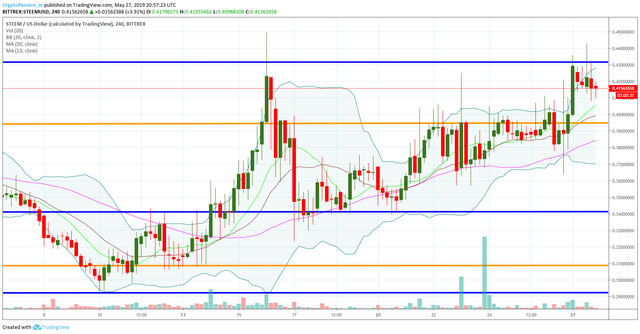
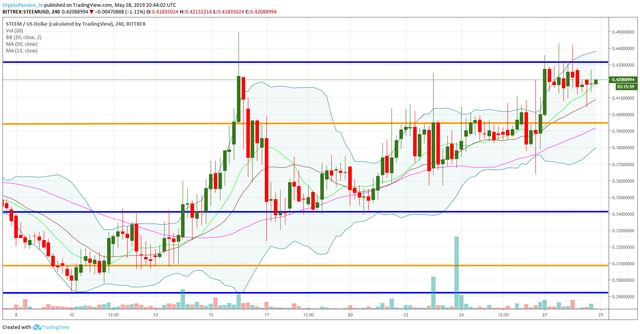
Since the break of the resistance line at 0.39$, the resistance around 0.43$ is blocking us. We can see clearly that it is the blocking zone at this moment but any UP move on the BTC should help us to break also that one. So let’s be patient because as I was saying to one of my readers, we are not anymore in the top 30 so sometimes, we have to wait that the moves on the BTC impact the TOP30 to have our turn with little delay.
Last Thursday alone, oil fell 6% and ended the week 7% down, it’s worst weekly lost in 2019. But one has to keep things in perspective, oil is still up almost 30% year to date.
The combination of a perceived global economic slowdown, higher levels of US oil storage, and rumors of a possible de-escalation of the Iran-US crisis are mitigating the clear and present danger in oil and gas markets When looking at crude oil markets, the situation on the ground is a clearly pro-OPEC. The speculation about a possible end to the OPEC+ production cuts is largely unfounded. US
The Dow Jones Industrial Average has declined for the fifth consecutive week, its longest such losing streak since 2011.
Specifically, the last time the Dow suffered a five-week losing streak was in June 2011, nearly eight years ago. After that, the index dropped another 7.5% in the subsequent three months, per data from Schaeffer’s Senior Quantitative Analyst Rocky White.
During the current losing streak, the Dow has surrendered less than 5%. Since 1900, there have been just eight similar streaks, after which the blue-chip barometer also experienced weaker-than-usual price action.
Almost any way you slice it, five-week losing streaks tend to precede weaker-than-usual