Three months ago, Google reported revenue of $36.3 billion, up 17% over the previous year. Google’s ad revenue consisted of 85% of that revenue or $30.7 billion which was up from $26.6 billion. The company said they remain focused and excited by significant growth opportunities across their other business. However, Wall Street didn’t want to hear that. They wanted to know why the ad revenue growth decelerated from 24% a year ago to 15%. I think what really pissed Wall Street off was Google didn’t have any real answer, so the they dropped the price big time.
This past week, Google reported their second quarter earnings. Revenue increased 19.3% year over year to $38.944 billion, accelerating from 16.7% growth in the first quarter, beating estimates by nearly $800 million. Net income for the quarter climbed to $9.947 billion, up nearly 21% year over year and ahead of expectations. Equally important, ad revenue rose 16.1% to $32.601 billion.
In the second quarter, annual paid click growth for Google properties continued slowing, dropping to 28% from a first-quarter level of 39%. But this was more than offset by the fact that CPC only fell 11% — a much smaller decline than 19% in the first quarter and also the smallest drop Google has seen in three years.
Porat mentioned on the call that “the benefits of applying machine learning” have boosted ad sales on Google properties, but didn’t offer additional details. In the past, Google has talked up its use of machine learning to help advertisers (including small businesses) optimize their ad campaigns based on goals such as maximizing ad clicks, sign-ups or revenue.
Price is back in monthly supply, but the chart suggests, potential all the unfilled sell orders have been used up and so Google has a shot of reaching all time new highs in the near future.
This post is my personal opinion. I’m not a financial advisor, this isn’t financial advise. Do your own research before making investment decisions.
As Bitcoin dropped an additional 8% on Saturday, naysayers claim the rally to a new all-time high is over. So what is it that’s keeping market analysts bullish in the face of a 33 percent correction?
Bitcoin price bears draw a line at $10,000
Bitcoin’s most recent price action has been less than satisfactory, unless you’re a bear. To date, the top digital asset is down 32% from it’s 2019 high of $13,739 and short term price action remains overwhelmingly bearish.
Over the past two weeks Bitcoin formed an M-top at $13,739 and $13,177 before dropping to the neckline around $9,600. Most traders expect that Bitcoin will retrace to the 61.8% and 50% Fibonacci Retracement level which is also near the CME futures gap. It’s possible that the group think surrounding the CME gap is causing it to function as a magnet, drawing BTC price nearer to the $8,500 – $7,500 range.
Dormant Bitcoin wallet address hit new all-time high
Earlier this week Coin Metrics released a report showing Bitcoin’s untouched supply reaching a new all-time high of 21%.
Not everyone supports this conclusion, however. Adamant Capital founding partner Tuur Demeester countered saying that: “I’m not so sure […] 5 years without updating your cold storage method is a long time in Bitcoin. Imo most of these coins are likely lost.”
Start of new bull markets coincides with miner capitulation, data shows
On Saturday expert crypto-analyst PlanB tweeted a rather intriguing chart that he and ParabolicTrav worked on.
According to the analysts, after a BTC/USD rally reaches its peak, a massive amount of Bitcoin is available at lower prices. The start of new Bitcoin bull markets have coincided with miner capitulation and Bitcoin price tends to rise from these bottoms to grow 100 times.
According to PlanB:
“We saw difficulty bottoms (miner capitulation) in Dec 2011 ($4.6), May 2015 ($230) and Dec 2018 ($3,896). Price continues to rise from these bottoms until ATH around 100x […] Implying a continuing uptrend until $370,000 ATH.”
In last week’s column — my third on Libra — I referred to a core dilemma confronting the cryptocurrency project’s financial inclusion goals: the impossibility of being both pro-privacy and pro-KYC.
I promise a break this week from Libra and its controversial founder, Facebook. But I want to dive deeper into that dilemma because the problem is hardly unique to that project. As “know-your-customer” rules have steadily encroached into their world, all cryptocurrency startups trying to expand financial access for the poor are hamstrung by requirements to identify and track the people they seek to serve.
This contradiction stems from tough policies contained under Anti-Money Laundering and Combating the Financing of Terrorism rules (AML-CFT), which were tightened worldwide after the September 11 attacks in 2001 and then again after the financial crisis. Since virtually every bank needs access to dollars, KYC rules everywhere tend to follow models laid down in the U.S. Bank Secrecy Act and in guidelines of the U.S. Financial Crimes Enforcement Network, or FinCEN.
Further internationalizing pressure comes from the inter-governmental Financial Action Task Force, or FATF, which sets the regulatory standards by which countries pressure each other to comply.
“It’s not a surprise to me that inevitably corporations are going after creating their own tokens but for Facebook to be one of the first big ones is is pretty much a surprise,” said Lukka CEO Jake Benson told us when news of Libra began to spread. The world shared his surprise when Facebook unveiled its wild cryptocurrency dreams last month. But that surprise quickly turned into concern and condemnation as politicians started thinking about what it meant for a company to run its own mint.
Facebook’s reaction to the hearings was also surprising. The usually-reticent social media giant sent their best fighter – Libra co-creator David Marcus – into the ring to defend the currency and the battle raged for two days as the U.S. Congress and Senate took turns bringing up their concerns.
The result? A stalemate… for now. token transactions.
Initial coin offering (ICO) consultant CoinLaunch has agreed to pay $50,000 to the Ontario Securities Commission (OSC), according to documents published on the regulator’s website dated July 24.
According to commercial litigator and former programmer Evan Thomas, CoinLaunch was consulted on two ICOs, BCZERO (raising funds for a Czech off-road truck racing team) and ECOREAL (raising funds for a Portuguese resort), both of which were found to be securities. CoinLaunch reportedly created the tokens, white papers and websites, advised on the sale structure and made introductions, including to crypto exchanges for listings.
According to Thomas, the OSC found that the service was an act in furtherance of the trade of the security tokens since it was instrumental to the solicitation of investors. The consultant agreed to pay a $50,000 fine under a settlement.
The hedge fund of famous investor Bill Miller saw 46% growth in the first half of 2019, reportedly in some part from investing in Bitcoin (BTC).
Citing an investor document, Bloomberg reports on July 26 that Miller achieved such outstanding results by investing in Bitcoin among other high-performing stocks. Alongside Bitcoin, other investments in the Miller’s fund reportedly include Amazon, security system firm ADT, as well as Avon Products.
The 69 year-old investor reportedly found success by following a similar investment strategy as he used during his three-decade run at Legg Mason, which envisions investing in securities that trade at a large discount to their intrinsic value.
“Cast your vote at 0x.org/vote to add support for ERC-1155 and the StaticCallAssetProxy!”
STEEM Trading Update by my friend @cryptopassion
Here is the chart of yersterday :
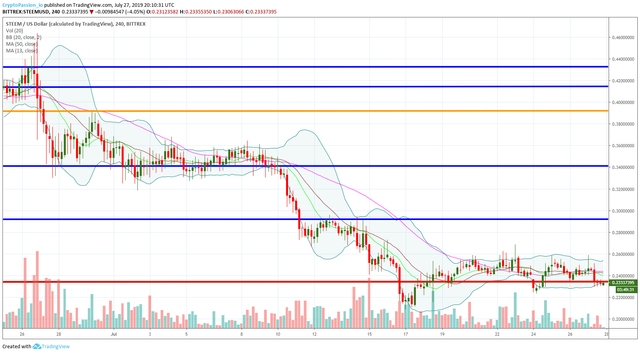
Here is the current chart :
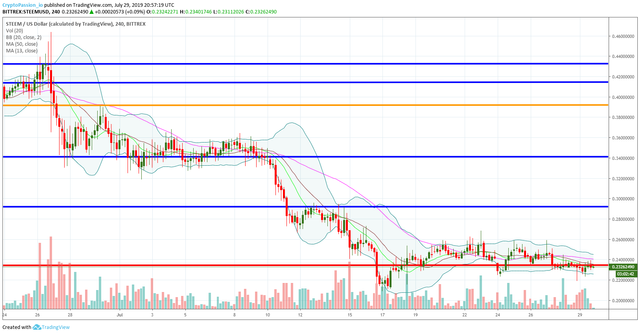
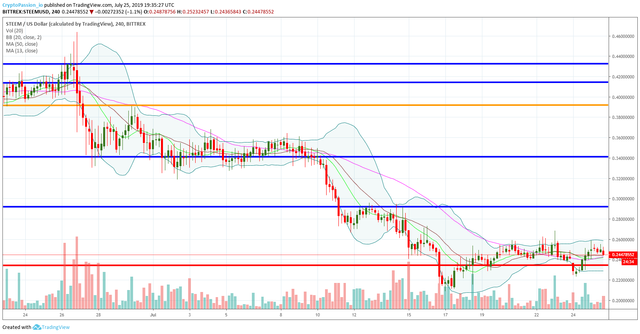
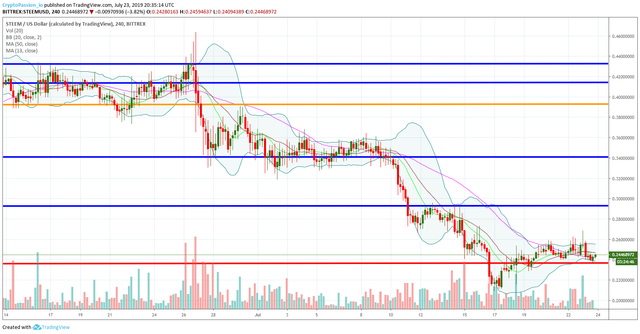
The STEEM is still sitting on the support line at 0.24$, waiting for the next move from the BTC. I’m really afraid that the BTC will continue it’s correction so yeah, I’m little bit pessimist about that support line at 0.24$. However, I really wish that I’m wrong and that this support line will keep us upper but be very carefull in the coming hours.
As the oil major BPis expanding its footprint in EV charging, the company has stated it is focusing on reducing charging times, “…to have a battery in a car by 2021 that can be charged completely in five minutes – for a lot more than 100 kilometers”.
After its acquisition of BP Chargemaster for US$170m, BP is now in the process of installingultra-fast EV chargers at service station in China, Germany, and the UK.
BP is also investing in biofuel development, as it considers the technology to be “the best way of decarbonizing long-distance jet transport”.
Analysis and Comments
This level of super fast charging is the holy grail of EVs. As cost comes down, and as the charging network grows, the last big barrier to overcome is the inconvenience of the time it takes to charge.
This shift, if achieved, could open up the EV market to those city dwellers who don’t have off street parking (so no easy home charging option).
To be clear, the BP target is just that; a target. The article claims, that the technology from a BP investment in an Israeli company called StoreDotalready allows ultra high speed charging of mobile phones but the EV version seems to be work in progress.
The technology (FlashBatteries) seems to be a combination of the use of organic compounds in the cathode (plus Silicon?) and some form of capacitor technology (those of you with good memories will recall that Tesla recently purchased Maxwell Technologies – a global leader in ultra and super capacitors).
Normally, I would be sceptical about such claims – the “we have found a way of producing super batteries” story appears on a regular basis in the tradepress. But with BP money behind them, perhaps this approach has a future.
Let the fun begin for those of us in the United States. According to a notice by the Internal Revenue Service (IRS) more than 10,000 people will be receiving letters to educate them on their tax liability on cryptocurrency transactions.
Here is a quote from the notice:
“Taxpayers should take these letters very seriously by reviewing their tax filings and when appropriate, amend past returns and pay back taxes, interest and penalties,” said IRS Commissioner Chuck Rettig. “The IRS is expanding our efforts involving virtual currency, including increased use of data analytics. We are focused on enforcing the law and helping taxpayers fully understand and meet their obligations.”
There are three variations: Letter 6173, Letter 6174 or Letter 6174-A, all three versions strive to help taxpayers understand their tax and filing obligations and how to correct past errors.
The letters will begin going out toward the end of August. Let me know in comments if you end up getting one of these letters.
Valve’s ‘The International 2019’ (TI19 – the world championship for its game Dota 2) has officially raised the largest single-event prize pool in esports history.
Currently, the total prize pool amounts to $30.4m, thereby surpassing the previously highest single-event prize pool of $30m (provided by Epic Games for its Fortnite Word Cup).
The tournament will be held in China for the first time in 2019, hosted by the Mercedes-Benz Arena in Shanghai from August 15th-25th.
Analysis and Comments
This is a significant development for a number of reasons:
Dota’s ‘The International’ prize pool is almost entirely crowdfunded via an in-game sale of a so-called ‘Battle Pass’,
only 25% of the in-game sales actually go towards the prize pool,
there are still more than 30 days left before cowdfunding stops, and
since the inception of crowdfunding the TI prize pool, the event has consistently broken its own record every year.
In summary, this is an all-time high in prize pool money for any esports event, showcasing both strong and growing support from the gaming community as well as from developers themselves: Last year, Epic Games announced it would support its Fortnite esports scene by providing a total of $100m for the 2018-2019 season, with the game’s World Cup featuring a $30m prize pool. This is the most any publisher has ever committed.
Esports serve a number of purposes, the main being extending the lifeof a game by encouraging and supporting an active gaming community. This is more important now than ever, as developers/publishers are moving away from the one-time up-front payment model towards in-game monetisation via downloadable content (DLCs) over the life of the game.
Facebook co-founder and CEO Mark Zuckerberg said that the company will work as long as it takes to appease regulators’ concerns over its Libra stablecoin. Zuckerberg delivered his statements during the firms Q2 results conference call on July 24.
During the call, Zuckerberg said that — some years ago — Facebook would have just released a new product without prior warning, but now the company has changed. More precisely, he stated:
“We’ve opened a period of – however long it takes to address regulators and different experts and constituents’ questions about this and then figure out what the best way to move forward is.”
He also noted that — when Facebook was working on the white paper with the 27 other members of the Libra Association — they expected that, since finance is heavily regulated, there were going to be a lot of questions asked about the project.
The U.S. Securities and Exchange Commission has issued a no-action letter to Pocketful of Quarters (PoQ), a gaming startup looking to issue tokens on the ethereum blockchain.
PoQ may legally sell its Quarters tokens to consumers without registering them as securities, the SEC Division of Corporation Finance wrote in its second no-action letter to a company seeking to launch a token sale. (The first was granted in April to TurnKey Jet, a business-travel startup.)
Quarters are built according to the ERC-20 standard – the first such token to receive U.S. regulatory approval. In the July 25 letter, Jonathan Ingram, chief legal officer for the SEC’s FinHub wing, wrote:
cointele “Based on the facts presented, the Division will not recommend enforcement action to the Commission if, in reliance on your opinion as counsel that the Quarters are not securities, PoQ offers and sells the Quarters without registration under Section 5 of the Securities Act and does not register Quarters as a class of equity securities under Section 12(g) of the Exchange Act.”
The cryptocurrency industry is still grappling with the legal implications of the initial coin offering (ICO) trend of 2017. Two years after the token boom, the value of Bancor’s BNT token is in the dumps – sinking from $4.49 in July 2017 to an all-time low last week of $0.44, according to CoinMarketCap.
Yet, the project’s main investors are still holding.
For example, Yoni Assia, CEO of the crypto exchange eToro, described the $153 million Bancor ICO as a “pivotal” moment for the industry and told CoinDesk he is holding BNT because he believes in the team.
The Bancor platform, which provides quick liquidity for niche ERC-20 tokens by using BNT as a market-making reserve currency for all assets on the network, has routinely attracted 100-250 traders a week, according to Etherscan’s tally of BNT token transactions.
The Nigeria Deposit Insurance Corporation (NDIC), a federal insurance overseer and safety net provider, has issued a public warning about relying on cryptocurrency transactions in a press release on July 25.
According to the press release, managing director and CEO of NDIC Umaru Ibrahim said that relying on cryptocurrencies is very risky, because they are unregulated and unbacked by central banks in most financial jurisdictions.
Much like the United States’s Federal Deposit Insurance Corporation, the NDIC provides a safety net for depositors and aims to protect the banking system from instability caused by bank runs or loss of confidence.
U.S. investors have been able to purchase Bitfinex’s LEO exchange tokens, if only indirectly.
Seattle-based Arrington XRP Capital and Los Angeles-based Arca both said they invested in LEO tokens, despite Bitfinex’s stated policy of refusing to sell them to U.S. residents or entities.
Both investment management firms told CoinDesk that, rather than purchasing the tokens from Bitfinex, they acquired them, legally, from third parties.
The distinction is important because, in an ongoing court battle with the New York Attorney General (NYAG), Bitfinex maintains that it banned U.S. individuals from its platform in August 2017 and U.S. corporates a year later.
In arguing that it has jurisdiction in the case, the NYAG claims the exchange did business with New York entities as recently as early 2019.
“Thrilled to announce that our first-ever Developer Community Call will take place Friday 26 July @ 9 AM.”
STEEM Trading Update by my friend @cryptopassion
Here is the chart of yersterday :
Here is the current chart :
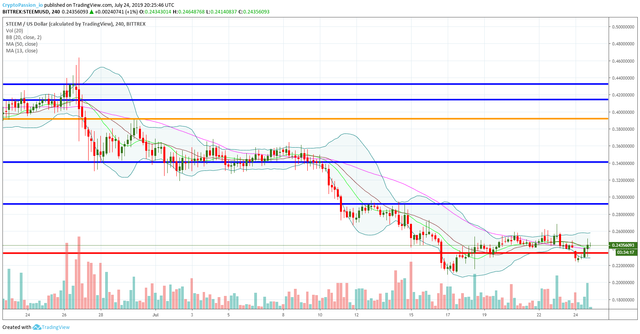
The false break of the support line yesterday triggered a bounce on the STEEM but we are already consolidating from it now. The positive point is that we are now back upper than this support line and that we are waiting for the next move. Till now it looks like that the support line at 0.24$ start to be considered as temporary low. A Up break out on the BTC could help us to validate that but let’s see what the market has planned.
This could be the first time the Lightning Network, a bitcoin scaling solution, officially impacts the U.S. presidential election.
Roughly a dozen bitcoiners who support Democratic presidential candidate Andrew Yang launched a crypto-friendly super PAC on Thursday, Humanity Forward Fund (Humanity FWD). Thanks to the PAC’s payment processor, OpenNode, the entity will be able to accept payments from lightning wallets.
“The super PAC obviously wants to receive donations as large as possible. But at the same time, individuals who want to donate just a bit to Yang’s platform now have that opportunity,” OpenNode CEO Afnan Rahman told CoinDesk. “It allows the donors to have all of the amount go toward the actual donation rather than miner fees.”
Ripple’s second-quarter report released Wednesday came with a few surprises: a gain, a loss, and a new partner. The distributed ledger technology firm’s total sales of XRP increased by nearly 48 percent to $251 million in the quarter, outpacing the first quarter’s $169 million in sales.
Direct institutional sales drove the uptick, increasing nearly 73 percent to $107.9 million from $61.9 million. Though programmatic sales still accounted for the majority of sales volumes with $144.6 million made in the second quarter up from $107 million in the first.
Despite this growth, the company states in a forward-looking projection:
“Ripple plans to take a more conservative approach to XRP sales in Q3.”
The Senate Banking Committee will hold a hearing on regulatory frameworks for cryptocurrencies and blockchain next week.
The committee said in a press release that it would hold an open session titled “Examining Regulatory Frameworks for Digital Currencies and Blockchain” on July 30, though it is unclear if this would be a fact-finding mission or if any specific pieces of legislation would be discussed.
Circle CEO Jeremy Allaire, representing the Blockchain Association; Rebecca Nelson, a member of the Congressional Research Service specializing in international trade and finance; and Mehrsa Baradaran, a law professor at the University of California Irvine School of Law will testify as expert witnesses.
Pantera Capital founder Dan Morehead discussed how Bitcoin (BTC) could hit $42,000 by the end of 2019, and even has the potential to reach $356,000 within a couple years. Morehead delivered his comments on an episode of the Unchained podcast on July 23.
Morehead specifically said that he predicts BTC will hit $42,000 by the end of the year, and climb to $356,000 by 2022. Morehead claimed that this would be consistent with the top cryptocurrency’s logarithmic growth rate:
“Graph the price of Bitcoin logarithmically […] its trend is going to grow at 235% compound annual growth rate and […] that put Bitcoin at $42,000 at the end of 2019. And I know this sounds crazy but we’re essentially halfway back there. […] I think it’s a good shot that by the end of the year we hit that. And if you just extrapolate that line out for another year it’s $122,000 per Bitcoin and then one more year, $356,000.”
United States Treasury Secretary Steven Mnuchin voiced new bearish views on Bitcoin today, saying that he probably will not be talking about the number one cryptocurrency in as soon as five years. In an interview with “Squawk Box” CNBC on July 24, Mnuchin said:
“I won’t be talking about Bitcoin in 10 years, I can assure you that […] I would bet even in 5 or 6 years I’m no longer talking about Bitcoin as Treasury Secretary. I’ll have other priorities […] I can assure you I will personally not be loaded up on Bitcoin.”
Mnuchin’s latest remarks follow a recent statement about how cryptocurrencies primarily exist as a vehicle for crime and speculative investment, saying, “I think to a large extent, these cryptocurrencies have been dominated by illicit activities and speculation.”
Meetup with NEO, LagomX, and Coin68 in Ho Chi Minh City, Vietnam from 14:30 – 15:30 (Indochina Time Vietnam Time).
STEEM Trading Update by my friend @cryptopassion
Here is the chart of yersterday :
Here is the current chart :
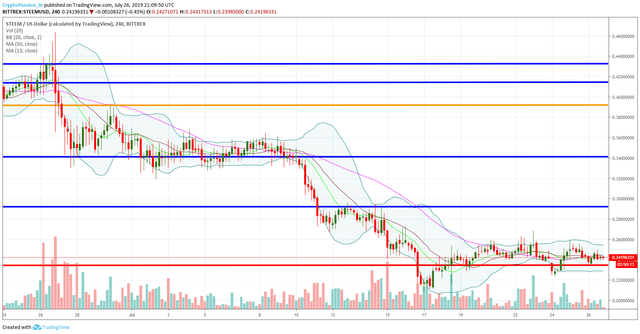
The support line at 0.24$ has been broken during some hours but it triggered an immediate bounce. It shows that this support line is quiet solid, at least from now. I don’t think we will be able to resist if the correction is continuing on the BTC but let’s at least enjoy that little good news. Steem is still alive….
This could be the first time the Lightning Network, a bitcoin scaling solution, officially impacts the U.S. presidential election.
Roughly a dozen bitcoiners who support Democratic presidential candidate Andrew Yang launched a crypto-friendly super PAC on Thursday, Humanity Forward Fund (Humanity FWD). Thanks to the PAC’s payment processor, OpenNode, the entity will be able to accept payments from lightning wallets.
“The super PAC obviously wants to receive donations as large as possible. But at the same time, individuals who want to donate just a bit to Yang’s platform now have that opportunity,” OpenNode CEO Afnan Rahman told CoinDesk. “It allows the donors to have all of the amount go toward the actual donation rather than miner fees.”
Ripple’s second-quarter report released Wednesday came with a few surprises: a gain, a loss, and a new partner. The distributed ledger technology firm’s total sales of XRP increased by nearly 48 percent to $251 million in the quarter, outpacing the first quarter’s $169 million in sales.
Direct institutional sales drove the uptick, increasing nearly 73 percent to $107.9 million from $61.9 million. Though programmatic sales still accounted for the majority of sales volumes with $144.6 million made in the second quarter up from $107 million in the first.
Despite this growth, the company states in a forward-looking projection:
“Ripple plans to take a more conservative approach to XRP sales in Q3.”
The Senate Banking Committee will hold a hearing on regulatory frameworks for cryptocurrencies and blockchain next week.
The committee said in a press release that it would hold an open session titled “Examining Regulatory Frameworks for Digital Currencies and Blockchain” on July 30, though it is unclear if this would be a fact-finding mission or if any specific pieces of legislation would be discussed.
Circle CEO Jeremy Allaire, representing the Blockchain Association; Rebecca Nelson, a member of the Congressional Research Service specializing in international trade and finance; and Mehrsa Baradaran, a law professor at the University of California Irvine School of Law will testify as expert witnesses.
Pantera Capital founder Dan Morehead discussed how Bitcoin (BTC) could hit $42,000 by the end of 2019, and even has the potential to reach $356,000 within a couple years. Morehead delivered his comments on an episode of the Unchained podcast on July 23.
Morehead specifically said that he predicts BTC will hit $42,000 by the end of the year, and climb to $356,000 by 2022. Morehead claimed that this would be consistent with the top cryptocurrency’s logarithmic growth rate:
“Graph the price of Bitcoin logarithmically […] its trend is going to grow at 235% compound annual growth rate and […] that put Bitcoin at $42,000 at the end of 2019. And I know this sounds crazy but we’re essentially halfway back there. […] I think it’s a good shot that by the end of the year we hit that. And if you just extrapolate that line out for another year it’s $122,000 per Bitcoin and then one more year, $356,000.”
United States Treasury Secretary Steven Mnuchin voiced new bearish views on Bitcoin today, saying that he probably will not be talking about the number one cryptocurrency in as soon as five years. In an interview with “Squawk Box” CNBC on July 24, Mnuchin said:
“I won’t be talking about Bitcoin in 10 years, I can assure you that […] I would bet even in 5 or 6 years I’m no longer talking about Bitcoin as Treasury Secretary. I’ll have other priorities […] I can assure you I will personally not be loaded up on Bitcoin.”
Mnuchin’s latest remarks follow a recent statement about how cryptocurrencies primarily exist as a vehicle for crime and speculative investment, saying, “I think to a large extent, these cryptocurrencies have been dominated by illicit activities and speculation.”
Meetup with NEO, LagomX, and Coin68 in Ho Chi Minh City, Vietnam from 14:30 – 15:30 (Indochina Time Vietnam Time).
STEEM Trading Update by my friend @cryptopassion
Here is the chart of yersterday :
Here is the current chart :
The support line at 0.24$ has been broken during some hours but it triggered an immediate bounce. It shows that this support line is quiet solid, at least from now. I don’t think we will be able to resist if the correction is continuing on the BTC but let’s at least enjoy that little good news. Steem is still alive….
The Semiconductors have been on fire as of late. Taiwan Semiconductor Manufacturing Company (TSM) is the world’s largest manufacturer of semiconductors beat analyst estimates for sales for this past quarter and signaled a rebound in the chip sector. Memory chipmaker Micron Technology (MU) reported better-than-expected earnings and say it expects demand to recover in the second half.
Today a couple of more semiconductor companies reported earnings today. Yesterday, Texas Instruments and Teradyne, automatic test equipment vendor reported their second-quarter earnings results. Both companies reported better-than-expected earnings and guidance.
ON Semiconductor Corporation manufactures and sells semiconductor components for various electronic devices to companies in the automotive, consumer, computing, industrial, communications, medical, and aerospace/defense markets.
ON Semiconductor Corporation reports earnings on Aug 5th. Today the Smart Money bought over 15, 000 call options with a strike price at $23 that expired on Aug 16th.
I would say they are off to an awesome start as the stock price jumped over a $1 today to close at $22.32. However, there are overhead sellers at the weekly demand at $24, just above the level where these options become profit. I tell you, the Smart Money sure does know how to pick the right levels.
This post is my personal opinion. I’m not a financial advisor, this isn’t financial advise. Do your own research before making investment decisions.
iRobot Corporation designs, builds, and sells robots for the consumer market worldwide. It offers Roomba floor vacuuming robots; Braava family of automatic floor mopping robots; and Mirra Pool Cleaning Robot to clean residential pools and removes debris as small as two microns from pool floors, walls, and stairs.
iRobot Corp. announced their second quarter earnings after the market close yesterday. In after hour trading, the stock fell double-digits after the company missed Wall Street’s estimates for sales for the second quarter and lowered its financial expectations for the full year, citing the impact of tariffs in President Donald Trump’s ongoing U.S.-China trade war.
“The direct and indirect impacts of the ongoing U.S.-China trade war and the recently implemented 25% tariffs are likely to constrain U.S. market segment growth in the second half of the year below our expectations at the start of 2019,” Angle said.
“Even as we operate in a higher tariff environment in the U.S., 2019 is shaping up to be another successful year of double-digit revenue growth and impressive global segment leadership,” Angle said.
After basing near the weekly demand at $86, price not only breached the weekly demand at $86, but also breached a critical major support/resistance line at $75. Thus, the chart suggests price is heading down to the weekly demand at $54.
This post is my personal opinion. I’m not a financial advisor, this isn’t financial advise. Do your own research before making investment decisions.