I’ve been keeping an eye on the weekly chart of Bitcoin and some other big cap coins. Starting this week they all looked a bit extended and I was 50/50 on whether price would push higher.
For a while price did, but with the sell off in recent days you can see price is digesting the prior move (or maybe purging).
A Bigger Picture
Looking at this weekly chart of Bitcoin we see what is a huge reversal type candle that will be formed unless we get a sick rally in the next 8 hours.
That upper wick is one of the biggest I have seen and shows sellers came in hard above the 11,500 area, which ironically was my upside profit target when BTC pushed above 10k.
It’s hard for me to get long when seeing this type of price action on the larger timeframe.
There was a rule that I was taught often back when I was a full-time equities trader.
Larger Time Frames Dominate
Conclusion
This is not to say price cannot go higher in the near-term. In fact price could rally 1k or more points and still technically not breach the reversal candle.
It is a warning signal though – that price has a higher probability of moving lower before it moves higher over the next week.
I’m trying to decide if I want to lighten my BTC position or not to be honest.
In yesterday’s update, I told you bitcoin looked ready to make a larger move. Since that time, we’ve seen it drop over $1,000. Price found some support at the ascending support line we’ve discussed.
Zooming out on the weekly chart, we can see we’re still trading above the upper Bollinger band. I’d like to see this week’s candle close above $11,500 later today. That would denote a major break above the prior resistance set back in January/February of 2018, which would likely signal continuation to the upside. As of now price has dropped below $11,500, trading at $11,100 on Coinbase.
In today’s video I discuss, where price may go from here, traps to avoid, key areas to watch and so much more. I hope you find it helpful.
I hope this has been helpful. I’d be happy to answer any questions in the comment section below. Until next time, wishing you safe and profitable trading.
Workin
If you found this post informative, please:
Get paid for viewing ads and Support the Crypto Ecosystem with Brave Browser. Free download here: https://brave.com/wor485
Bitcoin continues to consolidate within a tighter range. It looks like price may make a larger move over the next 24 hours. Daily volume remains healthy, but has dropped over the last 2 days.
In today’s video we’ll discuss where bitcoin’s next move may be, key areas to watch and so much more. I’ll also answer your direct questions after my analysis, which ends at the 14:40 mark in the video. If you’re not interested in hearing me address various comments and questions, you can stop the video there. I hope you find this helpful.
I hope this has been helpful. I’d be happy to answer any questions in the comment section below. Until next time, wishing you safe and profitable trading.
Workin
If you found this post informative, please:
Get paid for viewing ads and Support the Crypto Ecosystem with Brave Browser. Free download here: https://brave.com/wor485
People who got in Bitcoin for the first time in the last 1-2 due to FOMO got burned again (just like in late 2018) when price collapsed on Weds.
Bitcoin soared as much as 39% this week to $13,852, the highest since January 2018. But it hit a brick wall around 4:30 p.m. New York time Wednesday, plunging more than $1,800 within about 10 minutes. Moments later, prominent cryptocurrency exchange Coinbase Inc. reported an outage on its consumer site, which was resolved in under an hour. Swings continued Thursday, with the coin anywhere from down 15% to up 4.8%.It was down
In my last update, I told you if bitcoin broke above $11,500, we would likely see it test at least $13,500 (0.618 fib level). Price spiked as high as $13,850 before finding major resistance. It’s now put in a 25% correction, dropping as low as $10,400 before finding support. It’s currently trading around $11,850 on Coinbase.
We’re seeing a major influx of volume. A daily volume high of just over $45 billion was set 2 days ago. Today’s volume is an impressive $40 billion.
In today’s video I answer many of your direct questions. We’ll also discuss where bitcoin may be heading
Facebook has 2.7bn users and 90mn companies operating on its various platforms. Perhaps more than any other non-state player, it has the resources, reach and data trove to launch a global currency. The networking and social media giant is also loathed by many critics, who accuse it of abusing its market dominance. Hence, it is notable that Facebook is leading an association of companies that will co-manage the new currency and payments system as partners. It is a less than reprehensible plan, but there is a mountain to climb if Libra is to emerge as a new form of money.
This report will focus on what Libra must do if it is to become a widely-used medium of exchange. It will not judge if Facebook and its Libra grouping can develop payment services like Paypal, Venmo or Wepay; it won’t address whether Facebook will roll out rivals to Blackrock’s exchange traded funds or Alipay’s gigantic Chinese money market fund. With or without Libra being a success, Facebook could end up competing in all these areas—after all, none of the above providers have also created the holy grail of money.
What is certain is that if the new Libra were to be launched as a regular investment product, it would bomb. It may resemble a money market fund, except that the manager bags all accrued interest and the investor gets stuck with any value changes. On this basis, Blackrock or Goldman Sachs would likely fancy their chances against Libra.
Libra is, in fact, competing with central banks. Its model is to issue new Libra units and buy interest-bearing government bills from markets such as the US, UK, Germany and Japan. The fact that it may first exchange Libras for dollars, euros and yen, before buying the instruments does not change the basic proposition. It is similar to a central bank that scoops up safe interest-bearing assets using money that it has created out of thin air.
However, becoming a quasi central bank without government support will be hard. Users must be convinced to use the new currency in preference to the “legal tender” required by government agencies for a range of transactions.
Barbarians at the gate
Libra’s backers may be able to persuade regulators that they offer the requisite consumer protections and safeguards. They may even be able to automate the reporting of all capital gains and losses for tax purposes. But this does not mean that governments will meekly accept competition in the currency game. After all, if demand for fiat money shifts to Libra, the value of “old money”, when measured in goods and services, will fall. To avoid an inflation spiral, the responsible central bank will have to contract the supply of fiat money to match the now reduced demand. This will mean the central bank shrinking its own balance sheet, and likely pressuring its member banks to do the same thing (via monetary policy tightening).
Governments will be unnerved by this squeezing of their central banks since seigniorage profits—earned by the central bank issuing money at little or no cost and buying interest-paying assets—usually flows into state coffers. In the case of Libra, this same “money for free” will get distributed to the 100 members of the Libra Association, and not to the government.
Central and commercial banks buy lots of local-currency debt, especially paper issued by their own governments. Libra’s backers will buy similar government paper as backing for its units. However, because this group has promised to diversify across trusted currencies and government issuers, it will end up holding less US government paper than traditional US banks.
Still, if Uncle Sam does not love the Libra idea, other governments are likely to hate it—especially those in developing economies since the Libra Association is not likely to buy much of their public debt.
Take India, which has a history of currency debasement from unruly inflation. Any capital flight out of Indian banks is likely to see the authorities quickly stamp on Libra. And how precisely will they block a crypto-currency? Easy. They will just tell Facebook, Uber, Visa, Mastercard and the rest of the Libra Association that unless they desist with this currency nuisance, their main businesses will be excluded from India’s burgeoning consumer market.
But will users want to use Libra?
Still, regulators aside, will Libra be attractive to users? After all, the basic point of any currency is that it must be desired not just by a few people, but by many. The race to become money is the ultimate winner-takes-all contest; it is the most marketable “good” in an economy—the one that can be most readily and reliably traded for other goods, services and assets.
In each country or currency block, one currency typically dominates—and it is almost always the one needed by people to pay taxes. For some, this is a core reason to be skeptical about bitcoin’s chances of ever becoming money. Using two currencies is always more hassle than just one. And since fiat currencies will remain a necessary holding, at least to pay taxes, Libra has to give users good reasons for the hassle it creates.
The Libra Association promises to (i) provide banking to the “unbanked”, and (ii) offer lower transaction costs and faster settlements. At this point, it is not clear why Libra will succeed where existing financial institutions have failed. Is it because of new tech and/or greater scale and global reach? Or will Libra allow users to cut corners on “know your customer” rules and so cut costs for banking services? If it is the latter, then regulators’ revenge could be swift.
A question of value
Even if it proves a poor store of value in the long run, money must have low volatility over the short to medium term and a small chance of suddenly collapsing. bitcoin has so far failed both tests. Its value is very volatile, and there is always the fear/hope that a better crypto-currency may come along leaving dawdlers with a worthless stash of digital tokens. For these reasons, bitcoin has had the characteristics of a great speculative asset, but has never progressed to becoming anything resembling money.
In contrast, US dollar cash, which has lost half its real value since 1990, has proved a fairly awful investment. Yet at the same time, the dollar has been good as “money” since its value has been stable in the short to medium term, and no collapses in value have occurred.
Near-term stability is key as it allows a currency to act as a standard of value and to facilitate price comparisons. For example, the user can compare the price paid on a good last week, with the price offered by someone else today. If the price of money is soaring or plunging week-to-week, or even year-to-year, then more stable money will be sought after.
So how does Libra do on my key money checklist? Better than bitcoin and bolivars. But arguably not as well as US dollars, euros or even rupees.
Since Libra is backed by short-term assets issued by reputable governments and central banks, it should not face the “greater fool” problem of holders hitting the exits in a panic. So long as assets in the Libra reserve do not collapse, then, unlike bitcoin, it should weather market vicissitudes.
There is always a chance that Libra’s corporate backers get greedy by buying higher-yielding assets that have the potential to implode in the manner of sub-prime mortgage assets in 2008. After all, it is this group which earns the income, so arguably there is an agency-type problem. Still, at the outset, the Libra will be backed by assets that should be safe and liquid. Hence, there are reasons to treat it as credible.
Libra’s volatility problem
Libra’s backing means it should not suffer price volatility like bitcoin, but it is likely to be more changeable than most fiat currencies. For starters, a diversified asset base does not ensure price stability in real-term. Libra’s backers plan to anchor it to a basket of major currencies, like the International Monetary Fund’s quasi-currency, the Special Drawing Rights. The SDR’s problem is that it has proven more volatile than individual fiat currencies.
Price variations in US dollar cash are captured by the US CPI, which measures the prices of US consumer goods and services in US dollar terms. Since 1990, its annual variations have been between 0% and 5%, and the number has often been close to the Federal Reserve’s target of 2%. This has made price comparisons and economic calculations in US dollars fairly easy. Hence, dollars have made for decently good money.
By contrast, a US consumer who chose to diversify his or her cash holdings and use SDRs as money would have experienced much larger fluctuations in the real value of their money. SDR inflation rates (repricing the US CPI in SDR) have since 1990 regularly fluctuated between -10% and 10%.
Perhaps more surprisingly, Libra may offer no stability advantages over major developing economies. When investors do the same test for India—perhaps the biggest potential market for Libra—a similar picture emerges. The SDR may have held its value better than the rupee in the long run, but as already noted that is not the main thing with money. Even the rupee has displayed less price volatility than the SDR (see second pane of the chart below).
The relative stability of local currency versus the SDR shows that most central banks have been pretty good at targeting low and steady inflation—at least since 1990. When foreign monetary policy is imported, as in the case of SDR usage, the consumer must accept more volatile prices. As a real world example, Hong Kong’s CPI is more volatile than most countries, in part because it imports US monetary policy—which has been set to achieve stable US consumer prices, not stable Hong Kong consumer prices. Hong Kong people accept higher price volatility because they have to. The Hong Kong dollar is the fiat currency that is effectively imposed on the population by the government. By contrast, the Libra Association is asking consumers to willingly adopt a more volatile currency.
So given these dynamics, will prices be set in Libra? Probably not during the adoption phase, and perhaps not ever. As the service is rolled out, vendors like Uber will likely quote two prices when showing a fare—the local fiat price, and a Libra price which is a conversion of a fiat price.
Even if only Libra prices are quoted, this is likely to be a conversion of an internally set fiat price. After all, companies will still have fiat-denominated costs for the foreseeable future (taxes at least). So long as the Libra price is a conversion of fiat prices, it is likely to fluctuate more like the SDR price index shown above than the relatively stable fiat price indexes shown.
Hence, if governments do not shut down a competitor to their own “legal tender”, it is not clear that Libra will be attractive to users given the hassle of handling multiple currencies, paying capital gains taxes on all transactions, and dealing in an inherently more volatile currency. So why bother with Libra? We worry that users and governments may not.
Bitcoin has certainly been active lately. I can’t always tell what it’s going to do next, but I do understand what it has been up to and the latest BTC movements have helped to refine and confirm my analysis methods. Let me show you what I mean.
I managed to call the latest dip slightly in advance.
This was just before noon (UTC) on Wednesday when BTC was at about $12500:
From https://twitter.com/brain_bit/status/1143801736827670529
For a while I thought I had it wrong as BTC pumped another $1000 northwards, but then it did correct.
As I said in “Altcoin Buying Masterplan (it’s working…)” two weeks ago, I have
Growing up in liberal Canada, Vitalik Buterin—co-founder of the world’s second biggest blockchain, Ethereum—was never allowed to forget his Soviet heritage.
Canada is obviously a far cry from Soviet Russia. But it does have strong socialist tendencies, as Dmitry Buterin told early bitcoin adopter Jeff Berwick, in a recent interview. In the video clip, Buterin senior explains that his heritage was key to helping the would-be-entrepreneur look to alternative ways of organising people and ideas, that would ultimately lead him to blockchain.
The father of the 25-year-old boy-genius, Dmitry Buterin, 46, is from oil-rich Chechnya—a region which suffered some of the worst atrocities committed in Russia’s long, authoritarian past.
Buterin senior studied computer science in Moscow before turning serial entrepreneur. He emigrated with his family to Canada, when Vitalik was six, settling in Toronto. But the Soviet experience, during his formative years, has naturally stayed with him.
American financial clearing and execution company Apex Clearing and its crypto investment subsidiary Apex Crypto have launched a new trading platform for broker-dealers and financial advisors to help their clients trade crypto more effectively.
According to a June 27 press release announcing the new broker-integrated Apex Crypto platform, equity investors will be able to seamlessly open and fund new crypto trading accounts “within minutes” — rather than the purported weeks it would usually take clients to do so.
Founded in 2012, Apex Clearing is an SEC-registered and FINRA member digital wealth management firm owned by American financial services company PEAK6 Investments LLC.
Members of the U.S. House of Representatives questioned Financial Crime Enforcement Network (FinCEN) director Kenneth Blanco about Facebook’s planned cryptocurrency Thursday.
Representatives Emanuel Cleaver, II (D-MO), Trey Hollingsworth (R-IN), Bill Foster (D-IL) and French Hill (R-AR) held a briefing with members of the House Financial Services Committee, discussing the Libra project with Blanco, who heads up FinCEN, the U.S. Treasury Department’s anti-money-laundering wing.
The briefing was held as part of a broader look at how machine learning and artificial intelligence can limit illicit money laundering and related activities.
What started as a $575 million token sale is now a rewards program for watching videos.
TaTaTu’s initial coin offering (ICO) was among the biggest of 2018, with film producer Andrea Iervolino raising money from royals like Lady Monika Bacardi, of the famous liquor family. Before this raise, Iervolino was best known for films such as “Bernie The Dolphin” and “Finding Steve McQueen.”
As some token sales start to slowly yield results, TaTaTu offers a prime example of a platform that used “blockchain” as a fundraising technique and then largely moved on.
The TaTaTu project, originally meant to offer a publicly traded cryptocurrency associated with a media streaming platform similar to Netflix, once attracted investment from Ari Paul’s BlockTower Capital (which declined to comment for this article) and movie stars like Johnny Depp (whose representatives did not respond to requests for comment).
San Francisco-based incubator for the blockchain Ethereum Classic (ETC), ETC Labs, has announced that it has partnered with cryptocurrency firm Metronome to create a solution for Ethereum (ETH)/ETC interoperability, in an official blog post on June 27.
Per the announcement, blockchain interoperability—also referred to as “chainhopping”—is a property of a blockchain asset meaning that it can be transferred between separate blockchains. In this case, the cryptocurrency Metronome (MET) will be transferable between the ETH and ETC blockchains.
The ETH and ETC blockchains initially split in the summer of 2016 after a contentious vote to return money lost when The DAO collapsed in 2016.
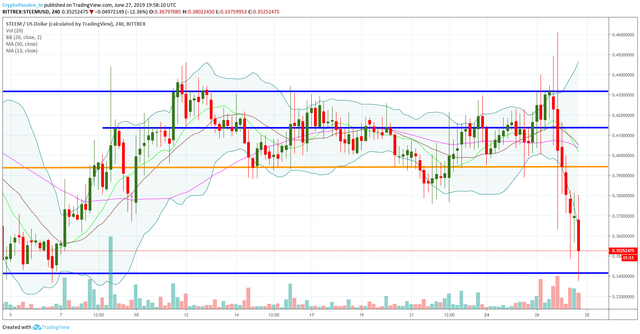
Yesterday I was saying that sentence : ” What else to say… imagine now that the BTC will correct, I’m quiet sure that we will break very easly all our support lines. “
Unfortunatly I was more that correct as we are breaking support lines after support lines on the STEEM. It is almost the case on every altcoins but again STEEM is one of the best in correction matter as we didn’t do any up or almost any up during the BTC run but now we are even correcting more than the average of altcoins. What to say… let’s wait better time and hope support line at 0.34$ will hold.
With every rip there is a dip. That is why we sell rips and buys dips. Bitcoin is dipping today and dipping hard.
Price extension and moving averages as a guide
I often talk about the 10 day moving average because it is my favorite short-term moving average and I have found it a good guide for when price gets too extended on a coin.
When that happens it becomes my target for the pullback (or bounce). Sure enough the price of BTC behaved accordingly and just spike down to it before finding some legs at the time of these writing.
Now, I expect
Public blockchain tokens will soon be trading on a major securities exchange.
Revealed exclusively to CoinDesk, Swiss security token firm BlockState plans to “passport” half a dozen ERC-20 tokens from ethereum, the second-largest public blockchain, to Corda, the private distributed ledger technology (DLT) platform developed by R3.
Before the end of the year, the tokens will be locked up in a smart contract on ethereum and “mirrored” versions of them will run on Corda. This is akin to global depository receipts, where shares of a company are held in custody in one country and a certificate representing ownership of them is traded in another.
Bitcoin mining difficulty – the measure of how hard it is to earn mining rewards in the world’s largest cryptocurrency by market cap – has reached a new record high above 7.93 trillion. That’s a seven percent jump from the 7.45 trillion record set during the recent two-week adjustment cycle, which was the highest since October 2018.
Bitcoin is designed to adjust its mining difficulty every 2,016 blocks (approximately 14 days), based on the amount of computing power deployed to the network. This is done to ensure the block production interval at the next period will remain constant at around every 10 minutes. When there are fewer machines racing to solve math problems to earn the next payout of newly created bitcoin, difficulty falls; when there are more computers in the game, it rises.
Facebook’s Libra white paper includes a brief but potentially seismic nod to digital identity standards.
With 2 billion users worldwide, Facebook may be able to succeed where others have failed in jump-starting a globally accepted digital ID.
Some identity experts say this is even more important than the cryptocurrency, but others question how much control Libra would give users and find its approach overbearing.
Coinbase first reported that it was investigating an issue in which its API and website were not functioning properly at 1:47 p.m. PDT on its status website.
Singapore-based crypto exchange Bitrue has suffered a major hack, losing 9.3 million XRP and 2.5 million cardano (ADA) from its hot wallet. The news was revealed in an official statement from the exchange published as a twitter thread on June 26.
At the time of the breach — 1 a.m. GMT+8 June 27 — the stolen funds would have been worth over $4.5 million in XRP (valued at $0.488) and $237,500 in ADA (valued at $0.095), according to CoinMarketCap data.
The exchange states that a purportedly single hacker first “exploited a vulnerability in our Risk Control team’s 2nd review process to access the personal funds of about 90 Bitrue users,” subsequently using this first experience to access the exchange’s hot wallet and steal the cryptocurrency.
We would like to share with you the latest development and future plans of Bibox and hear from you your feedback and suggestions.
STEEM Trading Update by my friend @cryptopassion
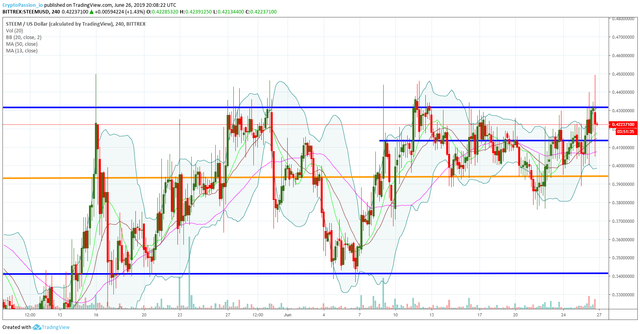
Here is the chart of yesterday :
Here is the current chart :
This resistance line at 0.43$ is still there… unbreakable… we are testing it and testing it but we don’t have the volume to break it more than some minutes. What else to say… imagine now that the BTC will correct, I’m quiet sure that we will break very easly all our support line. So yeah let’s wait and see what the steem want for us but again we are not on a ideal pattern.