In this episode our guest Nicholas Rodriguez, President of the Liberland Aid Foundation, discusses:
1) How his journey with Liberland began in Acapulco, Mexico 2) What it is like being former military in a Libertarian-oriented world 3) The power of face-to-face interactions, especially in regards to building Liberland’s future
It’s been easy to hate banks as investments — not only were some of the biggest players bailed out by taxpayers in 2008, but bank stocks and the financial sector more generally have underperformed the broader market for years.
But over the past three months, the financial sector has turned from laggard to leader, rising 5.9%, versus a 3.5% advance for the S&P 500 index SPX, +0.77% , making it the best-performing S&P sector since the start of April, according to FactSet. From the beginning of 2018 through March of this year, the S&P 500 had risen 6%, versus a 7.9% decline for the financial sector.
Within the broader financial sector, Opppenheimer analyst Chris Kotowski is particularly bullish on large banks, writing in a note to clients that “the breadth, stability and quality of [large banks’] earnings has never been better,” even if the market has shown much greater love to other sectors during the current bull market.
I’m not a fan of the banks. I should say, I’m no longer a fan of banks. Earlier in 2018 I went long, the ETF, XLF.
The Financial Select Sector SPDR® Fund, XLF seeks to provide precise exposure to companies in the diversified financial services; insurance; banks; capital markets; mortgage real estate investment trusts (“REITs”); consumer finance; and thrifts and mortgage finance industries.
But I got out when I saw the banks were not taking advantage of rising interest rates. Banks make loans to borrowers at a higher rate than non-performing assets such as savings accounts and CDs and profit from the difference. However, in an environment in which the yield curve is flattening, Banks’ margins are adversely affected.
NOTE: When interest rates rise or fall, it’s the short term interest rates that are moving the most. When a Bank issues loans, they are issuing longer term interests rate loans. As short term interest rates rise, Bank margins come under pressure, which affects their profitability.
So even if price breaches the the weekly supply at $28.
XLF has been range bound since mid-2017, so it’s dead money…take your money and invests elsewhere.
This post is my personal opinion. I’m not a financial advisor, this isn’t financial advise. Do your own research before making investment decisions.
A quick post to end off the week – let’s take a look at what the major Stores of Value are up to.
Gold and Bitcoin are my two favourite Stores of Value. Many people seem to believe that you should hold either one or the other – I believe that diversification is safer and better. It’s always nice to gain value, but a Store of Value should HOLD value as a primary characteristic, and gain value as a secondary one.
I know that property is also seen as a good store of value, but property rights are not universal, in some places property can be a risky investment. Ask Zimbabwean farmers how secure property is as a Store of Value.
Bitcoin
After a quick rise at the end of last month, Bitcoin has spent the week counter-correcting, over-compensating and generally just consolidating. There are evidently many new investors in the market and their weak hands are predictably scared by “sudden” rises. It is amusing to watch how shocked mainstream reporters seem by the “extreme volatility” of Bitcoin – or as more experienced crypto investors would call it: “the norm”.
At around $11400 at the time of writing, I consider Bitcoin to still be suffering the effects of a little FUD after it’s recent rise and subsequent fall. I believe it is trading at a lower price than it should be, and I expect it to recover about $1100 – $1200 over the next few days as it makes its way back to the median mid-term trendline. That trendline runs along the 0.382 diagonal Fib and is indicated by the dashed line on the chart below:
Made by Bit Brain with TradingView
Gold
After an up and down week, Gold looks to be ending on a bit of a low note and may well close below $1400. This is no cause for alarm. Gold has managed to hold the majority of its mid-June gains and is looking rather bullish. Looking at the chart we can see that it appears to be forming a bull flag after its climb. A bull flag is a continuation pattern and indicates that gold is likely to continue its climb. The dashed orange lines are the bull flag and the solid yellow lines are the limits of the converging triangle that Gold has now conclusively broken out from.
Made by Bit Brain with TradingView
The very thin dashed line is an interesting one and something which I only added to my chart yesterday: it’s a line running parallel to Gold’s previous climb. If Gold can once again climb like it did from 2000 to 2013, then that little dashed line is the path that it will follow: standby for possible $2000/oz Gold in November 2021. See the zoomed out chart below:
Made by Bit Brain with TradingView
For those who may be curious: that means $5000/oz Gold in June 2027…
Conclusion
After a week of ups and downs, I’m looking forward to seeing Bitcoin climb again soon. The media is speaking about Bitcoin much more than ever before. The mass media gets almosteverything wrong, but the exposure is still good. For the foreseeable future the altcoins will probably continue to suffer. Eventually the new money will find the likes of Ethereum, Litecoin etc, and then finally trickle down into increasingly smaller projects. For now it’s probably best not to turn your BTC into altcoins (which are NOT as good at storing value!).
Should BTC fail to climb for some reason, then it shouldn’t drop lower than the long-term trendline, now sitting at just over $10000 (which is also a psychological support level). That trendline is depicted by the thin dotted line on the BTC chart.
Ignore the media reports that try to state reasons for the recent increase in the prices of BTC and Gold. Once again, they miss the big picture and focus on stupid short-term issues like the Trade War or Zuckerberg’s pseudo-crypto. The big picture – as you know – is that fiat economies and the politically correct, liberal, yet despotic governments that support them are slowly losing public support as people wise up to their trickery and failures. If there’s one thing I would NOT store value in now then it is fiat based assets!
Yours in crypto
Bit Brain
“The secret to success: find out where people are going and get there first”
~ Mark Twain
“Crypto does not require institutional investment to succeed; institutions require crypto investments to remain successful”
With the S&P 500 up more than 19% already this year, investors are scrambling to find the next big winners. According to Wall Street analysts, these stocks could have the most room to run.
CNBC used FactSet to screen the stocks with the highest average 12-month price targets by analysts. To find the names with the highest conviction from Wall Street, CNBC winnowed down the pool by selecting the stocks whose forecast has only gone up in the past three months. Stocks that have fallen in the past three months were also excluded.
To be sure, consensus analyst opinion doesn’t always work and some investors even use it as a contrarian indicator. However, the list gives you an idea of the stocks analysts are most bullish about in meetings with clients.
The company that sparked my interests on the list was Royal Caribbean Cruises because it’s on my long term bear list.
This consumer confidence indicator provides an indication of future developments of households’ consumption and saving, based upon answers regarding their expected financial situation, their sentiment about the general economic situation, unemployment and capability of savings.
If consumer confidence is turning for the worst, discretionary spending will decline. If discretionary spending declines, so will Royal Caribbean Cruises’ revenue. If Royal Caribbean Cruises’ revenue decline, so will its stock price.
The chart suggests if price can close below $112, price will go to $83 over time.
This post is my personal opinion. I’m not a financial advisor, this isn’t financial advise. Do your own research before making investment decisions.
CME’s bitcoin futures product is continuing to show signs of increased popularity, with June setting a new record for open interest amid a surge of new account sign-ups.
More than 2,960 accounts have traded CME Group’s bitcoin (BTC) futures across all client types and time zones since launch, according to new data from the derivatives marketplace. In 2019 alone, there has been more than 950 new accounts created, marking a 30 percent increase in total client sign-ups, CoinDesk has learned.
In addition, the number of large open interest holders, entities that hold contracts worth at least 25 BTC (worth $280,000 at press time) grew to 49, up from an average of 46 during the last week of June, a new record.
At first glance, Facebook’s Libra cryptocurrency doesn’t make sense.
On its face, it is a non-speculative token which uses enough decentralization to make it difficult if not impossible for Facebook to profit off it as the company does from its social media platform.
But in crypto, there is always an upside to the people who launch a new protocol, in the event the protocol succeeds and even in many cases for simply having started development of the project.
This article deals specifically and exclusively with that upside, admittedly handwaving aside many other potential issues with the protocol, to be addressed elsewhere.
Venezuela’s President Nicolas Maduro ordered the country’s leading bank, Banco de Venezuela, to accept the nation’s cryptocurrency, the Petro (PTR) at all of its branches, the country’s Finance Ministry tweeted on July 4.
According to the tweet, Maduro gave “the express order to open Petro desks in all the branches of the Bank of Venezuela.” The announcement apparently came during an event celebrating the tenth anniversary of the nationalization of the bank in question.
On June 19, Maduro announced that 924 million bolivars (over $92.5 million) were allocated to the Digital Bank of Youth and Students to open one million Petro wallet accounts for the country’s youth. José Angel Alvarez, president of the country’s National Cryptocurrency Association, commented to cryptocurrency news outlet CCN:
“It is a bold and correct decision to move forward towards a hybrid economy where the fiduciary currency of a country competes face to face with cryptocurrency.”
The price of the popular dogecoin cryptocurrency is surging after the announcement that it will soon be listed on the Binance exchange.
Binance said in a support notice that trading will open for dogecoin (DOGE) at midday (UTC) Friday.
The exchange will at launch offer trading pairs for DOGE against Binance coin (BNB) and bitcoin (BTC), as well as the stablecoins tether (USDT), Paxos standard (PAX) and USD Coin (USDC).
Users can already deposit DOGE in preparation for trading, the exchange said.
Schiff, who is well known for warning investors not to trust bitcoin as replacement for gold, triggered the goodwill gestures after becoming the topic of a Twitter debate with Morgan Creek Digital co-founder, Anthony Pompliano. Pompliano (also known as Pomp), highlighted the fact that Schiff in fact does own some BTC despite his negative comments.
”This raises serious privacy, trading, national security, and monetary policy concerns for not only Facebook’s over 2 billion users, but also for investors, consumers, and the broader global economy.”
“Join us this Friday afternoon (EST) as special guest Dave Winterstein (co-founder and CEO) takes over the Aion AMA. ”
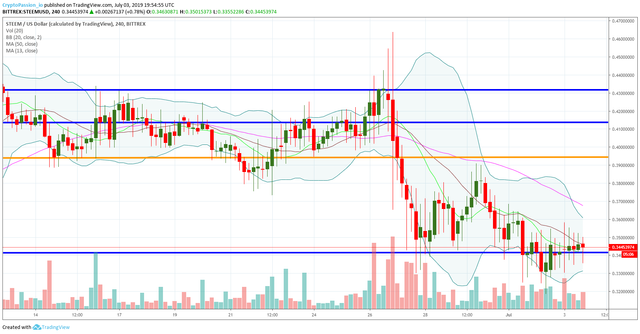
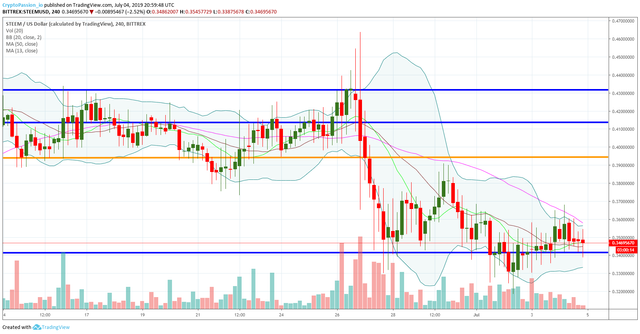
STEEM Trading Update by my friend @cryptopassion
Here is the chart of yesterday :
Here is the current chart :
The market is again trying to break the support line at 0.34$. As we can see, till now that line is doing well its job but I’m not sure it will stay alive long time if we continue to test it like that hours after hours. However, long tests like that can also show that we are reaching a low and that the market doesn’t want go lower. So everything is not always negative but for sure I would like to see the STEEM going UP and take some distance from that support line.
In Elliott Wave terms, YCC began a wave one advance on May 28. The red wave one finished on June 7, and the red wave two correction ended on June 16. The red wave three (blue sub-waves i-ii-iii-iv-v) advance finished on June 26, and the red wave four (blue sub-waves a-b-c) correction ended on July 4. If this wave count is correct, YCC should be heading next towards the June 26 peak in the red wave five.
Just yesterday evening, while resting (and playing @drugwars ) at my hotel room, I was having an exceptional, as usual, Crypto phone chat with my bro @beiker …
We spent more than an hour talking about the life in general but also mainly on crypto and blockchain tecnology… I don’t know how it came but I named DOGECOIN as one of those cryptos that used to have always incomprehensible PUMPS not justified afterwards by any new apparently…
Well, exactly 50 minutes ago, BINANCE announced the LISTING of DOGECOIN in the Exchange:
Suspiciously around 20′ before the TWITTER announcement, we have a LOOOOOONG GREEN candle of 50% higher price…
This long first candle is right now moving all DOGE price at a higher estratospheric level because uninformed people are just buying following the stupid new…
What is going to happen next?
Obviously, the same who put the massive order at the begining of the PUMP will sell taking all the money of enthusiastic people…
I don’t have anything against DOGECOIN, for me it is not a SHITCOIN as others think it is, DOGECOIN shares the 99% of CODE with BITCOIN…
… but it is a pitty that still Centralized Exchanges keep using these kind of tricks to increase massively their benefits in a very shady way…
aaaaah how I would like to see a real DEX massively adopted by Crypto investors…
@toofasteddie
—
Disclaimer: This is just my personal point of view, please, do your own assessment and act consequently. Neither this post nor myself is responsible of any of your profit/losses obtained as a result of this information.
Liberland delegation headed by Mr President will visit in the following days: 4 Budapest 5-7 Liberland 8 Belgrade 9-13 Montenegro 14-15 Albania 15-19 New York
Please click the link to listen to the 44th episode of my weekly crypto podcast ‘Two Minute Crypto.’ These are intended to be short, single-topic ramblings on some aspect of the cryptosphere. Comments and critiques welcome.
Two Minute Crypto – Wild Thoughts 5 – Bitcoin as Time
The root problem with conventional currency is all the trust that’s required to make it work. The central bank must be trusted not to debase the currency, but the history of fiat currencies is full of breaches of that trust.
Satoshi Nakamoto
Welcome to Two Minute Crypto this week I’d like to indulge in a little offbeat reflection on Bitcoin and discuss the concept of BTC as time or return on time invested.
The theory is quite simple -BTC is a scarce asset that
with every passing block moves closer to increased scarcity. Ever four years
the supply of newly minted BTC is halved with the next halvening less than a year
away. The current annual inflation is around 4% – so in under a year Bitcoin will
have already matched the 2% rate generally targeted by central banks. Four
years further down the road will see Bitcoin inflation drop to 1%. Such deflationary
supply lies at the heart of BTC design.
Contrast this with a typical currency which has no fixed supply and which year by year increasingly saturates the market ‘devaluing the current fiat in circulation. As we are all aware the longer you hold cash the less it is worth as its purchasing power declines as supply continues to expand. The last 10 years of ‘quantitative easing’ have substantially exacerbated this process -flooding markets with access to cheap credit.
Now to time – as you save cash – each and every year the buying power of that money diminishes and of course that loss of buying power compounds. A decline of 2% doesn’t seem like much but year by year and over a number of decades, it certainly does. It’s true that salaries do often track inflation, so wages generally rise. However, the value of each dollar saved nonetheless diminishes with each passing year. Actual real inflation rates are debatably much higher than 2%, and in some nations, double-digit inflation is the norm.
In order to earn that money, you invested ‘time’ – you
worked a job and saved a portion of your wages.
Bitcoin, however, establishes a different time to value ratio. Bitcoin earned now – all other factors remaining the same – will be worth more in the future. A Satoshi saved now will buy more in the future not less and the longer you hold the more it will purchase relative to other assets. Fiat and BTC exhibit directly contrasting time return propositions -cash debases at a steady rate – demanding a continued investment of time to acquire ever more fiat to attempt to retain purchasing power or saving’s targets. Bitcoin through ever-increasing scarcity offers a compounding appreciating return on investment – the earlier you set it aside the more it will be worth in terms of purchasing power the less you need to work to attain more of it in the future.
This scarcity and increasing return relative to time held is a core principle of Bitcoin and not is subject to the whim of any government or corporation.
Of course, underlying this thesis is the assumption that
Bitcoin does become a successful store of value with a degree of broad market
penetration. This is by no means inevitable but nor is it a ‘longshot’. Should
BTC achieve an ongoing place in global finance year by year its purchasing power
relative to inflationary currencies and assets will inexorably increase.
Bitcoin is designed to appreciate through time – whereas
fiat through a system of targeted inflation debases creating an inverse reward
relationship between BTC and fiat which compounds through time.
For those of you who live in the United States, Happy Independence Day! Since we talked last, bitcoin broken above the $11,500 resistance. This closes the upper CME gap at just above $12,000. Price has since dropped back on top of the $11,500 support where it’s consolidating.
Zooming out on the weekly chart, we can see the bulls have put up quite a fight after the extremely bearish close of last week’s candle.
In today’s video we’ll discuss where price may be heading next, key areas to watch, targets and so much more. I’ll also answer your questions. I hope you find it helpful.
I hope this has been helpful. I’d be happy to answer any questions in the comment section below. Until next time, wishing you safe and profitable trading.
Workin
If you found this post informative, please:
Get paid for viewing ads and Support the Crypto Ecosystem with Brave Browser. Free download here: https://brave.com/wor485