iRobot Corporation designs, builds, and sells robots for the consumer market worldwide. It offers Roomba floor vacuuming robots; Braava family of automatic floor mopping robots; and Mirra Pool Cleaning Robot to clean residential pools and removes debris as small as two microns from pool floors, walls, and stairs.
iRobot Corp. announced their second quarter earnings after the market close yesterday. In after hour trading, the stock fell double-digits after the company missed Wall Street’s estimates for sales for the second quarter and lowered its financial expectations for the full year, citing the impact of tariffs in President Donald Trump’s ongoing U.S.-China trade war.
“The direct and indirect impacts of the ongoing U.S.-China trade war and the recently implemented 25% tariffs are likely to constrain U.S. market segment growth in the second half of the year below our expectations at the start of 2019,” Angle said.
“Even as we operate in a higher tariff environment in the U.S., 2019 is shaping up to be another successful year of double-digit revenue growth and impressive global segment leadership,” Angle said.
After basing near the weekly demand at $86, price not only breached the weekly demand at $86, but also breached a critical major support/resistance line at $75. Thus, the chart suggests price is heading down to the weekly demand at $54.
This post is my personal opinion. I’m not a financial advisor, this isn’t financial advise. Do your own research before making investment decisions.
According
to two chief executive of technology companies, Age-tech, i.e. applications of technology designed to address
issues faced by elderly people, are often left unexploited as they do not
appeal to “kids doing start-ups”.
Age
tech start-up Birdie has designed a
system for care workers to digitise and
keep track of notes on elderly people living in care facilities. The
company has thus far raised €9.5m,
with more than 100 UK providers already using the tech.
Birdie
is also trialling a combination of static
motion and sonar sensors designed to pick up irregularities in behaviour
through machine learning that could indicate health issues.
Another
tech company (which remains unnamed) is targeting the steadily growing Alzheimer’s therapeutics market through specially
designed devices/toys that stimulate cognitive function.
Analysis and Comments
The author makes an important point towards the end of the article by highlighting that the typical customer for technology such as the above is likely to be an older person who is caring for an elderly relative.
As such, players in this space that aren’t exclusively targeting care facilities are in the tricky position of having to design solutions for the use of people who themselves might be similarly uncomprehending of thetech as their elderly charges (the article includes an example of a healthcare start-up which failed for that reason).
Last year was an interesting year for Age-tech, as it saw PointClickCare, a leading Canadian SaaS platform targeted at the long-term and post-acute care market, valued at a minimum of USD1bn following its latest funding round.
See here for a 2019 Age-tech market map including both listed and private players.
Marubeni Corp., a major Japanese sōgō shōsha, or general trading company, is now backing a blockchain-based power trading platform.
Per a report by Reuters on July 23, Marubeni has issued a loan to Lithuania-based blockchain project WePower. Per Reuters, the size of Marubeni’s stake in WePower after converting the loan is yet to be determined.
WePower has reportedly developed a platform which allows small- and medium-sized enterprises to more easily buy power specifically from wind- and solar-based sources via standardized digital power purchase agreements.
The platform aims to unlock tens of billions of dollars in power generation to smaller projects in the Australian electricity market which, according to Reuters, is running out of major power consumers that will buy large quantities over long periods of time.
The New York Times Company has revealed new details relating to its ongoing blockchain publishing experiments first revealed by CoinDesk in March.
Published Tuesday, a new website for the publisher’s News Provenance Project explains how the storied newspaper’s Research and Development team plans to use Hyperledger Fabric’s permissioned blockchain to authenticate news photographs in partnership with IBM Garage, the tech giant’s accelerator program.
The project aims to combat misinformation and adulterated media, which it argues harms small and large publishers alike. “News consumers [who] are deceived and confused…eventually become fatigued and apathetic to news,” the website says.
The Senate Banking Committee will hold a hearing on regulatory frameworks for cryptocurrencies and blockchain next week.
The committee said in a press release that it would hold an open session titled “Examining Regulatory Frameworks for Digital Currencies and Blockchain” on July 30, though it is unclear if this would be a fact-finding mission or if any specific pieces of legislation would be discussed.
Circle CEO Jeremy Allaire, representing the Blockchain Association; Rebecca Nelson, a member of the Congressional Research Service specializing in international trade and finance; and Mehrsa Baradaran, a law professor at the University of California Irvine School of Law will testify as expert witnesses.
Blockchain technology offers an opportunity for smaller banks in the Philippines to boost lending and offer other financial services in rural areas, according to Union Bank of the Philippines Chairman Justo Ortiz.
Union Bank is experimenting with the use of blockchain for remittances, allowing overseas Filipino workers to send money home quickly and efficiently and exercise greater control over who receives the funds and how they’re used, Ortiz said in an interview with Bloomberg Television on Tuesday.
By plugging the 500 or so Philippine rural banks into the system, the lenders would get detailed information on the income individuals or families receive from remittances, he said. That would give them greater comfort to offer loans and other banking services to people who often fall outside the formal financial system, he added.
If, as the saying goes, any publicity is good publicity, then Tuesday was a great day for Tron CEO Justin Sun.
The 28-year-old entrepreneur has been the talk of the crypto community for the last 24 hours, starting with Monday night’s announcement that a bout of kidney stones led him to postpone a long-awaited lunch with finance titan Warren Buffett.
Then came reports suggesting that the rescheduling was due to legal rather than medical problems. For a few hours, seemingly everyone on crypto Twitter believed Sun was in China, barred from leaving by the government amid accusations of lawbreaking.
“If you’re keen to learn programming on the #Waves blockchain, join us for the ‘Full-Cycle dApp Development’ workshop…”
STEEM Trading Update by my friend @cryptopassion
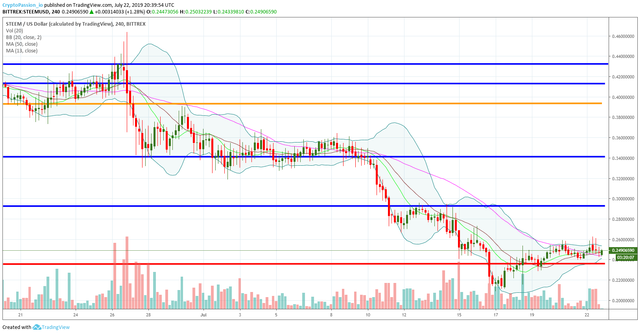
Here is the chart of yersterday :
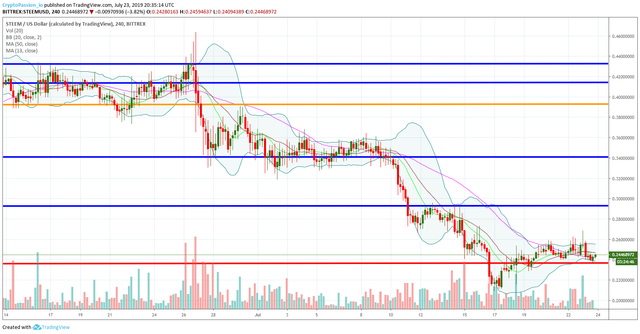
Here is the current chart :
The support line at 0.24$ has been tested but not broken. Like the BTC, we are having a little bounce on that support line but nothing really powerfull. A little correction on the BTC will make us break that support line quiet easly so yeah we are becoming very passive on the STEEM, just waiting for the BTC direction and doing corrections more powerfully than the BTC when it is the case.
Nestlé is about to launch a new 70% dark chocolate
bar, the “Cacao Fruit Chocolate”,which does not include any added
sugar.
It
will be made from the cacao fruit only, with the white cacao pulp acting as a
natural, more sustainable and healthy sweetener. The new product will be
launched in Japan this autumn and is expected to be introduced globally by
2020.
Another
100% cacao fruit juice with lime granita will be commercialised end of this
week at the KitKat Chocolatory Ginza Store. The two products will be sold at
$3.7 and $6.93, respectively.
Thecompany
is looking to patent the pulp mixture process, which helps to reduce food waste, as it uses 31% of
the pod vs. the current 22%.
Analysis and Comments
You should expect a continued increase in product reformulations and product innovations along the lines of Nestlé’s most recent launch.
This is largely driven by a combination of pressure coming from both the public as well as a growing number of governments and regulators, the latter of which are increasingly aware of the strain that obesity & diabetes is putting on global healthcare systems.
Already, diabetes care forms10-15% of healthcare budgets, and Healthcare analysts expect a near doubling of the number of diabetes patients by 2025, which risks bankrupting publically funded healthcare programmes in Europe and making health insurance increasingly unaffordable.
Nestlé
has developed a high-speed flow
packaging technology that allows paper to be used on a larger scale instead
of plastic films and laminates. As a result, Nestlé will sell its Yes snack
bars in a recyclable paper wrapper.
The
packaging, made of water-based coating and sustainable sources, is available in
13 countries and will be introduced in Europe and other locations going
forward.
Nestlé
has been committed to make all its
product packaging recyclable or reusable by 2025, and other manufacturers
(e.g. PepsiCo, Nestlé, Mars) have launched recyclable packaging programs as
well.
According
to Reuters, the company may also use paper packaging for its Kit Kat bars and
other products, once it is able to
supply sufficient amounts of the specially coated paper.
Analysis and Comments
As the article states, consumers’ demand for sustainable and environmental standards in the food industry has been increasing steadily, with a Nielsen survey from 2018 stating that 48% of U.S. consumers were likely to change their purchases to meet environmental standards.
Justin Sun’s hotly-anticipated lunch with billionaire investor Warren Buffett has been postponed, the Tron Foundation announced Monday.
Sun has fallen ill with kidney stones, the foundation said on Twitter. The parties have “agreed to reschedule at a later date.” The lunch, scheduled for July 25, was the prize for winning a charity auction. Sun bid $4.6 million earlier this year and seemingly intended to introduce the notoriously crypto-skeptical Buffett to a number of influential figures in the space.
Fundament, a blockchain startup coming out of stealth mode, has received the green light to issue the first tokenized real-estate backed bond that can be widely offered to individual investors.
Announced Tuesday, the Berlin-based firm has obtained approval from Germany’s financial regulator, BaFIN, for the 250 million euro ($280 million) offering. By virtue of being regulated, the token will be open to any retail investor anywhere with no minimum investment restriction.
In other words, someone in, say, Indonesia will be able to buy 100 euros worth of ethereum tokens and thereby indirectly invest in German commercial property.
A BaFin representative told Coindesk: “We can confirm that we granted approval for a Fundament Group prospectus. It has indeed been the first time we have approved a prospectus regarding blockchain-based real estate bonds, but not the first time in respect to blockchain technology as such.”
Bitcoin futures platform Bakkt is scheduled to begin testing its new contracts Monday.
Nearly a year since revealing its ambitious vision, Intercontinental Exchange (ICE) is still waiting on regulatory approvals to take the platform live. Still, despite having to delay its new market multiple times, the parent of the New York Stock Exchange is moving forward with plans to offer potentially the first physically-settled bitcoin futures in the U.S.
It will apparently be testing two different types of contracts Monday: a daily and a monthly contract. Bakkt aims to list the futures, which would be traded through ICE Futures U.S. and cleared through ICE Clear U.S., the parent company’s clearinghouse.
As most Drugwars players are aware, there has been a few updates to the game, I will try to guide you through them in this post, if you have any question, feel free to comment and I will do my best to answer your questions.
Map and Base system
With this new update, we understood that we will be playing from now on on a DW “World Map”.
Once you decided to settle in a territory, you could access this view where you can see other people’s bases. Gang name has been added when you click on a specific base
More information Following this link to my post: https://steemit.com/drugwars/@vlemon/drugwarslastupdatesguide-j6mkcqgp5z
Lawyers for Bitfinex and Tether, in the course of an ongoing case against the New York Attorney General (NYAG), submitted multiple fillings on July 22 alleging that the companies never served customers within New York.
In one filing, attorney Stuart Hoegner noted the provision in Bitfinex’s terms of service that require that customers that transact be foreign entities:
“Under Bitfinex’s and Tether’s Terms of Service, Eligible Contract Participants (“ECPs”) that transact with Bitfinex or Tether must be foreign entities. Although those foreign entities may have shareholders or personnel who reside in, or otherwise have contact with, the United States or New York, Bitfinex’s and Tether’s customers are the foreign entities themselves … Bitfinex and Tether do not transact with any New York ECPs.”
“Join us on July 23rd at 2PM UTC for an AMA with LTO network , CEO Rick Schmitz and Tech lead Arnold Daniels in the Trust Wallet Telegram.”
STEEM Trading Update by my friend @cryptopassion
Here is the current chart :
The STEEM is in waiting mode since days, just sitting little upper than the support line at 0.24$. We are waiting a decision about the next BTC direction and that support line in red won’t hold us for sure if we have a correction on the BTC. So yeah I’m afraid that we are not yet on the low on the STEEM… let’s see, we should see the next move on the BTC in the coming hours.
The
number of charging points in China has risen to 1m (up 69% YoY).
At
the end of 2018 there were 760k charging points in China, up from 440k at end
of 2017.
Analysis and Comments
Charging infrastructure is a lot more important than battery cost and subsidies in sustaining EV growth. The Chinese authorities are shifting their priorities from subsidizing EVs to financing the roll out of charging infrastructure.
The availability of high power/speed charging infrastructure will make short range EVs (~150miles) viable as your first car rather than your second one.
This is necessary, as battery costs are likely to bottom out at above $100/kWh which would make mass market EVs with long range commercially unaviable in the absence of subsidies.
Indian cities are planning to buythousands of electric buses over the next few years.
In India, the government is spending $1.3bn on its electric bus programme and the funds will be used to subsidise60% of the cost of the bus.
Analysis and Comments
Chinese bus OEMs such as BYD are the best placed to benefit from this opportunity, because they have a clear cost advantage versus bus OEMs in Europe and the US.
For the cobalt market (and hence Umicore), the bus market will also be important due to the shift in battery technology in buses from LFP to NMC which will boost cobalt demand.
Bank of America has filed for a patent for a settlement system citing the Ripple ledger, according to a filing on Google Patents.
The patent in question — the application of which was published on June 6 — describes a system using distributed ledger technology (DLT) as an interbank communication tool. The proposed system would enable real-time settlement with transactions being communicated through a shared, decentralized ledger to which both the banks would have access.
The decentralized network would both verify the identity of the payer and the payee and enable communication between the institutions. Notably, multiple illustrations included in the patent explicitly cite Ripple DLT. Ripple’s base asset and proposed settlement gateway asset XRP is not mentioned in the patent.
Among the barrage of commentary accompanying the Libra circus on Capitol Hill last week was a single short tweet from lawyer Marco Santori that summed up the core problem confronting Facebook’s cryptocurrency project – and, for that matter, any corporate-led effort of its kind.
Satoshi was following a Cypherpunk dream. He/she or they wanted to bring privacy to digital payments, to translate the offline experience of cash transactions into the online realm. The idea: that a user needn’t prove their identity to execute a transaction with anyone else on the Internet – just as there’s no need for me to show a document proving that I’m Michael Casey every time I hand over some dollar notes to someone.
Justin Sun, the founder of Tron and winner of the annual auction for a lunch with renowned investor Warren Buffett, has invited more notable figures from the crypto industry to attend.
Earlier today, July 21, Sun invited the founder and CEO of trading platform eToro, Yoni Assia, to the lunch with the chairman and CEO of Berkshire Hathaway via tweet. Assia quickly responded saying, “Justin, it is my honor to join you for lunch with @WarrenBuffett. A big step for bridging between the traditional finance world and the new one!”
Yesterday, Sun invited the head of the Binance Charity Fund, Helen Hai. Hai reportedly responded within minutes and said the luncheon would be an opportune chance to discuss cryptocurrency and philanthropy. Binance Charity is the philanthropic arm of cryptocurrency exchange Binance.
As most Drugwars players are aware, there has been a few updates to the game, I will try to guide you through them in this post, if you have any question, feel free to comment and I will do my best to answer your questions.
Map and Base system
With this new update, we understood that we will be playing from now on on a DW “World Map”.
Once you decided to settle in a territory, you could access this view where you can see other people’s bases. Gang name has been added when you click on a specific base
More information Following this link to my post: https://steemit.com/drugwars/@vlemon/drugwarslastupdatesguide-j6mkcqgp5z
Few trading tools are as simple and as elegant as the “Awesome Oscillator.”
First developed by American trader Bill Williams, the aptly named Awesome Oscillator (AO) is a momentum indicator that takes advantage of an immediate trend. The AO plots its data using a histogram, similar to how the MACD histogram functions, in that it delivers a buy and sell signal when the bars pass above or below the neutral 0 line.
But that is just one of its main features, the others involve taking stock of an asset’s momentum as well as any immediate change noticed via patterns on the histogram (more on that later).
Taiwan Semiconductor Manufacturing Company (TSM) is the world’s largest foundry, meaning they manufacture semiconductors. This past Thursday they beat analyst estimates for sales for the quarter, but more importantly signaled a rebound from the current chip down cycle.
Memory chipmaker Micron Technology (MU) reported better-than-expected earning, increased its DRAM (dynamic random access memory) industry demand growth outlook for 2019 and say it expects demand to recover in the second half.
I’m no genius, but clearly these are clues that the semiconductor sector might be bottoming. And what’s funny about making money investing in stocks, you don’t have to be a genius, just need to be able to connect the dots. And if you can’t connect the dots, just follow what the Smart Money does because they have information at their disposable that you and I can only dream about.
On Friday, I noticed unusual options activity in Micron Technology. What’s interesting is these options are short dated, meaning they are going to expire soon. What’s more interesting is these options only become profitable if and when Micron’s stock increase $10 or 22% over the next four weeks, meaning the Smart Money bought a little over 14,000 of the August 30th call options with a strike price at $55.
If the Smart Money is right, these call options have the potential to increase 5X. Will the Smart Money be right, stay tuned.
NOTE: funny how the strike price lines up with the monthly supply at $55.
This post is my personal opinion. I’m not a financial advisor, this isn’t financial advise. Do your own research before making investment decisions.
As most Drugwars players are aware, there has been a few updates to the game, I will try to guide you through them in this post, if you have any question, feel free to comment and I will do my best to answer your questions.
I think everybody figured out a way to settle their Primary base in order to continue playing.
The easiest way was to click under your avatar to find a spot to settle.
Map and Base system
With this new update, we understood that we will be playing from now on on a DW “World Map”.
Once you decided to settle in a territory, you could access this view where you can see other people’s bases. Gang name has been added when you click on a specific base
You can only develop 5 new bases with this new “Occupation Troop”. In the future, you might be able to have some more (around 5) but you will need to pay to have them
As the game is today, nobody can steal your base
New Occupation Troop
This is the troop you will need to train in order to settle and create a new base
New troop “moves”
Occupy: To colonise a new base. You will start from scratch with this new one
Transport: To transport ressources from one base to another, useful to give a boost to your new settlements
Station: As it is called, it is to station your troops at another base. Your troops WILL participate at any fight against this base. Useful information: When a fight happens, the owner of the base will have priority over troop losses
Storage Capacity
The storage system changed. Until July, 25th it will stay the same except if you increased your storage capacities
The new system is going to be 15% of the total capacity compared to 25% before, nevertheless the total capacity of your storage building has been multiplied by 3-4x meaning that the new Safe is 2.5*3x higher than previously
Buildings
HQ is specific to the base as the Training Facility and all production storage buildings
The level of trainings you researched are common for all your troops even the one hired in a different base than the Primary
Pantheon level is also common to the account and not to a specific base
Generally, a Federal Reserve rate cut is very well-received by the stock market, especially if it’s done during a growing economy.
In fact, there have been six such rate cuts since 1971, and the stock market has rallied after every single one. On average, the stock market has risen 9.7% in the three-month period following a non-recession rate cut. If a similar outcome were to happen now, it would indeed send stocks to new highs.
In December, Powell said the Fed’s program to reduce the bond holdings on its balance sheet was on “autopilot.” Powell later went on and raised short-term rates another one-quarter percent. The Markets didn’t like what Powell said and showed him by tanking.
In early January, during a round table with Janet Yellen and Ben Bernanke, Powell said, there is no preset path for raising rates or adjusting the balance sheet. The Markets like what he had to say, eventually climbing 10%.
Then in late January, Powell said the case for raising rates has weakened somewhat. In addition, Powell made it very clear to the Markets and used the word “patient” eight times in his speech regarding hiking interest rates.
The FOMC meets on July 30 and 3 where they will announce, no rate cuts, 25 basis point rate cut or 50 basis point rate cut. If Powell cut rates by 50 basis point, we will see new all time highs within weeks. Anything other then that and we may see a sell off.
This post is my personal opinion. I’m not a financial advisor, this isn’t financial advise. Do your own research before making investment decisions.