In Elliott Wave terms, FOAM began a wave one advance on June 26. The red wave one (blue sub-waves i-ii-iii-iv-v) finished on July 7, and the red wave two (blue sub-waves a-b-c) correction ended on July 20. If this wave count is correct, FOAM should be heading next towards the July 7 peak in the red wave three.
Facebook co-founder and CEO Mark Zuckerberg said that the company will work as long as it takes to appease regulators’ concerns over its Libra stablecoin. Zuckerberg delivered his statements during the firms Q2 results conference call on July 24.
During the call, Zuckerberg said that — some years ago — Facebook would have just released a new product without prior warning, but now the company has changed. More precisely, he stated:
“We’ve opened a period of – however long it takes to address regulators and different experts and constituents’ questions about this and then figure out what the best way to move forward is.”
He also noted that — when Facebook was working on the white paper with the 27 other members of the Libra Association — they expected that, since finance is heavily regulated, there were going to be a lot of questions asked about the project.
The U.S. Securities and Exchange Commission has issued a no-action letter to Pocketful of Quarters (PoQ), a gaming startup looking to issue tokens on the ethereum blockchain.
PoQ may legally sell its Quarters tokens to consumers without registering them as securities, the SEC Division of Corporation Finance wrote in its second no-action letter to a company seeking to launch a token sale. (The first was granted in April to TurnKey Jet, a business-travel startup.)
Quarters are built according to the ERC-20 standard – the first such token to receive U.S. regulatory approval. In the July 25 letter, Jonathan Ingram, chief legal officer for the SEC’s FinHub wing, wrote:
cointele “Based on the facts presented, the Division will not recommend enforcement action to the Commission if, in reliance on your opinion as counsel that the Quarters are not securities, PoQ offers and sells the Quarters without registration under Section 5 of the Securities Act and does not register Quarters as a class of equity securities under Section 12(g) of the Exchange Act.”
The cryptocurrency industry is still grappling with the legal implications of the initial coin offering (ICO) trend of 2017. Two years after the token boom, the value of Bancor’s BNT token is in the dumps – sinking from $4.49 in July 2017 to an all-time low last week of $0.44, according to CoinMarketCap.
Yet, the project’s main investors are still holding.
For example, Yoni Assia, CEO of the crypto exchange eToro, described the $153 million Bancor ICO as a “pivotal” moment for the industry and told CoinDesk he is holding BNT because he believes in the team.
The Bancor platform, which provides quick liquidity for niche ERC-20 tokens by using BNT as a market-making reserve currency for all assets on the network, has routinely attracted 100-250 traders a week, according to Etherscan’s tally of BNT token transactions.
The Nigeria Deposit Insurance Corporation (NDIC), a federal insurance overseer and safety net provider, has issued a public warning about relying on cryptocurrency transactions in a press release on July 25.
According to the press release, managing director and CEO of NDIC Umaru Ibrahim said that relying on cryptocurrencies is very risky, because they are unregulated and unbacked by central banks in most financial jurisdictions.
Much like the United States’s Federal Deposit Insurance Corporation, the NDIC provides a safety net for depositors and aims to protect the banking system from instability caused by bank runs or loss of confidence.
U.S. investors have been able to purchase Bitfinex’s LEO exchange tokens, if only indirectly.
Seattle-based Arrington XRP Capital and Los Angeles-based Arca both said they invested in LEO tokens, despite Bitfinex’s stated policy of refusing to sell them to U.S. residents or entities.
Both investment management firms told CoinDesk that, rather than purchasing the tokens from Bitfinex, they acquired them, legally, from third parties.
The distinction is important because, in an ongoing court battle with the New York Attorney General (NYAG), Bitfinex maintains that it banned U.S. individuals from its platform in August 2017 and U.S. corporates a year later.
In arguing that it has jurisdiction in the case, the NYAG claims the exchange did business with New York entities as recently as early 2019.
“Thrilled to announce that our first-ever Developer Community Call will take place Friday 26 July @ 9 AM.”
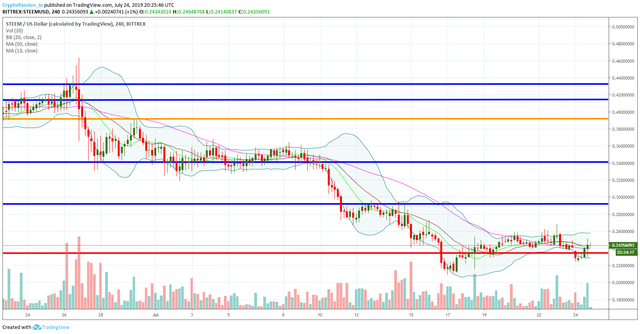
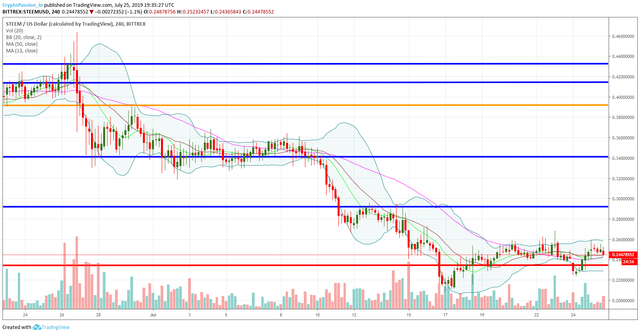
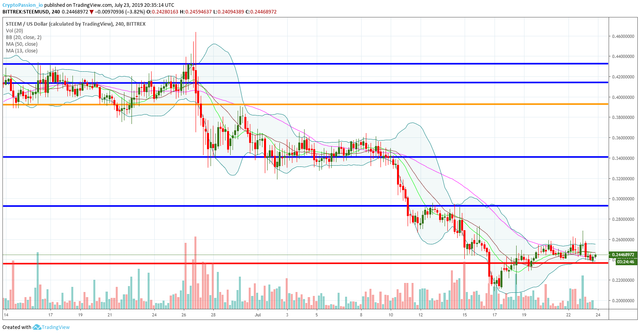
STEEM Trading Update by my friend @cryptopassion
Here is the chart of yersterday :
Here is the current chart :
The false break of the support line yesterday triggered a bounce on the STEEM but we are already consolidating from it now. The positive point is that we are now back upper than this support line and that we are waiting for the next move. Till now it looks like that the support line at 0.24$ start to be considered as temporary low. A Up break out on the BTC could help us to validate that but let’s see what the market has planned.
… despite the amount of Liquid STEEM deposited at the exchanges keeps growing according to the last weekly post of @penguinpablo (you can read it here), STEEM is showing a strong resistance against sellers.
This is the weekly amount of STEEM withdrawn to the Exchanges:
This is the weekly averaged position of STEEM at The Total Market Cap:
…and this is the current 4h-Chart of STEEM:
The amount of STEEM deposited at the exchanges still is enormous but there is something that has changed since a few days ago.
Exactly 4 days ago the RSI showed us a well formed BULLISH DIVERGENCE when STEEM hit the Bottom of the year, forming as well a double bottom in the long correction.
Maybe Sellers have relaxed a little the tension but what is sure is that we have buyers here so there is a clear interest on STEEM.
And it is clearly sustaining the fall of STEEM at the Total Market Cap… of course, with the permission of BITCOIN. If BTC falls strongly STEEM will be affected as well
Hopefully we have reached an equilibrium at the market that will allow STEEM to recover not only the price but also the visibility.
If you take a look at the daily chart of litecoin things do not look great from a technical standpoint. I hold a long-term position and even added on the last bounce even though on the short term things don’t look bullish.
So I ask myself the question…
Why am I Long This Chart Right Now?
Head and shoulders patterns I feel have become less reliable than you would normally assume, but that doesn’t mean we can ignore them.
Look at the chart…..pretty clear head and shoulders top followed by a break down and then rally to the neckline around 100-105 which then failed and here we now have price floating in the middle of no man’s land.
We can easily go back down to text the recent low of 77 and possible lower if it were to fail. On the other hand bulls can step in a buy out of nowhere (as happens in crypto from time to time) and push price to test that neckline again and possible make the pattern moot.
The point is…
There is no real clear edge….and if there is one then it is biased to the downside.
The funny part it – I don’t have this trendline drawn on the chart but you can see there is an uptrend starting in April going into July that has been broken and then tested on that last little bounce only to fail.
Can you see the uptrend line I am talking about….try to draw it on the chart if not.
This could be the first time the Lightning Network, a bitcoin scaling solution, officially impacts the U.S. presidential election.
Roughly a dozen bitcoiners who support Democratic presidential candidate Andrew Yang launched a crypto-friendly super PAC on Thursday, Humanity Forward Fund (Humanity FWD). Thanks to the PAC’s payment processor, OpenNode, the entity will be able to accept payments from lightning wallets.
“The super PAC obviously wants to receive donations as large as possible. But at the same time, individuals who want to donate just a bit to Yang’s platform now have that opportunity,” OpenNode CEO Afnan Rahman told CoinDesk. “It allows the donors to have all of the amount go toward the actual donation rather than miner fees.”
Ripple’s second-quarter report released Wednesday came with a few surprises: a gain, a loss, and a new partner. The distributed ledger technology firm’s total sales of XRP increased by nearly 48 percent to $251 million in the quarter, outpacing the first quarter’s $169 million in sales.
Direct institutional sales drove the uptick, increasing nearly 73 percent to $107.9 million from $61.9 million. Though programmatic sales still accounted for the majority of sales volumes with $144.6 million made in the second quarter up from $107 million in the first.
Despite this growth, the company states in a forward-looking projection:
“Ripple plans to take a more conservative approach to XRP sales in Q3.”
The Senate Banking Committee will hold a hearing on regulatory frameworks for cryptocurrencies and blockchain next week.
The committee said in a press release that it would hold an open session titled “Examining Regulatory Frameworks for Digital Currencies and Blockchain” on July 30, though it is unclear if this would be a fact-finding mission or if any specific pieces of legislation would be discussed.
Circle CEO Jeremy Allaire, representing the Blockchain Association; Rebecca Nelson, a member of the Congressional Research Service specializing in international trade and finance; and Mehrsa Baradaran, a law professor at the University of California Irvine School of Law will testify as expert witnesses.
Pantera Capital founder Dan Morehead discussed how Bitcoin (BTC) could hit $42,000 by the end of 2019, and even has the potential to reach $356,000 within a couple years. Morehead delivered his comments on an episode of the Unchained podcast on July 23.
Morehead specifically said that he predicts BTC will hit $42,000 by the end of the year, and climb to $356,000 by 2022. Morehead claimed that this would be consistent with the top cryptocurrency’s logarithmic growth rate:
“Graph the price of Bitcoin logarithmically […] its trend is going to grow at 235% compound annual growth rate and […] that put Bitcoin at $42,000 at the end of 2019. And I know this sounds crazy but we’re essentially halfway back there. […] I think it’s a good shot that by the end of the year we hit that. And if you just extrapolate that line out for another year it’s $122,000 per Bitcoin and then one more year, $356,000.”
United States Treasury Secretary Steven Mnuchin voiced new bearish views on Bitcoin today, saying that he probably will not be talking about the number one cryptocurrency in as soon as five years. In an interview with “Squawk Box” CNBC on July 24, Mnuchin said:
“I won’t be talking about Bitcoin in 10 years, I can assure you that […] I would bet even in 5 or 6 years I’m no longer talking about Bitcoin as Treasury Secretary. I’ll have other priorities […] I can assure you I will personally not be loaded up on Bitcoin.”
Mnuchin’s latest remarks follow a recent statement about how cryptocurrencies primarily exist as a vehicle for crime and speculative investment, saying, “I think to a large extent, these cryptocurrencies have been dominated by illicit activities and speculation.”
Meetup with NEO, LagomX, and Coin68 in Ho Chi Minh City, Vietnam from 14:30 – 15:30 (Indochina Time Vietnam Time).
STEEM Trading Update by my friend @cryptopassion
Here is the chart of yersterday :
Here is the current chart :
The support line at 0.24$ has been broken during some hours but it triggered an immediate bounce. It shows that this support line is quiet solid, at least from now. I don’t think we will be able to resist if the correction is continuing on the BTC but let’s at least enjoy that little good news. Steem is still alive….
In Elliott Wave terms, Maecenas began a wave one advance on May 12. The red wave one (blue sub-waves i-ii-iii-iv-v) finished on May 18, and the red wave two (blue sub-waves a-b-c) correction ended on June 30. If this wave count is correct, Maecenas should be heading next towards the May 18 peak in the red wave three.
In case you don’t know, you have an amazing tool called “STEEM SCOT Voting Power” created by @blockchainstudio on which you can perform staking, claiming, check Voting Power or change your weight multiplier there.
It also tells you how much in STEEM is your Staked Token worth.
For instance, I have 1210 PAL staked:
So, according to the tool and also to the current trading price of PAL vs STEEM, in my case it is worth 508 Steem, ie 128 $…
Not bad taking into account that my investment has been almost zero!
The same you can do with any Steem-engine token, just change my user name and the Token symbol in the link below:
…since BITCOIN have not passed yet the lowest point of the correction marked as “C” in the chart.
BTC is reaching again a well-known support already around 9400 USD…
I am confidence on that this strong support would hold BITCOIN avoiding falling lower and hopefully make resume the uptrend of the market which everybody is expecting.
This is my main scenario, the alternative one is bearish and it is based on an “ugly” Head and Shoulders pattern that may be in formation. Something like the following:
The target drop in case this pattern would be triggered launches a price for BITCOIN below 5000 USD… but, as I said, this is not my main scenario for me as far as BITCOIN keeps moving above the 9000 USD.
Disclaimer: This is just my personal point of view, please, do your own assessment and act consequently. Neither this post nor myself is responsible of any of your profit/losses obtained as a result of this information.
According
to two chief executive of technology companies, Age-tech, i.e. applications of technology designed to address
issues faced by elderly people, are often left unexploited as they do not
appeal to “kids doing start-ups”.
Age
tech start-up Birdie has designed a
system for care workers to digitise and
keep track of notes on elderly people living in care facilities. The
company has thus far raised €9.5m,
with more than 100 UK providers already using the tech.
Birdie
is also trialling a combination of static
motion and sonar sensors designed to pick up irregularities in behaviour
through machine learning that could indicate health issues.
Another
tech company (which remains unnamed) is targeting the steadily growing Alzheimer’s therapeutics market through specially
designed devices/toys that stimulate cognitive function.
Analysis and Comments
The author makes an important point towards the end of the article by highlighting that the typical customer for technology such as the above is likely to be an older person who is caring for an elderly relative.
As such, players in this space that aren’t exclusively targeting care facilities are in the tricky position of having to design solutions for the use of people who themselves might be similarly uncomprehending of thetech as their elderly charges (the article includes an example of a healthcare start-up which failed for that reason).
Last year was an interesting year for Age-tech, as it saw PointClickCare, a leading Canadian SaaS platform targeted at the long-term and post-acute care market, valued at a minimum of USD1bn following its latest funding round.
See here for a 2019 Age-tech market map including both listed and private players.